Lesson 04 — Sharing and Taking Turns
Learners practice sharing and taking turns, and discover that fair sometimes means everyone gets what they need, not exactly the same amount.
Objectives
Objectives
- D09.S2.K.01 Tell when something is fair or unfair in a simple situation like sharing or taking turns.
Essential question
How do sharing and taking turns make things fair?
Key vocabulary
Materials
Standard materials
- A shared object to pass · 1 A ball, a shell, or a special "turn marker" for turn-taking practice
- Timer or song · 1 To mark turns (a short song or counting works)
- Crayons and paper · per learner
Low-tech / no-cost
- Voice and body Pass a found object and take turns speaking or holding it; no timer needed — count together
- Found objects Stones, sticks, or leaves to share into groups
Enriched / lab & device
- Visual turn chart · 1 A chart with a pocket or name tags showing whose turn is next
- Digital timer · 1 per group A simple countdown timer app to make turns concrete and visible
Works in different contexts
- large-group Pass one object around a big circle with a song to mark turns, so everyone gets the same amount of time
- self-directed The learner practices dividing a small set of objects and explains when "the same amount" is fair and when "what each needs" is fair
- outdoor-only Share one natural item (a stick, a flower, a turn on a log) and practice a fair way to take turns around the group
Lesson 4 — Sharing and Taking Turns
Summary
Learners practice sharing and taking turns with a real object, then meet a deeper idea: fair does not always mean the same amount — sometimes fair means everyone gets what they need.
Objectives
- Tell when something is fair or unfair in a simple situation like sharing or taking turns. (D09.S2.K.01)
Connection
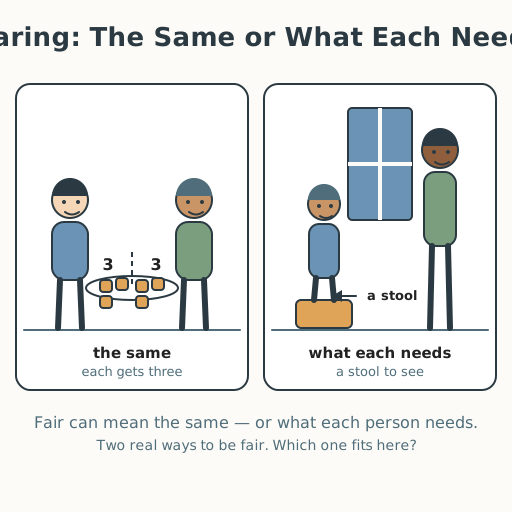
One swing, one ball, one snack to split — sharing and taking turns are how a group makes one thing work for everyone. Sometimes fairness means each person gets the same; other times fairness means each person gets what they need, which can look different. A tall person and a small person may need different stools to see the same window — that is fair, and it is not the same.
Materials
- A shared object to pass (ball, shell, or “turn marker”)
- A timer or a short song to mark turns
- Crayons and paper
Preparation
- Choose a shared object to pass and a way to mark turns (song, counting, or timer).
- Arrange a circle.
Facilitator note
Written to the learner (“you”). This lesson introduces equity gently: fair is not always equal. Use the stool-and-window or snack-and-hunger examples; keep it concrete and never abstract. Some learners will insist “same amount” is the only fair way — honor that as one real way, and hold the “what you need” idea alongside it as a question to wonder about, not a correction. Turn-taking should feel cooperative, not competitive; no one wins or loses. The passing object echoes talking circles used by many Indigenous peoples around the world, where an object passes from speaker to speaker so each voice is heard — we use it respectfully, not as decoration. A learner who cannot hold or pass the object still takes a turn: a partner passes it for them, or they point to a picture, sign, or nod their name or the thing they like. Sharing your name or one thing you like can be spoken, signed, pointed to, or shown with a gesture — no one is required to speak aloud.
Procedure
- Gather (5 min). What is one thing in your home or class that everyone has to share?
- Take turns (15 min). Pass the shared object around the circle (or have a partner pass it for you). When it is your turn, share your name or one thing you like — say it, sign it, or point to it. Everyone gets a turn — that is fair. Use the song or timer to mark each turn.
- Same or need? (10 min). Think together: a big child and a small child both want to see out the window. The small child needs a stool; the big child does not. Is giving the stool to the small child fair? Yes — fair can mean what each needs, not the same amount.
- Draw it (10 min). Draw one picture of sharing the same way, or one picture of sharing by what each person needs. Tell a partner which kind of fair your picture shows.
- Close (5 min). Remember: sharing and taking turns are fair — and fair can sometimes mean each person gets what they need.
Differentiation
- Support: Practice only “same amount” sharing with a clear, equal split; model counting out equal groups.
- Extension: Invite learners to invent their own “different needs” example (a coat for a cold friend, a bigger piece for a hungry friend) and share it.
Assessment
- Formative (observation): Can the learner tell a fair and an unfair way to share or take turns, and begin to name “what each needs” as fair?
- Artifact (portfolio): The “same or need” drawing, kept in the learner’s portfolio.
Home connection
At home, share something one of two ways — the same amount, or by what each person needs — and tell a grown-up which way you chose and why it was fair.