Lesson 05 — Making a Group Decision
Learners make a real group decision together — hearing every voice, listening, and choosing as a group rather than one person deciding for all.
Objectives
Objectives
- D09.S3.K.01 Take part in a group decision or a small job that helps the class.
Essential question
How do we decide together as a group?
Key vocabulary
Materials
Standard materials
- Two or three simple choice cards · 1 set Pictures of real choices the group can make (which song, which game, which name for a class plant)
- A "talking object" · 1 A shell, stone, or stick held by whoever is speaking
Low-tech / no-cost
- Voice and body Use raised hands, nodding, or stepping to a chosen corner to show a choice; no cards or object needed
- Found objects A stick or stone as the talking object; drawn choices on the ground with chalk or dirt
Enriched / lab & device
- Choice cards with magnets or clips · 1 set Movable cards to build a group decision board everyone can see
- A simple tally or sticker chart · 1 To count choices and show the group's decision taking shape
Works in different contexts
- large-group Take the decision in small circles first so every voice is heard, then gather the whole group to choose together
- self-directed The learner (or a small learner group without an adult) poses a simple shared choice, hears each person, and records what the group decides
- outdoor-only Mark two or three choice spots with sticks or stones and have learners walk to their choice, then talk it over together
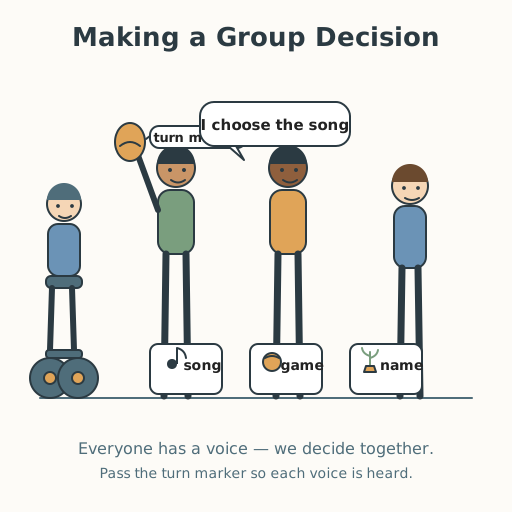
Lesson 5 — Making a Group Decision
Summary
Learners make a real, simple decision together. They practice hearing every voice, listening, and choosing as a group — learning that a group decision belongs to everyone, not to one person.
Objectives
- Take part in a group decision or a small job that helps the class. (D09.S3.K.01)
Connection
Groups decide things all the time: a family chooses what to eat, a class chooses a song, a village decides where to put a well. When everyone has a voice and everyone listens, the choice belongs to the whole group. You have a voice too — what you think matters, and so does what everyone else thinks.
Materials
- Two or three simple choice cards (which song, which game, which name for a class plant)
- A talking object (shell, stone, or stick)
Preparation
- Choose a real, small decision the group can make today (a song, a game, a name).
- Prepare two or three choice cards and a talking object.
Facilitator note
Written to the learner (“you”). This is real decision-making, not a simulation — carry out the choice the group makes. Every voice matters equally: no one’s idea is worth more because of age, status, or volume. Guide but do not impose; if a quiet child has not spoken, make gentle space without forcing. Across cultures, groups decide in many ways — talking it through, raising hands, stepping to a corner — and none is “the” right way. The talking object echoes talking circles used by many Indigenous peoples around the world, where an object passes from speaker to speaker so each voice is heard — we use it with respect, not as decoration. Keep the decision small enough to finish and honor today. “Voice” means however a learner shows their choice — spoken words, sign, a nod, a gesture, pointing to or tapping a choice card, eye-gaze, or a communication board. A learner who does not speak aloud still shares a choice; a grown-up or peer can voice it. A learner who cannot hold or pass the talking object, raise a hand, or step to a corner can point, nod, or eye-gaze to their choice, and a partner can move or pass for them. Never force anyone to speak aloud or to move — pointing and signing are full participation.
Procedure
- Gather (5 min). Think of a time a group made a choice you were part of. How was it decided?
- Meet the choices (10 min). Look at the choice cards. Here are two or three things we could choose. What does each one mean?
- Hear every voice (15 min). Pass the talking object (or have a partner pass it for you). When it is your turn, show which choice you like and one reason — say it, sign it, or point to the card. When it is not your turn, listen (with ears or eyes). Every voice gets a turn.
- Choose together (10 min). Show your choice — raise a hand, step to your choice, point, or nod (or have a partner move for you). Count together (a scribe can count for the group). Look at what most people chose, and talk: can we all agree to this? If not, is there a choice that includes more people?
- Do it (5 min). Make your decision real — sing the song, play the game, or name the plant. A group decision belongs to everyone.
Differentiation
- Support: Offer just two choices; model giving one reason with a word and a gesture. A non-speaking learner points to the choice card; a learner who cannot pass the object or step has a partner move for them.
- Extension: Invite learners to notice whose voice was not heard and think of a way to include them next time.
Assessment
- Formative (observation): Does the learner share a choice, listen to others, and join in the group’s decision?
- Performance: The group’s finished decision — carried out and named as the group’s own.
Home connection
At home, help make one small family choice together — what to eat, what game to play — where every person says their idea before you decide.