Lesson 06 — A Class Job That Helps
Learners choose and carry out a small, real job that helps the whole class, and see how each person's help makes the group stronger.
Objectives
Objectives
- D09.S3.K.01 Take part in a group decision or a small job that helps the class.
Essential question
What small job can I do that helps our class?
Key vocabulary
Materials
Standard materials
- Class job chart · 1 A simple chart with a few jobs and spaces for names or pictures (watering plants, passing paper, tidy-up helper, greeter)
- Job tools · 1 set Small real tools for the jobs (a small watering can, a basket, a cloth)
Low-tech / no-cost
- Voice and body Act out each job and practice it with no tools; mark jobs with hand-drawn pictures
- Found objects A cup for watering, a cloth for wiping, a basket for tidying
Enriched / lab & device
- Picture job cards with name pockets · 1 set Movable cards so jobs can rotate fairly among learners
- A class "helper" badge or apron · 1 per job A simple marker that shows who is doing each job today
Works in different contexts
- large-group Pair learners so each job has two helpers; rotate jobs daily so everyone gets a turn at each
- self-directed The learner picks one job, does it, and tells a grown-up or peer how it helped the group
- outdoor-only Do a job that helps the shared outdoor space — watering plants, clearing a path, picking up litter safely — and name how it helps
Lesson 6 — A Class Job That Helps
Summary
Learners choose and carry out a small, real job that helps the class — watering plants, passing paper, tidying, greeting. They see how many small helps add up to a group that works for everyone.
Objectives
- Take part in a group decision or a small job that helps the class. (D09.S3.K.01)
Connection
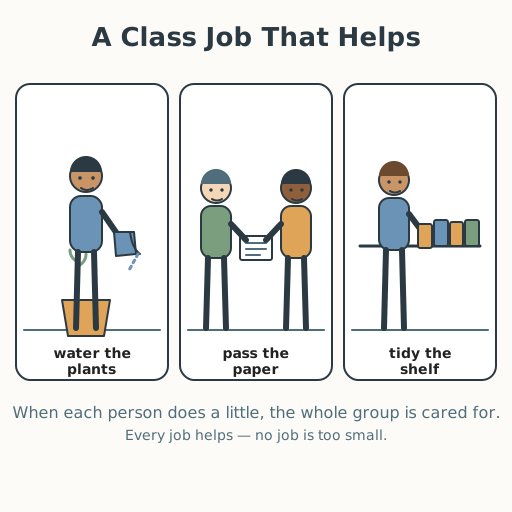
A class, a family, and a village all run on small jobs done by many hands. One person waters the plants, one tidies the shelf, one greets people at the door. When each person does a little, the whole group is cared for — and no one has to do everything alone.
Materials
- A class job chart
- Small real tools for the jobs (watering can, basket, cloth)
Preparation
- Set up a class job chart with a few simple jobs and spaces for names or pictures.
- Gather the small tools and arrange the jobs where learners can reach them.
Facilitator note
Written to the learner (“you”). Jobs here are contributions, not rewards or punishments — everyone gets to help, and jobs rotate so no one is stuck and no one is left out. Every job is equally important; resist ranking “big” jobs above “small” ones. Frame the job as care for the shared space and for each other, never as obedience. Where a job needs adult help (water near plants, reaching high shelves), step in alongside the child, not instead of them. A learner with limited movement can choose a job and direct it while a partner does the reaching, carrying, or watering — that is doing the job too. Sharing how it helped can be spoken, signed, pointed to on the chart, or shown with a gesture; no one is required to speak aloud.
Procedure
- Gather (5 min). What are some things your class needs every day to feel good and work well?
- Meet the jobs (10 min). Look at the job chart. Name each job and what it does: watering plants, passing paper, tidying, greeting. Every job helps.
- Choose and do your job (20 min). Pick one job (or take your turn). Do it with the real tool, gently and carefully. If you finish, ask: “How else can I help?”
- Share how it helped (5 min). Tell the group — or show with a point, sign, or gesture — what you did and how it helped: “I watered the plants so they can grow” or “I tidied the shelf so we can find things.”
- Close (5 min). Remember: when each person does a little, the whole group is cared for. Your help matters.
Differentiation
- Support: Pair the learner with a partner or adult for a single, very concrete job step.
- Extension: Invite learners to invent a new job the class needs and propose adding it to the chart.
Assessment
- Formative (observation): Does the learner complete a small job and say or show how it helped the class?
- Performance: The finished job, shown in the shared space and reflected on aloud.
Home connection
At home, pick one small job you can do each day — setting the table, feeding a pet, wiping a surface — and tell a grown-up how it helps the family.