Lesson 07 — Solving a Small Disagreement
Learners practice a simple three-step way to solve a small disagreement with words — stop, use words, ask for help — and to make things right afterward.
Objectives
Objectives
- D09.S4.K.01 Use words (or a grown-up's help) to solve a small disagreement and make things right.
Essential question
How do I use words to solve a small disagreement and make things right?
Key vocabulary
Materials
Standard materials
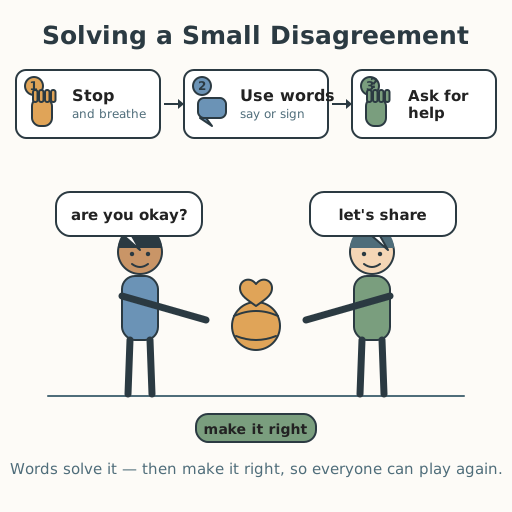
- "Stop, words, help" picture strip · 1 set A three-step visual (stop and breathe, use words, ask a grown-up for help if needed)
- Two soft toys or puppets · 2 For acting out a small disagreement and its repair
- Crayons and paper · per learner
Low-tech / no-cost
- Voice and body Act out the disagreement and repair with your own hands and words; no toys or strips needed
- Drawn steps in the dirt or on paper Draw the three steps together on the ground or a shared sheet
Enriched / lab & device
- Laminated "stop, words, help" cards · 1 per learner A durable reminder card for the classroom peace corner
- A calm-down tool · 1 set A soft object to squeeze or a slow-breathing visual for the "stop" step
Works in different contexts
- large-group Act out the disagreement with two puppets while the whole group calls out the next step, then invite pairs to rehearse
- self-directed The learner follows the three steps with a picture strip and practices saying the repair words aloud
- outdoor-only Use a real small conflict over a shared found object (a stick, a turn on a log) and practice the three steps right there
Lesson 7 — Solving a Small Disagreement
Summary
Learners practice a simple, gentle way to solve a small disagreement with words — stop and breathe, use words, ask a grown-up for help — and to repair harm by making things right, rather than by punishing.
Objectives
- Use words (or a grown-up’s help) to solve a small disagreement and make things right. (D09.S4.K.01)
Connection
Disagreements happen everywhere people are together — two children wanting the same toy, a tussle over a turn. You can solve a small disagreement without hurting anyone: stop, use your words, and ask a grown-up to help if you need to. Then you make it right — the hurt is repaired and everyone can play again.
Materials
- A “stop, words, help” picture strip
- Two soft toys or puppets
- Crayons and paper
Preparation
- Prepare a three-step “stop, words, help” picture strip.
- Set up a small space for acting out with two soft toys or puppets.
Facilitator note
Written to the learner (“you”). This lesson teaches repair, not punishment: after a small hurt, the goal is making things right — a kind word, returning what was taken, checking the friend is okay — not shaming or excluding anyone. Name feelings before fixes; both sides get heard. The three steps are a scaffold, not a script to obey; wonder together about what might work in each case. Where an adult is present, the adult’s help is welcome and safe — asking for help is strength, not weakness. Keep examples small, everyday, and free of blame. “Use your words” means however a learner expresses themselves — spoken words, sign, a gesture, pointing to a feeling or a picture on the strip, or a communication board. A learner who does not speak aloud still “uses words”: a grown-up or peer can voice what they point to or sign. Learners who are deaf or hard of hearing follow the strip by sight and sign; learners who are blind or low-vision hear the steps named and touch or feel the toys. Acting out with the toys is one way to practice, not the only way — a learner with limited movement can point to the step on the strip, or direct a partner or adult to move the toys while they show the feeling and choose the repair. Never require anyone to speak or to act in front of the group.
Procedure
- Gather (5 min). Think of a small disagreement you have seen — two people wanting the same thing. What happened next?
- Meet the three steps (10 min). Learn the steps: Stop and breathe. Use your words — say, sign, or point to how you feel and what you need (a grown-up or peer can voice it for you). Ask a grown-up for help if it is too hard alone.
- Act it out (15 min). With the two soft toys, show a small disagreement — both want the same ball. Practice the steps: stop, use words (“I was playing with it; can we take turns?” — say it, sign it, or point to it on the strip), ask for help if needed. A learner who does not move the toys can point to the step or direct a partner to move them.
- Make it right (10 min). After the words, make it right: return the ball, say “are you okay?”, or find a way to share. Repair is how we fix the hurt, not punish the person.
- Close (5 min). Remember: words can solve small problems, and making it right fixes the hurt so everyone can play again.
Differentiation
- Support: Practice only “stop and breathe” and “ask a grown-up” first; model the repair words word by word. A non-speaking learner can point to the strip’s pictures for each step; a learner with limited movement can have a partner move the toys.
- Extension: Invite learners to invent their own small conflict and practice solving it with the three steps and a repair.
Assessment
- Formative (observation): Can the learner use words (or ask for help) to solve a small disagreement and name a way to make it right?
- Performance: The acted-out repair, shown with the soft toys and reflected on aloud.
Home connection
At home, if a small disagreement happens, try the three steps — stop, use words, ask for help — and then make it right together.
Resources
- International Institute for Restorative Practices (restorative practices — repairing harm rather than only punishing): https://www.iirp.edu/