Lesson 08 — Fairness & Caring for Others
Learners bring the unit together in a four-part "kind choice" page — kind/helpful, fair, a shared decision or job, and making things right — and share it as a class book.
Objectives
Objectives
- D09.S1.K.01 Name something kind or helpful to do for a friend or animal and say why it is good.
- D09.S2.K.01 Tell when something is fair or unfair in a simple situation like sharing or taking turns.
- D09.S3.K.01 Take part in a group decision or a small job that helps the class.
- D09.S4.K.01 Use words (or a grown-up's help) to solve a small disagreement and make things right.
Essential question
How do I practice fairness and caring all together?
Key vocabulary
Materials
Standard materials
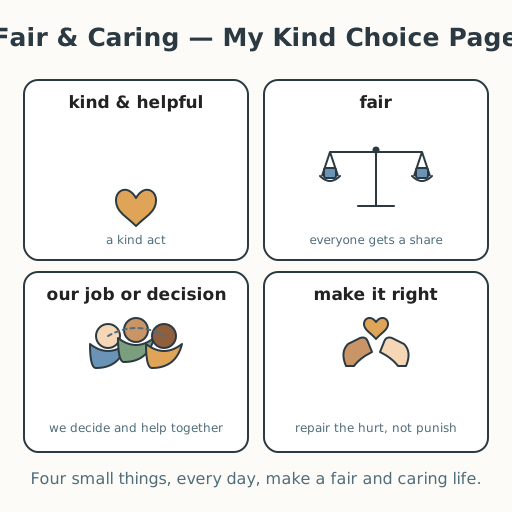
- One "kind choice" page per learner · per learner A page with four boxes: "kind/helpful," "fair," "our decision or job," and "make it right"
- Crayons and drawing tools · per learner
- Class job chart · 1 The chart from Lesson 6, to keep the class job alive
- Stapler, string, or clips · 1 set For gathering pages into a class "Fair & Caring" book
Low-tech / no-cost
- One large shared sheet A single paper or cloth divided into four parts, filled together
- Voice and body Each learner tells their four-part page aloud and points to the box they are sharing
Enriched / lab & device
- Individual "Fair & Caring" books · 1 per learner Four small pages bound together for a keepsake book to take home
- Class display with photos or audio · 1 display A wall or recording that gathers every learner's four-part page
Works in different contexts
- large-group Learners fill their four boxes, then share in small circles and contribute one box each to a shared class book
- self-directed The learner completes all four boxes alone, then shares the finished page with a grown-up or peer
- outdoor-only Build the four-part page on the ground with found objects in four marked circles, then share aloud
Lesson 8 — Fairness & Caring for Others
Summary
Learners gather everything from the unit into one four-part “kind choice” page: a kind or helpful act, a fair idea, a group decision or class job, and a way to make things right. They share their page and build a class “Fair & Caring” book.
Objectives
- Name something kind or helpful to do for a friend or animal and say why it is good. (D09.S1.K.01)
- Tell when something is fair or unfair in a simple situation like sharing or taking turns. (D09.S2.K.01)
- Take part in a group decision or a small job that helps the class. (D09.S3.K.01)
- Use words (or a grown-up’s help) to solve a small disagreement and make things right. (D09.S4.K.01)
Connection
Fairness and caring are not one big thing — they are many small things you can do every day: a kind act, a fair share, a helpful job, and a repair after a small hurt. When you put them together, you are practicing how to live well with other people — at home, in class, and anywhere people are together.
Materials
- A four-box “kind choice” page per learner
- Crayons and drawing tools
- The class job chart
- Stapler, string, or clips for a class book
Preparation
- Prepare a four-box page for each learner (or one large shared sheet): “kind & helpful,” “fair,” “our decision or job,” “make it right.”
- Set up a gathering place and a spot to assemble the class “Fair & Caring” book.
Facilitator note
Written to the learner (“you”). This is the unit’s capstone: each child authors their own small statement of how to be fair and caring. Keep all four boxes optional in depth — a word, a mark, or a drawing counts. This is a celebration of what learners can do, not a test of what they know; there is no “correct” page. Celebrate each page as a real contribution. The class job chart stays live after this lesson, so the unit’s habits continue beyond the page.
Procedure
- Gather (5 min). Remember the unit: kind and helpful acts, fair and unfair, deciding together and class jobs, and making things right. You have practiced all four.
- Fill the four boxes (20 min). On your page, draw or write one thing in each box: something kind or helpful; something fair; one group decision or class job you took part in; and one way to make things right after a small hurt.
- Share (10 min). With a partner or small group, show your page and tell about one box you are proud of. Listen to theirs.
- Make the class book (5 min). Add your page to the “Fair & Caring” book or wall. Now everyone’s kind choice is together.
- Close (5 min). Fairness and caring are many small things you can do every day. Your choices matter — to your friends, your class, and you.
Differentiation
- Support: Complete one box at a time with a grown-up scribe; a single word or mark in each box counts.
- Extension: Invite learners to add a fifth box: “tomorrow” — one fair or caring thing they will do next.
Assessment
- Summative (portfolio): The four-part “kind choice” page shows a kind act, a fair idea, a shared decision or job, and a repair.
- Observation: Does the learner connect each box to the right idea from the unit and share it in their own words?