Lesson 02 — Tools All Around Me
Learners go on a tool hunt through their own space and through pictures of the wider world, naming the tools people use at home, in fields, at markets, and on roads — and the job each one helps with.
Objectives
Objectives
- D10.S1.K.01 Name a tool or device people use and tell what it helps them do.
Essential question
What tools do people use all around me, at home and in the wider world?
Key vocabulary
Materials
Standard materials
- Picture cards of tools in different places · 1 set Tools at home, in a kitchen, in a field, at a market, on a road — a few per place
- Paper and crayons · per learner
Low-tech / no-cost
- A walk around the learning space Find and name real tools — a broom, a cup, a chair, a door handle — by touching and holding them as well as seeing them; no cards needed
- Memory game with voices and bodies Take turns saying "I see a ___ that helps us ___" and acting it out
Enriched / lab & device
- A short set of photos of tools in use around the world · 1 set A loom in one land, a water pump in another, a fishing net, a plow — each showing the tool and the person using it
- A class "tools around us" poster kit · 1 Large paper and glue so the group can build a poster of tools found in their own place
Works in different contexts
- large-group Sort the picture cards into places (home, field, market, road) on the floor together, everyone saying each tool and its job aloud
- self-directed A learner walks the space alone, names five tools they can see, and draws their favorite with the place it lives
- outdoor-only Walk and spot tools outdoors — a fence post, a path, a gate, a bucket — and name what each helps people do there
- multi-age Older learners partner with younger ones to lead the tool hunt and help label each tool's drawing
Lesson 2 — Tools All Around Me
Summary
Learners hunt for tools close by and far away. They name the tools people use at home, in a kitchen, in a field, at a market, and on a road, and say what job each one helps with. They close by drawing one tool and the place it lives.
Objectives
- Name a tool or device people use and tell what it helps them do. (D10.S1.K.01)
Connection
Tools are not hidden away in one place — they are all around you, right now. The cup you drink from, the door you open, the broom by the wall, the pot in the kitchen, the jug by the well: every one is a tool someone made. Look around, and you will find tools everywhere.
Materials
- Picture cards of tools in different places (home, kitchen, field, market, road)
- Paper and crayons
Preparation
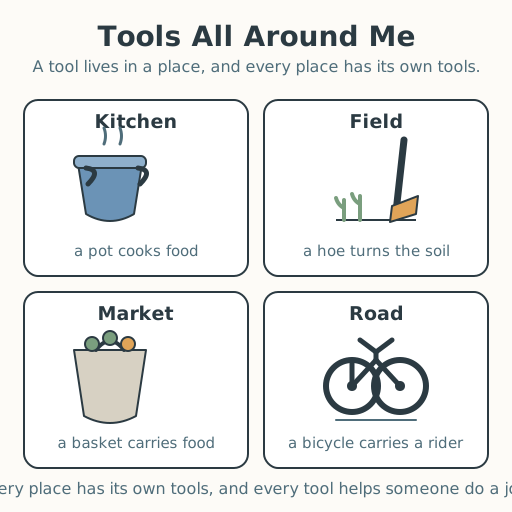
- Draw or gather a few picture cards of tools, each in a place: a pot in a kitchen, a hoe in a field, a basket at a market, a bicycle on a road.
- Prepare to walk the space and spot real tools.
Facilitator note
This lesson is written to the learner (“you”). As facilitator, guide the tool hunt but let learners do the finding — noticing is the learning. Keep the lens wide and equal: a farmer’s hoe and a cook’s pot and a road’s bicycle are all real tools, and no place’s tools are more important than another’s. A phone is one tool among many, not the star. Honor the tools of the learners’ own homes, whatever they are.
Procedure
- Gather (5 min). Look around the room right now. Can you already see one tool?
- Tool hunt at home (10 min). Walk and point to tools you can see — a cup, a chair, a door handle, a broom. For each, say the tool and its job: “A chair helps us sit and rest.”
- Tools far away (15 min). Look at the picture cards. People in every place use tools: a pot in a kitchen, a hoe in a field, a basket at a market, a bicycle on a road. Sort the cards by place. Which place would you like to visit?
- Draw a tool in its place (10 min). Draw one tool and the place it lives.
- Close (5 min). Every place has its own tools, and every tool helps someone do a job. What tool did you find that you did not notice before today?
Differentiation
- Support: Go on the hunt with a partner and name tools together; match just two tool cards to two places.
- Extension: Invite learners to name a tool from their own home and tell what it helps a grown-up do there.
Assessment
- Formative (observation): Can the learner point to or hold a tool in their space and say what it helps people do?
- Artifact (portfolio): The “tool in its place” drawing.
Home connection
At home, go on a tool hunt with a grown-up in one room — the kitchen or the yard. Find three tools and say each one’s job. Then ask the grown-up which tool they use the most.