Lesson 01 — My Feelings This Year
Learners look back over the year, remember feelings they felt, and describe one feeling from the year using a word, a drawing, or a movement.
Objectives
Objectives
- D01.S1.K.02 Describe a feeling using words, a drawing, or a movement.
Essential question
What feelings did I have this year, and how can I show them?
Key vocabulary
Materials
Standard materials
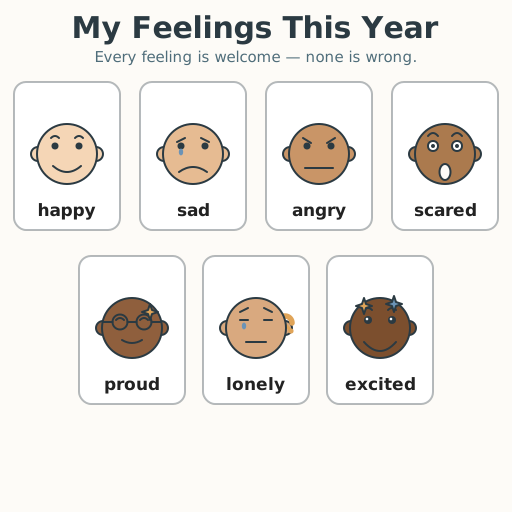
- Feeling face cards · 1 set Happy, sad, angry, scared, calm faces (reused from earlier in the year)
- Crayons and paper · per learner
- Your portfolio of work from this year · per learner The learner's own collected drawings and work to look back through
Low-tech / no-cost
- Voice and body Act out each feeling with a face and a movement; no cards needed
- A shared class memory circle Recall together the feelings the class felt this year, spoken aloud
Enriched / lab & device
- Laminated feeling face cards · 1 set per pair Durable cards for sorting and matching feelings to memories
- A recording device · 1 per group To capture each learner telling one feeling from the year and why
Works in different contexts
- large-group Hold up each feeling face card and make the face together; let each child take one turn naming a feeling they felt this year
- self-directed A learner looks back through their own portfolio alone and draws or acts out one feeling from the year to show a grown-up
- outdoor-only Find a sky, shadow, plant, or wind that matches a feeling from the year and show it with a word or movement
- multi-age Older learners help younger ones label their feeling drawings and listen as each child tells their memory
Lesson 1 — My Feelings This Year
Summary
Learners look back over the year and remember the feelings they felt — happy, sad, proud, scared, calm, and more. They choose one feeling from the year and describe it using a word, a drawing, or a movement, noticing how much they have grown.
Objectives
- Describe a feeling using words, a drawing, or a movement. (D01.S1.K.02)
Connection
Everyone feels many feelings in a year — happy, sad, proud, scared, calm, and more. Today you look back at your year and tell how you felt, using a word, a drawing, or a movement. Remembering your feelings helps you see how much you have grown.
Materials
- Feeling face cards (happy, sad, angry, scared, calm)
- Crayons and paper
- Your portfolio of work from this year
Preparation
- Gather the feeling face cards used earlier in the year.
- Have each learner’s portfolio (or a small pile of their own work) ready to look back through.
- Arrange a circle for gathering and sharing.
Facilitator note
This lesson is written to the learner (“you”). This is a reflective close to the year, not a test. Help each learner recall feelings from across the year — their own, not a “correct” answer. Every feeling is welcome; there are no right or wrong feelings. Honor that families and cultures express feelings differently, and let each child show their feeling in the way that feels natural to them.
Procedure
- Gather (5 min). Sit comfortably. Think back over your year — all the days from the start of school until now.
- Feelings memory walk (10 min). Look at each feeling face card. Make each face together. Which feelings do you remember feeling this year? Happy? Sad? Proud? Scared? Calm? Point or name each one you remember.
- Choose one feeling (5 min). Pick one feeling you had this year. Think of the time you felt it. What happened? Where were you? Who was with you?
- Show it (15 min). Describe your feeling in one of three ways: a word, a drawing, or a movement. You can draw the time you felt it, or act the feeling out with your whole body.
- Share (5 min). Share with a partner or the class. Say or show the feeling and, if you like, the memory that goes with it.
- Close (5 min). Feelings come and go, and they change. You felt many feelings this year — and you are still growing.
Differentiation
- Support: Offer two feeling faces to choose from, and model a word and a gesture to go with each.
- Extension: Invite learners to draw two feelings from the year and tell what changed between them.
Assessment
- Formative (observation): Can the learner name a feeling they felt this year and describe it with a word, drawing, or movement?
- Artifact (portfolio): The feeling drawing or a photo of the movement, kept in the learner’s portfolio as a record of the year.
Resources
- CASEL SEL Framework (foundational competencies): https://casel.org/fundamentals-of-sel/