Lesson 02 — The Groups I Belong To
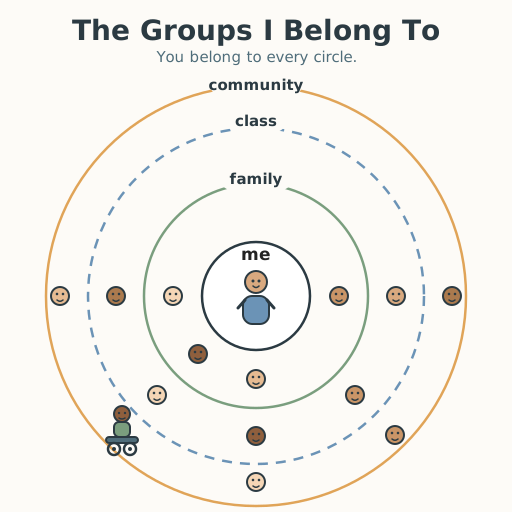
Learners name the groups they belong to — family, class, and community — and draw themselves inside each group, noticing that every person belongs to more than one "us."
Objectives
Objectives
- D01.S2.K.02 Name the groups to which they belong (family, class, community).
Essential question
What groups do I belong to, and who is in them with me?
Key vocabulary
Materials
Standard materials
- Paper and crayons · per learner
- A large sheet of paper · 1 per learner For a "me in my groups" picture with room for several circles
Low-tech / no-cost
- Sticks, stones, or chalk Draw the group circles on the ground outside and stand in each one
- Voice and body Name each group aloud and step into a pretend circle for each one
Enriched / lab & device
- Printed photos of learners and their groups · optional Real photos of family, class, and community to sort into groups
- A poster-making kit · 1 per group To build a keepable class "our groups" poster
Works in different contexts
- large-group Draw one big class circle on paper or the floor; each child steps in, says their name, and names one group they belong to
- self-directed A learner draws themselves in the middle of a page and draws a circle for each group they belong to, telling a grown-up about each one
- outdoor-only Mark a big circle on the ground and step inside for each group — family, class, community — naming who is in it with you
- multi-age Older learners interview younger ones ("Who is in your family?") and help them draw each group circle
Lesson 2 — The Groups I Belong To
Summary
Learners name the groups they belong to — family, class, and community — and draw themselves inside each one. They notice that every person is part of more than one “us,” and that each group matters.
Objectives
- Name the groups to which they belong (family, class, community). (D01.S2.K.02)
Connection
You are one person, and you also belong to many groups — your family, your class, and your community. Everywhere you go, you are part of more than just yourself. Today you name the groups that make you part of an “us.”
Materials
- Paper and crayons
- A large sheet of paper for each learner’s “me in my groups” picture
Preparation
- Fold or draw circles on each learner’s large sheet — one space for each group (family, class, community), with the learner in the middle.
- Arrange a circle for gathering and sharing.
Facilitator note
This lesson is written to the learner (“you”). There is no one “right” family or community — some children live with grandparents, aunts and uncles, one parent, several generations together under one roof, or chosen family; some belong to a faith community, a neighborhood, a sports team, a market, or a language group. Honor every family shape and every community equally; never rank one as better than another. Let each child name the groups that are true for them.
Procedure
- Gather (5 min). Sit comfortably. Think: who is “us” for you? Who are the people you are with, in different places?
- Name your groups (10 min). Think of the groups you belong to: your family, your class, your community. Say each one aloud, or point, draw, or gesture to show it. Who is in it with you?
- Draw yourself in (15 min). In the middle of your page, draw yourself. Around yourself, draw a circle for each group you belong to, and draw or scribble the people in it. You can use one circle for family, one for class, one for community — and add any other group that is yours.
- Share (10 min). Share your picture with a partner. Point to each circle and name the group and one person in it.
- Close (5 min). Look around. Everyone here belongs to more than one group. You are in many “us-es” — and each one is a place where you belong.
Differentiation
- Support: Start with just two groups (family and class), and model naming one person in each.
- Extension: Invite learners to add a circle for a group they hope to belong to or a new friend they want in one of their groups.
Assessment
- Formative (observation): Can the learner name at least one group they belong to and point to a person in it?
- Artifact (portfolio): The “me in my groups” picture, kept in the learner’s portfolio.
Home connection
Bring your “me in my groups” picture home and show it to a grown-up. Point to each circle and name the group. Ask the grown-up: what groups do you belong to?