Lesson 02 — Showing Feelings
Learners learn that a feeling shows up in three places — face, body, and voice — and practice reading those clues in themselves and others.
Objectives
Objectives
- D01.S1.01.01 Name and show a growing set of feelings such as proud, lonely, and excited in themselves and others.
Essential question
How can I see a feeling in someone else's face, body, and voice?
Key vocabulary
Materials
Standard materials
- Feeling face cards (seven faces) · 1 set Happy, sad, angry, scared, proud, lonely, excited
- Hand mirrors · 1 per pair Optional, to watch one's own expressions
- Paper and crayons · per learner
Low-tech / no-cost
- A partner's face Use a friend's real face as the "mirror" and the "card"
- Voice and body Describe and act out each feeling aloud; no cards, mirrors, or paper needed
Enriched / lab & device
- Laminated feeling cards · 1 set per group Compare drawn faces with real photos of classmates showing each feeling
- Camera or tablet · 1 per group Record short clips of faces and voices for each feeling to play back
Works in different contexts
- large-group One volunteer shows a feeling with face, body, and voice; the whole group reads the three clues aloud before guessing
- self-directed A learner uses a mirror to make each feeling and then draws the one they see most clearly
- outdoor-only Play "feeling freeze" outdoors — call a feeling, everyone freezes into a statue of it, then describe what they see in others' statues
- level-grouped Learners who already know the seven feelings work on noticing smaller clues (eyebrows, breathing, voice pitch)
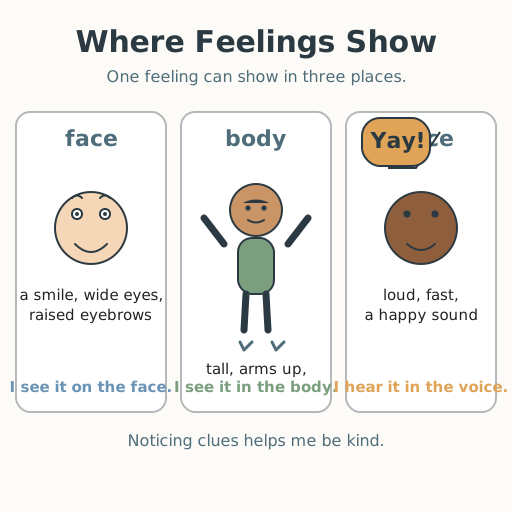
Lesson 2 — Showing Feelings
Summary
Learners discover that a feeling is not just a word — it shows up in three places: the face, the body, and the voice. They practice reading those clues in themselves and in others, and they learn that noticing how someone feels is the first step to being kind.
Objectives
- Name and show a growing set of feelings, such as proud, lonely, and excited, in themselves and others. (D01.S1.01.01)
Connection
Feelings do not stay hidden inside — they show on your face, in how you stand, and in how your voice sounds. When a friend is quiet with drooping shoulders, you can guess they might be sad or lonely, even before they say a word. Reading these clues helps you understand the people around you and know when to offer a hand.
Materials
- Feeling face cards (happy, sad, angry, scared, proud, lonely, excited)
- Hand mirrors (optional)
- Paper and crayons
Preparation
- Set out the feeling face cards and mirrors.
- Clear a space where learners can move freely for “feeling freeze.”
- Arrange partners.
Facilitator note
This lesson is written to the learner (“you”). Prepare the cards, mirrors, and open space, then lead the statue game and the closing discussion. Remind learners that clues are guesses, not certainties — a quiet person might be tired, not sad. Honor that people from different families and places may show the same feeling in different ways; treat no single face or gesture as the “right” one. Model curiosity (“I wonder if…”) rather than certainty.
Procedure
- Gather (5 min). Think of a time you felt proud, lonely, or excited. Where did that feeling show? On your face? In your body? In your voice?
- Three clue spots (10 min). A feeling shows in three places: your face (a smile, a frown, wide eyes), your body (tall, curled up, bouncing), and your voice (loud, quiet, fast). Look at each card and name the clues in all three spots.
- Mirror check (10 min). With a partner or a mirror, make a feeling. Watch your face change. Try the same feeling with a different body — how does proud look when you stand tall versus slouched?
- Feeling freeze (15 min). The group calls a feeling. Everyone freezes into a statue of it using face and body. Look around: what clues do you see in others? Take turns describing what you notice.
- Close (5 min). Reading feelings is like reading clues. When you notice someone else’s feeling, you can be kind.
Differentiation
- Support: Focus on one clue spot at a time (faces first, then bodies).
- Extension: Draw a friend’s face showing a feeling and label the clues you used to guess.
Assessment
- Formative (observation): Can the learner name at least one clue in the face, body, or voice for a given feeling?
- Peer: Learners describe a clue they saw in a partner’s statue.
Home connection
Play “guess the feeling” at home: make a face, and have someone guess what you feel from your face, body, and voice.