Lesson 03 — I Felt ___ When ___
Learners learn the sentence frame "I felt ___ when ___" and practice joining a feeling to the situation that caused it.
Objectives
Objectives
- D01.S1.01.02 Connect a feeling to the situation that caused it, using the frame I felt ___ when ___.
Essential question
How do I put a feeling and what caused it into one sentence?
Key vocabulary
Materials
Standard materials
- Sentence-frame chart · 1 Large "I felt ___ when ___" frame written where all can see it
- Feeling face cards (seven faces) · 1 set
- Paper and pencils · per learner
Low-tech / no-cost
- The spoken frame Practice "I felt ___ when ___" aloud with voice and body; no paper needed
- Found objects or drawings Use a small object or a quick drawing to stand for the situation in the frame
Enriched / lab & device
- Fill-in-the-blank sentence strips · 1 per learner Pre-printed frame with blank lines to complete and illustrate
- Recording device · 1 per group Record learners speaking their "I felt ___ when ___" sentences to replay
Works in different contexts
- large-group Do the frame as a chant — the group claps the rhythm while one volunteer fills in the blanks
- self-directed A learner writes or draws three "I felt ___ when ___" sentences about their own day
- outdoor-only Use a real outdoor moment as the "when" — "I felt excited when I saw the bird" — and say the frame aloud
- level-grouped Learners ready to extend add a second part: I felt ___ when ___ because ___
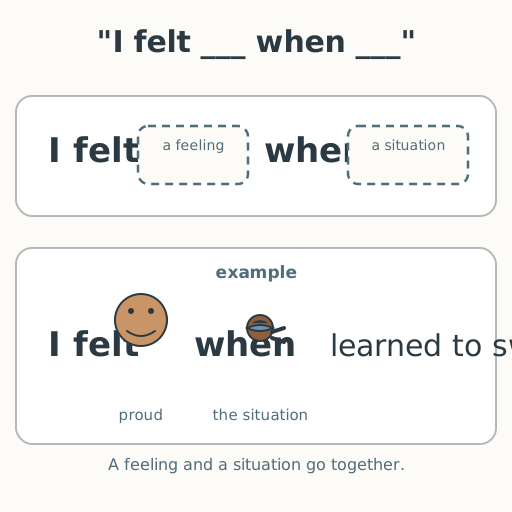
Lesson 3 — “I Felt ___ When ___”
Summary
Learners meet a simple sentence frame — “I felt ___ when ___” — that joins a feeling to the situation that caused it. They practice the frame aloud, with their bodies, and in writing or drawing.
Objectives
- Connect a feeling to the situation that caused it, using the frame “I felt ___ when ___.” (D01.S1.01.02)
Connection
Every feeling comes from somewhere. You do not just feel excited — you feel excited when your birthday comes, or when you see a friend. Putting the feeling and the situation into one sentence — “I felt excited when my aunt arrived” — helps you understand yourself and helps other people understand you, too.
Materials
- A large “I felt ___ when ___” frame on chart paper
- Feeling face cards (happy, sad, angry, scared, proud, lonely, excited)
- Paper and pencils
Preparation
- Write the frame “I felt ___ when ___” large enough for all to see.
- Set out the feeling cards as reminders.
- Prepare a few example sentences to model the frame.
Facilitator note
This lesson is written to the learner (“you”). Model the frame several times before inviting learners to try it. Accept any feeling, even a “negative” one — the goal is accurate naming, not “good” answers. Keep the frame concrete: a real situation the learner experienced, not an abstract one.
Procedure
- Gather (5 min). Listen to two example sentences: “I felt excited when I saw my cousin” and “I felt lonely when my friend went home.” What two parts does each sentence have? A feeling, and a when.
- Learn the frame (10 min). Say the frame together: “I felt ___ when ___.” The first blank is a feeling; the second blank is the situation that caused it. Clap the rhythm as you say it.
- Practice with the cards (10 min). Choose a feeling card, then add a real “when.” Say the whole sentence to a partner. (“I felt proud when I learned to swim.”)
- Write or draw it (15 min). Write the frame and fill in your own blanks, or draw a picture of the situation with the sentence below it.
- Close (5 min). Feelings and situations go together like a lock and a key. The frame helps you put them together.
Differentiation
- Support: Offer the frame with the feeling word already filled in; the learner only supplies the “when.”
- Extension: Add a “because” — “I felt proud when I learned to swim because I tried many times.”
Assessment
- Formative (observation): Can the learner complete the frame with a real feeling and a real situation that match?
Home connection
At home tonight, tell someone one thing that happened and how it made you feel, using the frame “I felt ___ when ___.”