Lesson 02 — What Each Part Can Do
Learners connect each named body part to a simple job it can do, act the jobs out, and notice that different bodies do the same jobs in different ways.
Objectives
Objectives
- D03.S1.01.01 Identify and name basic body parts such as head, arms, legs, hands, and feet and tell a simple use for each.
Essential question
What is each body part for?
Key vocabulary
Materials
Standard materials
- Body-parts chart or cards · 1 set Reuse the head, arms, legs, hands, feet cards from Lesson 1
- A soft ball or beanbag (optional) · 1 To hold, pass, and balance during the "what can it do?" game
Low-tech / no-cost
- Your own body Act out each part's job with your own body; no cards or props needed
- Found objects A stone, leaf, or stick to hold, reach for, and step around
Enriched / lab & device
- Action picture cards · 1 set per pair Photos of people doing each job (reaching, holding, standing) in many different ways and with different tools
- Camera or tablet · 1 per group Photograph learners doing each job to build a class "what my body can do" gallery
Works in different contexts
- large-group Call a part and its job, then the whole group acts it out together before one learner demonstrates
- self-directed A learner works through the card set alone, acting out each part's job and naming it aloud
- outdoor-only Act out each job outside — reach for a branch, stand on a log, hold a stone — and name which part does it
- level-grouped Group learners who already know the names to think up a second job for each part, while others practice the first
Lesson 2 — What Each Part Can Do
Summary
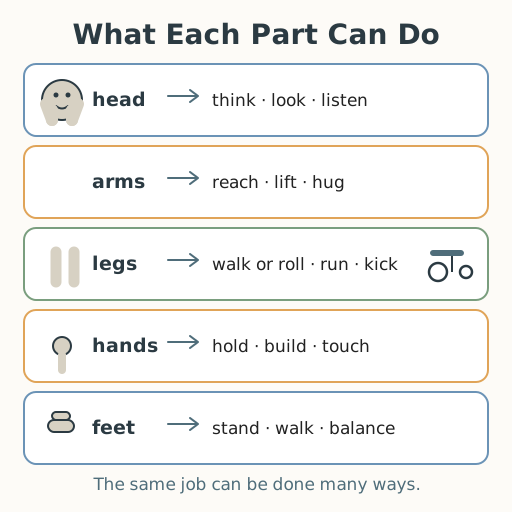
Learners match each body part they named in Lesson 1 to a simple job it can do — the head to thinking and looking, arms to reaching and hugging, legs to walking, hands to holding, feet to standing. They act the jobs out and notice that different bodies do the same jobs in different ways.
Objectives
- Tell a simple use for basic body parts such as head, arms, legs, hands, and feet. (D03.S1.01.01)
Connection
Every part of your body is busy with a job, all day long. Your hands hold your spoon, your chopsticks, or your pencil; your legs walk you — or your wheels roll you — to where you are going; your arms can reach a cup or wrap around someone in a hug. When you know what each part does, you can thank your body for all the work it does for you.
Materials
- Body-parts chart or cards (head, arms, legs, hands, feet)
- A soft ball or beanbag (optional)
Preparation
- Set out the body-parts cards from Lesson 1.
- Clear space to act out each part’s job.
- Place the ball or beanbag nearby for the “what can it do?” game.
Facilitator note
This lesson is written to the learner (“you”) so it works in a classroom and for a self-directed learner. Prepare the cards and space, then guide the acting-out game. The heart of this lesson is that the same job can be done many ways: a body that uses a wheelchair still reaches and goes; a hand, a mouth, a tool, or a friend’s help can all hold and carry. Never hold up one way of moving as the “right” way. Celebrate each learner’s own way.
Procedure
- Gather (5 min). Look at your five body-part cards. Quick — point to your head, arms, legs, hands, and feet as you say each name.
- Match a job to each part (10 min). For each part, say one job it can do: head — think, look, listen; arms — reach, lift, hug; legs — walk, run, kick; hands — hold, build, touch; feet — stand, walk, balance. Act out each job as you say it.
- “What can it do?” game (15 min). Pass the ball or point to a card. When you get a part, act out its job and name it: “Legs — I use them to run!” Others guess the job.
- Different bodies, same jobs (10 min). Think: can a person reach without arms or walk without legs? Yes — people reach with a mouth, a tool, or a chair that moves, and go with wheels or a friend’s help. The job is the same; the body just does it its own way.
- Close (5 min). Your body is full of helpers. Name one part and thank it for the job it does for you today.
Differentiation
- Support: Match one part to one job at a time; model the action and let the learner copy.
- Extension: Ask learners to name a second job for each part (feet can tip-toe; hands can wave).
Assessment
- Formative (observation): Can the learner name a simple use for head, arms, legs, hands, and feet, and act it out?
Home connection
Watch someone at home do a job (stirring, sweeping, carrying) and name the body part doing the work.