Lesson 03 — My Body's Signals
Learners learn that the body sends signals — hunger, thirst, and tiredness — and practice noticing and naming each one in their own bodies.
Objectives
Objectives
- D03.S1.01.02 Notice and name body signals such as hunger, thirst, and tiredness when they feel them.
Essential question
What is my body telling me?
Key vocabulary
Materials
Standard materials
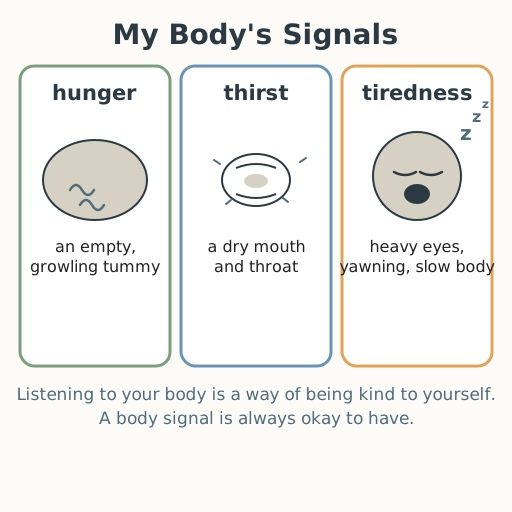
- Signal picture cards · 1 set Three cards — an empty growling tummy (hunger), a dry mouth (thirst), a yawning heavy-lidded face (tiredness)
- A bell or shaker (optional) · 1 To show what a "signal" is — a sound that tells you something
Low-tech / no-cost
- Your own body Feel and name each signal in your own body; no cards needed
- Voice Describe each signal aloud ("tummy growling", "mouth dry", "eyes heavy")
Enriched / lab & device
- Laminated signal cards · 1 set per pair Durable cards for repeated sorting and matching of hunger, thirst, tiredness
- Tablet or camera · 1 per group Photograph learners acting out each signal to build a class "my body talks" poster
Works in different contexts
- large-group Ring the bell to introduce "signal", then hold each card up high and describe the body feeling aloud for all to hear
- self-directed A learner works through the three cards alone, feeling each signal in their body and naming a time they noticed it
- outdoor-only Name the signals outdoors; notice how a full day of play can bring hunger, thirst, and tiredness, and check in on each
- multi-age Older learners act out a signal while younger learners guess whether it is hunger, thirst, or tiredness
Lesson 3 — My Body’s Signals
Summary
Learners learn that their body talks to them through signals. They meet three big ones — hunger, thirst, and tiredness — feel where each one shows up, and practice noticing and naming the signal their own body is sending right now.
Objectives
- Notice and name body signals such as hunger, thirst, and tiredness. (D03.S1.01.02)
Connection
Your body is always sending you little messages, like a bell that rings to get your attention. A growling tummy is your body saying “I need food”; a dry mouth says “I need water”; heavy, sleepy eyes say “I need rest.” When you learn to notice these messages, you can take good care of yourself.
Materials
- Signal picture cards (hunger, thirst, tiredness)
- A bell or shaker (optional)
Preparation
- Print or draw three signal cards: hunger, thirst, tiredness.
- Have the bell or shaker ready to show what a “signal” is.
- Arrange a circle for gathering and the guessing game.
Facilitator note
This lesson is written to the learner (“you”) so it works in a classroom and for a self-directed learner. Prepare the cards and bell, then guide the body check and guessing game. Handle hunger and thirst with care: never assume what a learner has or has not eaten or drunk today, and never make a learner feel that noticing hunger or thirst is a problem. A body signal is always okay to have. If a learner names a signal, respond warmly and help them think about what to do next; if food or water is not available, help them name a trusted adult to tell.
Procedure
- Gather (5 min). Sit comfortably and get very still. Put a hand on your tummy. Listen. Does your body feel quiet and settled, or is it trying to tell you something?
- Meet three signals (15 min). A signal is a message your body sends. Meet three: hunger — a growling, empty tummy; thirst — a dry mouth and throat; tiredness — heavy eyelids, yawning, a slow, heavy body. Act out each signal with your face and body, and say where you feel it.
- Guessing game (10 min). When you hear a body message, point to the card it matches: “Your tummy growls” — hunger. “Your mouth feels dry” — thirst. “Your eyes want to close” — tiredness.
- Body check now (10 min). Close your eyes for a quiet moment. Which signal, if any, is your body sending right now? Name it to yourself, then share with a partner if you want. There is no right answer — noticing is the skill.
- Close (5 min). Your body talks to you all day. Listening to it is a way of being kind to yourself.
Differentiation
- Support: Introduce one signal at a time and act it out together before moving on.
- Extension: Ask learners to name where in the body each signal lives (tummy, mouth, eyes) and draw it.
Assessment
- Formative (observation): Can the learner match hunger, thirst, or tiredness to its body feeling and name one signal their own body is sending?
Resources
- World Health Organization — global health and wellbeing reference: https://www.who.int/