Lesson 10 — My Body, My Senses
A capstone that brings the whole unit together: learners name body parts and their uses, name their body's signals, perform a movement sequence, and complete a careful-hands task, then celebrate everything their bodies can do.
Objectives
Objectives
- D03.S1.01.01 Identify and name basic body parts such as head, arms, legs, hands, and feet and tell a simple use for each.
- D03.S1.01.02 Notice and name body signals such as hunger, thirst, and tiredness when they feel them.
- D03.S2.01.01 Perform basic movements such as skipping, galloping, hopping, and jumping with balance and control.
- D03.S2.01.02 Use small hand movements such as cutting, threading, and buttoning with growing accuracy.
Essential question
How does my body name itself, send signals, move, and do careful work?
Key vocabulary
Materials
Standard materials
- Body-parts and signal cards · 1 set Reuse the cards from Lessons 1–5 for the review
- A beat source (clapping or drum) · 1 For the movement sequence
- Safety scissors, beads, string, and a button board · 1 set per learner or pair For the careful-hands challenge
- Paper and crayons · per learner For the "my body celebration" drawing
Low-tech / no-cost
- Your own body and voice Name parts, act out signals, move, and do a careful hand job with no cards or props
- Found objects A leaf to thread, a fold to tear, or a coat to button
Enriched / lab & device
- A "body celebration" station rotation with a timer or music · 1 set Four labeled stations — name, signal, move, careful hands — to rotate through
- Camera or tablet · 1 per group Photograph each learner's celebration drawing or movement to make a class "our bodies" book
Works in different contexts
- large-group Run four short stations and rotate small groups through name, signal, move, and careful hands, gathering at the end for a shared celebration
- self-directed A learner moves through all four tasks on their own — naming, signaling, moving, and careful work — then draws their celebration
- outdoor-only Hold the whole capstone outside — name parts, act out signals, skip and jump in a clear space, and thread a leaf onto a stem
- multi-age Older learners lead each station and help younger learners name, signal, move, and do careful work
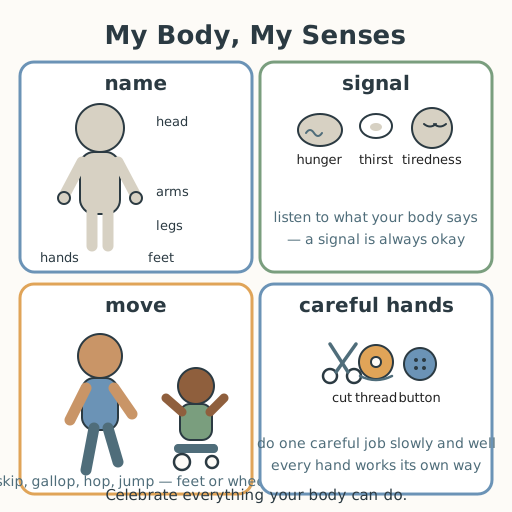
Lesson 10 — My Body, My Senses
Summary
The capstone lesson gathers everything from the unit: learners name their body parts and one use for each, name the signals their bodies send, perform a movement sequence (skip, gallop, hop, jump, balance), and complete a careful-hands task (cut, thread, or button). They close by celebrating all the things their one body can do.
Objectives
- Identify and name basic body parts and tell a simple use for each. (D03.S1.01.01)
- Notice and name body signals such as hunger, thirst, and tiredness. (D03.S1.01.02)
- Perform basic movements such as skipping, galloping, hopping, and jumping with balance and control. (D03.S2.01.01)
- Use small hand movements such as cutting, threading, and buttoning with growing accuracy. (D03.S2.01.02)
Connection
You have spent this whole unit getting to know the body that is yours — its names, its messages, its movements, and its careful hands. Today you put it all together. Every body is different, and every body can do wonderful things in its own way. This is a day to notice and celebrate yours.
Materials
- Body-parts and signal cards
- A beat source (clapping or drum)
- Safety scissors, beads, string, and a button board
- Paper and crayons
Preparation
- Set up four stations: Name (cards and labels), Signal (signal cards), Move (a clear space and a beat), Careful Hands (scissors, beads, button board).
- Prepare paper and crayons for the closing celebration drawing.
- Plan the rotation so every learner visits every station.
Facilitator note
This lesson is written to the learner (“you”) so it works in a classroom and for a self-directed learner. Set up the four stations, run the rotation, then lead the closing celebration. The capstone is a celebration of growth, not a test: observe what each learner can now do, and note it for the portfolio without ranking anyone. Honor every body in its own way — adapted movement and adapted hand tasks count fully. Keep hunger, thirst, and tiredness responses gentle and non-shaming, as in the earlier lessons.
Procedure
- Gather (5 min). Look back over the unit. What did you learn about your body? Name one thing you are proud of.
- Name station (10 min). Point to head, arms, legs, hands, and feet, and say one job each one does. Label a quick drawing of yourself with the five names.
- Signal station (10 min). Look at the signal cards. Name hunger, thirst, and tiredness, and say where each one lives in your body. What is your body telling you right now?
- Move station (10 min). To the beat, do your movement sequence: skip, gallop, hop, jump — then balance on one foot, steady as a tree. Do it in your own body’s way, with wheels or seated springs if that is you.
- Careful-hands station (10 min). Choose one careful job — cut along a line, thread some beads, or button a button — and do it slowly and well.
- Celebrate (10 min). Draw or show one thing your body can do and name one signal it sends. Share it with the group. Your body is yours, it talks to you, and it can do wonderful things.
Differentiation
- Support: Shorten the rotation to two stations (name and move), with an adult or partner helper at each.
- Extension: Ask learners to combine everything into a short “all about my body” performance — naming, signaling, moving, and careful work in one flow.
Assessment
- Summative (performance/observation): Can the learner name body parts and uses, name body signals, perform skip/gallop/hop/jump with control, and complete a careful-hands task?
- Artifact (portfolio): The labeled self-portrait and the “my body celebration” drawing, kept in the learner’s portfolio.
Home connection
Show someone at home your “my body celebration” drawing and tell them three things your body can do and one signal it sends you.