Lesson 09 — Cutting, Threading, and Buttoning
Learners practice three small hand movements — cutting, threading, and buttoning — at three stations, building the careful finger control these everyday jobs need.
Objectives
Objectives
- D03.S2.01.02 Use small hand movements such as cutting, threading, and buttoning with growing accuracy.
Essential question
How do my hands do small, careful jobs?
Key vocabulary
Materials
Standard materials
- Safety scissors · per learner Blunt-tipped scissors for small hands
- Paper strips with drawn lines · per learner Straight and curved lines to cut along
- Beads or pasta with holes, and a string or shoelace · 1 set per learner For threading practice
- A button board or a shirt with large buttons · 1 per pair For buttoning practice
Low-tech / no-cost
- Tearing paper Tearing along a folded line builds the same hand control as cutting
- Found objects with holes Pasta, seeds with holes, or leaves poked with a safe hole, threaded onto a string
- Own clothing with large buttons or fasteners Practice buttoning on the shirt or coat you are wearing
Enriched / lab & device
- Lacing cards or a dressing frame · 1 set per pair Reusable lacing and buttoning practice boards
- Chunky beads and laces in varied sizes · 1 set Beads of many sizes so each learner can choose the challenge that fits
Works in different contexts
- large-group Run three stations — cutting, threading, buttoning — and rotate small groups through each with a helper at each station
- self-directed A learner moves through the three tasks at their own pace, choosing the bead or button size that fits their hands
- outdoor-only Thread leaves or seeds with holes onto a stem or string, and button a coat or shirt as part of dressing for outside
- level-grouped Learners who cut, thread, and button easily choose the smallest beads and curviest lines, while others use larger pieces
Lesson 9 — Cutting, Threading, and Buttoning
Summary
Learners practice three small hand movements — cutting along a line, threading beads onto a string, and buttoning — at three stations. Each job builds the careful finger control needed for dressing, making, and writing, with larger pieces and adapted versions for every hand.
Objectives
- Use small hand movements such as cutting, threading, and buttoning with growing accuracy. (D03.S2.01.02)
Connection
Think of buttoning a shirt in the morning, threading a needle, or cutting paper to make a card. These little jobs use your fingers in careful, exact ways — the same finger control you use to write and draw. Practice makes your hands stronger, surer, and more skillful.
Materials
- Safety scissors
- Paper strips with drawn lines
- Beads or pasta with holes, and a string or shoelace
- A button board or a shirt with large buttons
Preparation
- Set up three stations: cutting (scissors and lined paper), threading (beads and string), buttoning (button board or shirt).
- Tie a knot in one end of each string so beads stay on.
- Choose buttons and beads in a range of sizes so each learner can pick what fits their hands.
Facilitator note
This lesson is written to the learner (“you”) so it works in a classroom and for a self-directed learner. Set up the three stations and rotate learners through them. Small hand movements take time and repetition; praise effort and growing control, not speed or perfection. Honor every hand: some learners need larger beads and buttons, thicker string, or pre-cut paper; some do the job with a mouth, a tool, or a friend’s help. Offer adapted versions as real choices, never as “less.” Supervise scissors closely.
Procedure
- Gather (5 min). Wiggle your fingers. Look at your hands — they are your small, careful tools. Today they will practice three jobs.
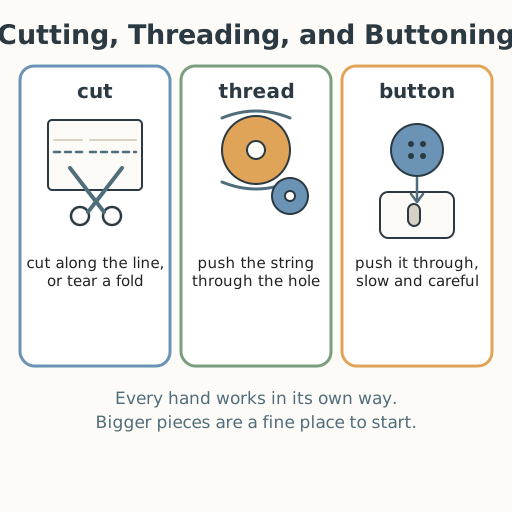
- Cutting station (10 min). Hold the scissors with your thumb in one hole and fingers in the other. Cut slowly along the drawn line, turning the paper, not the scissors. If cutting is hard, tear along a folded line instead — it builds the same control.
- Threading station (10 min). Pick a bead and push the string through its hole. Slide it down, then thread the next. Choose beads that fit your hands — bigger beads are a fine place to start.
- Buttoning station (10 min). Push a button through its hole, then pull it through the other side. Try it on the board, then on a shirt or coat. Buttons take patience — slow fingers are careful fingers.
- Close (5 min). Look at what your hands did today. Your fingers are getting stronger and more careful with every try.
Differentiation
- Support: Offer pre-cut shapes, extra-large beads and buttons, and hand-over-hand help with the first cut or button.
- Extension: Ask learners to cut along a curved or zig-zag line, or thread a pattern of bead colors (two red, one blue).
Assessment
- Formative (observation): Can the learner cut along a line, thread several beads, and button a large button with growing accuracy?
- Artifact (portfolio): A cut-and-threaded strand or a buttoned sample, kept or photographed for the portfolio.
Home connection
Practice one careful hand job at home — buttoning your own shirt, threading a bead, or folding paper — and show someone what your hands can do.