Lesson 02 — Listening Without Interrupting
Learners practice a "listening body" and discover how to let a classmate finish speaking before they add their own words.
Objectives
Objectives
- D02.S1.01.02 Listen without interrupting while a classmate is speaking.
Essential question
How do I show that I am really listening?
Key vocabulary
Materials
Standard materials
- Listening stone · 1 A smooth stone or small object the speaker holds while talking
- Story cards or a short picture book · 1 set Simple prompts for "tell me about..." partner practice
Low-tech / no-cost
- A found object A pebble, shell, or leaf can be the listening stone
- Voices only Practice listening bodies and turn-taking with talk alone; no cards or books needed
Enriched / lab & device
- Soft chime or timer · 1 A gentle sound to mark the end of a speaking turn
- Audio recorder · 1 per pair Record a partner talk and play it back to check for interrupting
Works in different contexts
- large-group Model a "listening body" big and clear for all; call out one speaker at a time and let the whole group practice quiet listening together
- self-directed A learner listens to a story recording or an older reader and practices holding a "noticing thought" (a comment that wants to burst out) until the story pauses
- outdoor-only Sit in a circle outdoors; listen to a natural sound (wind, birds) for one quiet minute, then take turns telling what you heard without interrupting
- multi-age An older learner reads or tells a short story while a younger learner practices a listening body, then they swap
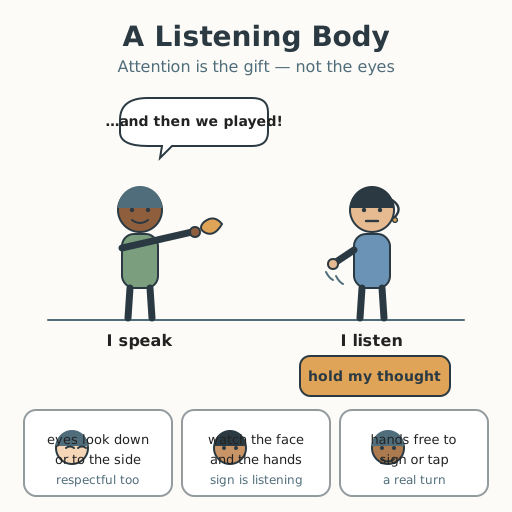
Lesson 2 — Listening Without Interrupting
Summary
Learners build a “listening body” — a body that shows a speaker they are being heard — and practice letting a classmate finish speaking before they talk. They notice the urge to interrupt and learn a way to hold their thought until it is their turn.
Objectives
- Listen without interrupting while a classmate is speaking. (D02.S1.01.02)
Connection
When you let a friend finish speaking, you show that their words matter. Listening is caring with your ears or your eyes and your whole body — there is more than one way to listen. It is a skill, not just something that happens — and like any skill, it gets better with practice.
Materials
- A listening stone (or any small object)
- Story cards or a short picture book
Preparation
- Arrange a circle for gathering.
- Choose a short “tell me about…” topic for each pair (a pet, a game, a meal).
Facilitator note
Interrupting is normal at this age; it is excitement, not rudeness. Teach the “noticing thought” gently: when a comment wants to burst out, the learner can hold a finger, tap their knee, or keep it “in their pocket” until the speaker finishes. Do not shame interruptions; celebrate the catching of them. For the eyes, honor each learner’s culture: in many traditions, looking down or to the side while listening is the respectful way, and that is a real listening body too. Never insist on “eyes on the speaker.” Honor every way of listening and speaking: for a learner who is Deaf or hard of hearing, watching the speaker’s face and hands is listening, and “ears open” is not required. For a learner who does not speak with their mouth, their “voice” may be sign, a gesture, a picture card, or a device — and their “listening body” keeps their hands free, not “still.” Any way a learner listens or speaks is a real listening body and a real turn. Read the procedure aloud and model the listening body yourself.
Procedure
- Gather (5 min). Sit in a circle. Think: what does it feel like when someone lets you finish talking all the way?
- Build a listening body (10 min). Make a listening body together: turn your body toward the speaker, open your ears — or your eyes, watching their face and hands. Keep your mouth quiet, or let your hands sign if signing is your way to speak. For the eyes: different families teach different ways. Some teach “look at the speaker”; some teach that looking down or to the side is the respectful way to listen. Both are real listening bodies. Use the way your family and culture teach. Notice what each part of your body does.
- Meet the urge to interrupt (10 min). Think of a time a thought wanted to burst out of your mouth while a friend was talking. Practice a quiet way to hold it: tap your knee, or keep the thought “in your pocket” until the speaker is done.
- Partner listening (15 min). One partner holds the listening stone and shares about the topic — with their voice, with sign, or by pointing to pictures. The other partner listens with a listening body, holding their thoughts. When the speaker is done, swap.
- Close (5 min). Remember: everyone’s words matter. Waiting to speak is a gift you give to the person talking.
Differentiation
- Support: Shorten speaking turns (one sentence each); give a gentle hand signal for “hold that thought.” For a Deaf or hard-of-hearing learner, seat them where they can clearly see the speaker’s face and hands; for a non-speaking learner, offer picture cards or sign to share their turn.
- Extension: Ask learners to retell one thing their partner said — a first step toward showing they really listened.
Assessment
- Formative (observation): Does the learner let a partner finish a sentence or idea before speaking?
- Peer (partner check): Partners give a friendly thumbs-up when they felt listened to.