Lesson 03 — Waiting to Speak
Learners practice the routines of turn-taking — raising a hand, waiting, and using kind words to ask for a turn — so group talk feels fair to everyone.
Objectives
Objectives
- D02.S1.01.02 Listen without interrupting while a classmate is speaking.
- D02.S1.01.01 Use kind words such as please, thank you, and may I when speaking with classmates and adults.
Essential question
How do I wait for my turn to talk?
Key vocabulary
Materials
Standard materials
- Turn marker · 1 Any decorated stick or wand that travels to show whose turn it is
- Hand-raising picture cards · 1 set Simple cards showing a raised hand and a waiting body
Low-tech / no-cost
- A found stick A stick from outside can be the turn marker
- Hands and bodies Practice raising a hand and waiting with no cards or props
Enriched / lab & device
- Chime or visual timer · 1 A gentle sound or visual countdown to show when a turn is done
- Turn-tracking chart · 1 per group A reusable chart where learners move a marker to show who speaks next
Works in different contexts
- large-group Pass one turn marker around a large circle; everyone practices raising a hand and waiting while many are waiting their turn
- self-directed A learner practices with a family member or older friend at home, taking turns and raising a hand before speaking
- outdoor-only Sit in a circle outdoors and pass a found stick; a hand, card, or wave raised to the sky is the signal to speak
- multi-age Older learners model raising a hand and waiting; younger learners mirror them before speaking
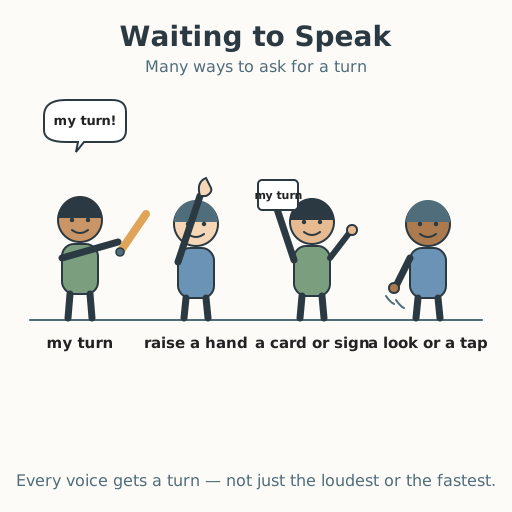
Lesson 3 — Waiting to Speak
Summary
Learners practice how to take a turn in group talk: raise a hand, wait without grabbing, and use kind words to ask for a turn. They play turn-taking games so that waiting feels fair and doable.
Objectives
- Listen without interrupting while a classmate is speaking. (D02.S1.01.02)
- Use kind words such as please, thank you, and may I when speaking with classmates and adults. (D02.S1.01.01)
Connection
In a group, everyone has something to say, but only one voice can be heard at a time. Waiting your turn is a way of sharing the talking time so that everyone gets a fair chance to be heard — not just the loudest or the fastest.
Materials
- A turn marker
- Hand-raising picture cards
Preparation
- Arrange a circle for gathering.
- Agree on a quiet signal for “I want to speak” (a raised hand).
Facilitator note
This lesson turns waiting from a rule into a fair-sharing practice. The aim is not obedience but equity: every voice gets a turn. Use the turn marker so the turn is visible and concrete. Praise waiting (“you waited and your idea still got heard”) more than you praise speed. The “raised hand” signal can be any clear signal a learner can make — a raised hand, a raised card, a look, a tap, a small sound, or a partner who raises on their behalf; honor each learner’s way of asking for a turn. A learner who does not speak with their mouth can ask for a turn with sign, a picture card, or a device — that is a real “May I have a turn, please?” Read the procedure aloud; play the games with the learners.
Procedure
- Gather (5 min). Sit in a circle. Think: what happens when everyone talks at once? Is it easy to hear anyone?
- Meet the turn marker (10 min). The person holding the stick speaks; everyone else listens. Practice: pass the stick around and have each person share their name and one favorite thing — with their voice, with sign, or by pointing to a picture. Only the stick-holder talks.
- Raise a hand, wait (10 min). Learn the signal: show your signal to ask for a turn — a raised hand, a raised card, a look, a tap, or a partner who raises for you. Practice signaling and waiting — not calling out — until the stick comes to you. Notice how it feels to wait.
- Ask with kind words (15 min). When you want a turn, you can say “May I have a turn, please?” — or sign it, or point to a “my turn, please” card. Play a game where you ask with kind words, wait for the stick, then speak.
- Close (5 min). Remember: waiting your turn is fair to everyone. Every voice matters, including yours.
Differentiation
- Support: Use a very short turn (“one word about today”) so waiting stays short; offer a physical token to hold while waiting. Offer a non-hand signal (a card, a look, a tap) for learners who cannot raise a hand, and a picture “my turn, please” card for learners who do not speak.
- Extension: Invite learners to run the turn-marker circle themselves, choosing who speaks next with kind words.
Assessment
- Formative (observation): Does the learner show their turn signal (a raised hand, a card, a look, or a partner raising for them) and wait for the turn marker instead of calling out?
- Self (reflection): Ask: “How did it feel to wait? Was it hard or easy today?”