Lesson 10 — Learning to Live Together
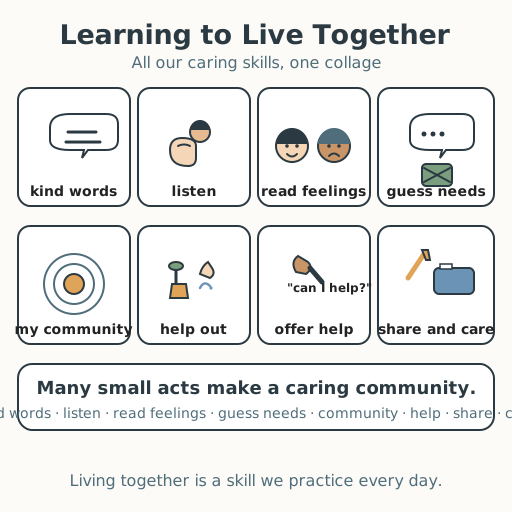
Capstone: learners bring all eight skills together — kind words, listening, reading feelings, guessing needs, naming communities, helping, and sharing — to plan and carry out one caring act for their class community.
Objectives
Objectives
- D02.S1.01.01 Use kind words such as please, thank you, and may I when speaking with classmates and adults.
- D02.S1.01.02 Listen without interrupting while a classmate is speaking.
- D02.S2.01.01 Guess how a classmate feels by reading their face, voice, or body.
- D02.S2.01.02 Tell what another person might want or need in a familiar situation.
- D02.S3.01.01 Name several communities they belong to, such as family, class, and neighborhood.
- D02.S3.01.02 Describe one thing each community does together and one way they help out.
- D02.S4.01.01 Offer help to a classmate who is struggling, without being asked.
- D02.S4.01.02 Share classroom resources and take care of shared materials.
Essential question
How do I help our class be a caring community?
Key vocabulary
Materials
Standard materials
- "Caring community" plan sheet · 1 per group A simple plan sheet for choosing one caring act to do together
- Caring-act supplies · varies Whatever the chosen act needs (cloth, paper, a card, a plant to water)
Low-tech / no-cost
- Hands and voices Do the caring act with bodies and words alone; no special supplies needed
- Found and reusable items Use whatever is already in the room or outside for the caring act
Enriched / lab & device
- Camera or tablet · 1 per group Document the caring act to build a class "how we live together" book or poster
- Class sharing circle props · 1 set A turn marker and soft rug for a celebratory closing circle
Works in different contexts
- large-group Split into small teams, each doing one caring act, then gather in one big circle to share what each team did
- self-directed A learner plans and carries out one caring act at home or in class, using every skill, and records it in a drawing or a few sentences
- outdoor-only Carry out the caring act outdoors — clean a shared space, water plants, or help a neighbor — then gather to reflect
- multi-age Mixed-age teams plan a caring act together, with older learners writing the plan and younger learners leading the doing
Lesson 10 — Learning to Live Together
Summary
This capstone lesson gathers everything from the unit into one caring act. Learners plan and carry out a small act of care for their class community — cleaning a shared space, making a welcome card, or helping a younger group — using kind words, listening, reading feelings, guessing needs, and sharing along the way.
Objectives
- Use kind words such as please, thank you, and may I when speaking with classmates and adults. (D02.S1.01.01)
- Listen without interrupting while a classmate is speaking. (D02.S1.01.02)
- Guess how a classmate feels by reading their face, voice, or body. (D02.S2.01.01)
- Tell what another person might want or need in a familiar situation. (D02.S2.01.02)
- Name several communities they belong to, such as family, class, and neighborhood. (D02.S3.01.01)
- Describe one thing each community does together and one way they help out. (D02.S3.01.02)
- Offer help to a classmate who is struggling, without being asked. (D02.S4.01.01)
- Share classroom resources and take care of shared materials. (D02.S4.01.02)
Connection
All the skills in this unit fit together like tools in one box: kind words, listening, reading feelings, guessing needs, knowing your community, helping, and sharing. Today you use the whole box at once to make your class a kinder place — the same way people everywhere build caring communities with many small acts.
Materials
- A “caring community” plan sheet
- Caring-act supplies (cloth, paper, a card, a plant to water — whatever the act needs)
Preparation
- Prepare a short menu of caring acts learners can choose from (tidy a shared space, make a welcome card, help another class, water the plants).
- Set out supplies and a plan sheet for each small group.
Facilitator note
This is a performance of the whole unit, not a test. Keep it joyful and low-stakes. Let learners choose their caring act; your job is to notice and name the skills as they appear (“I heard kind words,” “I saw you notice she needed help”). Celebrate effort, not perfection. No learner must speak in front of the group; sharing can be by drawing, action, or a partner speaking on their behalf. Every culture builds community with small acts of care — name that as you close. Read the procedure aloud.
Procedure
- Gather (5 min). Sit in a circle. Think: what is one small thing that would make our class kinder today?
- Pick a caring act (10 min). With your group, choose one caring act from the menu. Talk it over: what will we do together, and how will each of us help out? Use kind words and take turns speaking.
- Do it together (20 min). Carry out your caring act. While you work: notice how friends feel, guess what they might need, and offer help before being asked. Share materials so everyone has enough.
- Share back (10 min). Gather in a circle. Each group shares what it did — with words, with pictures, or by acting it out — and the class listens without interrupting. Name one skill you used today.
- Close (5 min). Remember: living together is a skill we practice every day, with kind words, listening, care, and help. Today you did it all at once.
Differentiation
- Support: Offer a two-option menu and a picture-based plan sheet; assign a “helper buddy” to each learner.
- Extension: Invite groups to plan a second caring act for a community beyond the classroom (a sibling group, a neighbor) and describe how the same skills apply.
Assessment
- Performance (observation): Does the learner use kind words, listen, and offer help during the caring act?
- Artifact (portfolio): The group’s plan sheet and a drawing of the caring act, kept as the unit’s culminating artifact.