Lesson 03 — Speaking in Complete Sentences
Learners build complete sentences from simple frames and share their own ideas in a full sentence, so others can understand them.
Objectives
Objectives
- D04.S1.01.02 Speak in complete sentences to share an idea or experience so others can understand.
Essential question
How do I put my idea into a complete sentence so others understand me?
Key vocabulary
Materials
Standard materials
- Sentence frame chart · 1 A chart showing a simple frame such as "I like ___" and "I saw ___"
- Picture cards of familiar things · 1 set Food, animals, places, toys — anything learners know and can name
- Soft ball or beanbag · 1 Optional, for passing during the sentence game
Low-tech / no-cost
- A spoken sentence frame Just say the frame aloud; no chart needed
- Real objects instead of picture cards Point to anything in the room or outside to finish a sentence
Enriched / lab & device
- Sentence frame strips (laminated) · 1 set per pair Reusable strips learners can point to and fill in
- A simple audio recorder · 1 per group Record learners' sentences so they can hear their own complete sentences
Works in different contexts
- large-group Model a sentence with the whole group, then pass the ball so each learner adds one complete sentence in turn
- self-directed A learner says sentences aloud to a mirror or into a recorder, checking each one has a "who" and a "what happened"
- outdoor-only Finish the sentence about something seen outside — "I see ___" — naming real things in view
- level-grouped Group learners who are ready for longer sentences together and let them stretch one idea into two sentences
Lesson 3 — Speaking in Complete Sentences
Summary
Learners learn that a complete sentence has a “who” and a “what happened.” They build sentences from simple frames, then share an idea of their own in a full sentence so others can understand them.
Objectives
- Speak in complete sentences to share an idea or experience so others can understand. (D04.S1.01.02)
Connection
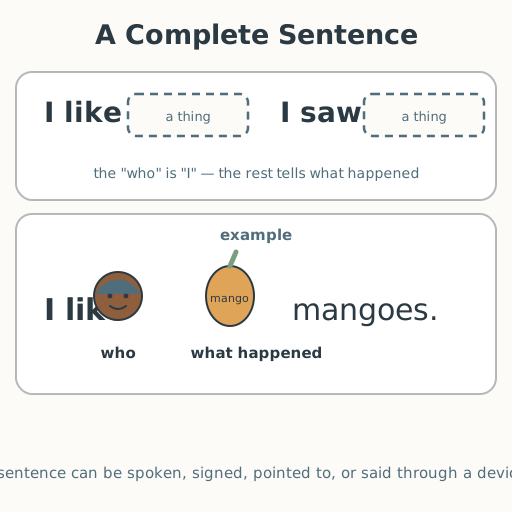
When you say only one word — “mango” — people guess what you mean. When you say a whole sentence — “I like mangoes” — they know exactly. A complete sentence has a who and a what happened, and it helps your idea travel clearly to another person.
Materials
- A sentence frame chart (“I like ___”, “I saw ___”)
- Picture cards of familiar things
- A soft ball or beanbag (optional)
Preparation
- Write or display two simple sentence frames.
- Gather picture cards (or plan to point at real objects).
- Arrange a circle for the sentence game.
Facilitator note
This lesson is written to the learner (“you”) so it works in a classroom and for a self-directed learner. Prepare the frames and cards, then guide the game. The goal is completeness, not a “correct” accent or dialect — every way of speaking is honored. Gently stretch one-word answers into sentences by asking “Who? What happened?” without correcting the learner’s voice. A complete sentence can also be signed, built with picture cards, or spoken through a communication device — a “who” and a “what happened” arranged in any of these ways is still a complete sentence.
Procedure
- Gather (5 min). Sit in a circle. Say one word about something you like. Now listen as a friend guesses what you meant. One word leaves a lot of guessing.
- Meet the sentence (5 min). A complete sentence has two parts: a who and a what happened. Look at the frame “I like ___.” The who is “I”; the rest tells what happened.
- Build sentences (10 min). Using a frame, fill in the blank. Say the whole sentence out loud: “I like rice.” “I saw a goat.” Say each one clearly.
- Sentence game (15 min). Pass the ball (or point in turn). When it reaches you, finish a frame with your own idea and say the complete sentence. Everyone listens, then the next person goes.
- Share your own idea (5 min). Without the frame now, tell the group one thing about your day in a complete sentence. Remember the who and the what happened.
- Close (5 min). Complete sentences help your ideas reach other people. The clearer you speak, the more you can share.
Differentiation
- Support: Keep the frame visible and accept two-word completions at first, then say the full sentence together.
- Support (non-speaking): Build the sentence by signing it, pointing to picture cards in order, or using a device — the “who” and “what happened” can be shown, not only said.
- Extension: Stretch one idea into two complete sentences (“I like mangoes. They are sweet.”).
Assessment
- Formative (observation): Can the learner share an idea in a complete sentence with a clear who and what happened?
Home connection
Tell someone at home one complete sentence about your day, and ask them to tell you one back.