Lesson 04 — Letters and Sounds
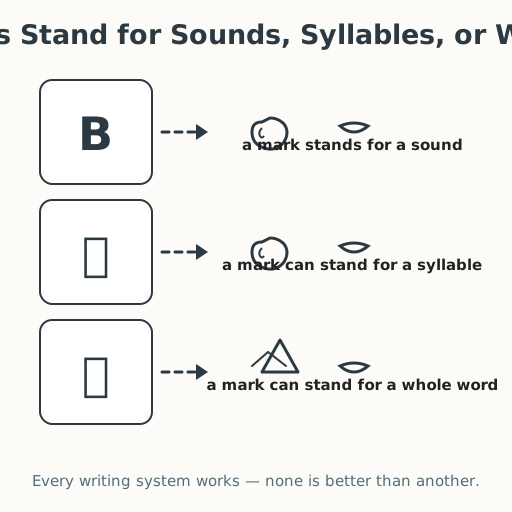
Learners explore their own writing system and learn that its marks — letters or characters — stand for sounds, syllables, or words, matching a few marks to what they say.
Objectives
Objectives
- D04.S2.01.01 Decode simple words by sounding out letters and letter groups in their home writing system.
Essential question
How do the marks of my writing system stand for sounds, syllables, or words?
Key vocabulary
Materials
Standard materials
- A chart of a few marks from the learners' home writing system · 1 Letters or characters actually used in the learners' language or languages
- Picture cards of familiar words · 1 set One picture for each mark or syllable to be introduced
Low-tech / no-cost
- Marks written large in the air or on the ground No printed chart needed; write each mark big with a finger or a stick
- Voice and objects Say the sound and touch a real object whose name begins with it
Enriched / lab & device
- Mark-and-sound cards (sturdy) · 1 set per pair Durable cards pairing a mark with a picture and the sound it stands for
- A tablet or audio player with mark-sound clips · 1 Optional audio of each mark's sound for independent practice
Works in different contexts
- large-group Show each mark large, say its sound, and have the whole group say it back together before matching to a picture
- self-directed A learner works through the mark cards alone, saying each sound aloud and matching it to its picture
- outdoor-only Write marks in the dirt or sand with a stick and say each sound as it is written; match to an object nearby
- multi-age Older learners who read confidently coach younger ones in saying each mark's sound, in the shared home writing system
Lesson 4 — Letters and Sounds
Summary
Learners meet the marks of their own writing system — letters or characters — and discover that marks stand for sounds, syllables, or whole words. They match a few marks to what they say, honoring the writing system of their home language.
Objectives
- Decode simple words by sounding out letters and letter groups in their home writing system. (D04.S2.01.01)
Connection
Your language is written with marks. In some writing systems a mark stands for one sound; in others a mark stands for a whole syllable or even a whole word. Every system works, and no writing system is better than another — they are just different ways humans record their words. Today you will look closely at the marks of your own language.
Materials
- A chart of a few marks from the learners’ home writing system
- Picture cards of familiar words
Preparation
- Choose 3–5 marks (letters or characters) from the learners’ home writing system.
- For each mark, pick a familiar word and picture that use it.
- Prepare the chart or plan to write marks large.
Facilitator note
This lesson is written to the learner (“you”) so it works in a classroom and for a self-directed learner. The key commitment is script-agnosticism: do not assume the Latin alphabet or that “one mark = one sound.” A learner’s system may be Arabic, Devanagari, Chinese characters, Cyrillic, Ethiopic, Hangul, or another — honor it. Work in the writing system(s) actually present in your classroom or home, and never rank scripts. If learners use different systems, celebrate each one side by side. For a learner who is blind or has low vision, make the marks tactile — raised lines of string, sand-glue, clay, or found objects — so the shape can be felt with the hands; the learner points or touches to match a mark to its sound. A learner who does not use a speaking voice matches by pointing, touching, or gesturing instead of saying the sound aloud.
Procedure
- Gather (5 min). Think of a word you say every day. How would you write it down? Every language has its own way — its own writing system.
- Meet your marks (10 min). Look at each mark on the chart. Say its sound (or its syllable or word) out loud together. Notice its shape — where it is tall, where it curves, where it connects to its neighbors.
- Match mark to word (15 min). For each mark, find the picture whose word uses it. Say the word slowly and listen for the mark inside it. In a system where a mark is a whole syllable or word, point to the picture whose word that mark already tells.
- Write it big (10 min). With your finger or a stick, trace each mark large in the air or on the ground while saying its sound. Feel its shape with your whole arm.
- Close (5 min). The marks of your writing system carry your language’s sounds. Learning them is the first step to reading. Every language’s marks are a treasure.
Differentiation
- Support: Introduce just two marks; match each to one picture and repeat the sound many times.
- Support (blind/low-vision): Use raised or textured marks so the shape can be felt; match by touch, not sight.
- Support (non-speaking): Match mark to sound by pointing or touching rather than saying it aloud.
- Extension: Find another word that uses the same mark and say it, hearing the shared sound.
Assessment
- Formative (observation): Can the learner match a mark to the sound, syllable, or word it stands for, and say it back?
Home connection
Ask someone at home to show you one mark of your home writing system and tell you its sound. Bring what you learned to share.