Lesson 05 — Sounding Out Words
Learners decode simple words by sounding out each mark in their home writing system and blending the parts together, following explicit modeling and guided practice.
Objectives
Objectives
- D04.S2.01.01 Decode simple words by sounding out letters and letter groups in their home writing system.
Essential question
How do I sound out a word, mark by mark, and blend it together?
Key vocabulary
Materials
Standard materials
- A short list of simple words in the home writing system · 1 set Words made of marks the learners already know (for syllable/character systems, a list of simple two-mark words)
- Sliding pointer or finger · 1 To point under each mark while sounding out
Low-tech / no-cost
- Words written large in the air or on the ground No printed list needed; write each word big as you sound it out
- Clapping or stepping Clap or step once for each sound or syllable as you blend
Enriched / lab & device
- Word cards with one mark per box · 1 set per pair Words with boxes under each mark to point and blend, or syllable blocks for character systems
- A recording of words sounded out slowly · 1 A model to listen to and imitate for independent practice
Works in different contexts
- large-group Sound out a word together, the whole group saying each mark's sound as the facilitator points, then blending it in one voice
- self-directed A learner points under each mark, says each sound aloud, then slides a finger to blend — checking against a picture when possible
- outdoor-only Write a word in the dirt, walk or hop once per sound or syllable as you say it, then blend while stepping all the way through
- level-grouped Group learners who blend quickly and give them slightly longer words while others keep practicing two-mark words
Lesson 5 — Sounding Out Words
Summary
Learners learn to decode — to sound out a word mark by mark and blend the parts into a whole word. In alphabetic systems they blend sounds; in character systems they combine syllables or word-marks. They practice with explicit modeling and guided practice in their own writing system.
Objectives
- Decode simple words by sounding out letters and letter groups in their home writing system. (D04.S2.01.01)
Connection
Reading is like putting beads on a string: you say each part, one after another, then slide them together into one word. A cook follows steps in order to make a dish, and a reader follows marks in order to make a word. Today you will learn to sound out and blend — the heart of decoding.
Materials
- A short list of simple words in the home writing system
- A sliding pointer or finger
Preparation
- Write 3–5 simple words made of marks the learners know.
- Plan to model “sound out, then blend” for each word.
- Have pictures for the words when possible, so learners can check their blend.
Facilitator note
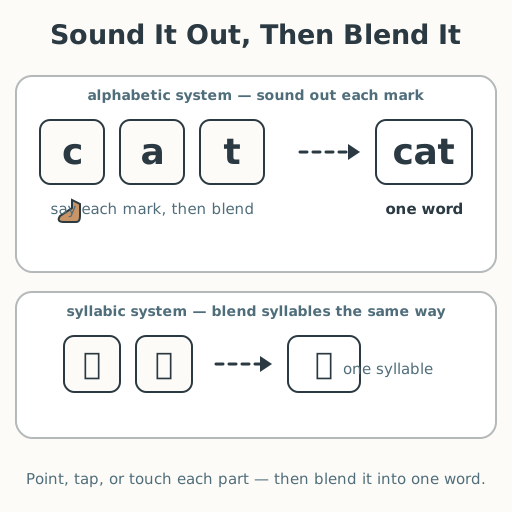
This lesson is written to the learner (“you”) so it works in a classroom and for a self-directed learner. Use explicit instruction, worked examples, and guided practice (philosophy §13). Stay script-agnostic: in an alphabetic system, sound out letter by letter and blend; in a syllabic or character system, combine the syllables or word-marks the same way. Never assume one mark = one sound. Honor the learner’s actual writing system, and celebrate every way words are built. For a learner who is blind or has low vision, offer tactile marks (raised string, sand-glue, clay, or textured objects) so each part can be felt and blended by touch. A learner who does not use a speaking voice sounds out by pointing, tapping, or touching each mark in order and then blending with a gesture or a device.
Procedure
- Gather (5 min). Watch your teacher (or a helper) read one word. Notice they do not guess the whole word at once — they build it piece by piece.
- Watch and listen (10 min). For one word, point under the first mark, say its sound, then the next, then the next. Now slide your finger under the whole word and say it fast, blended together. That is sounding out and blending.
- Do it together (10 min). Pick a word. Point under each mark together and say each sound or syllable. Then blend it in one voice. Check: does it match the picture?
- Try it yourself (15 min). Sound out the next words on your own or with a partner — point, say each part, then blend. If the blend sounds strange, go slower and try again.
- Close (5 min). Decoding means you do not need anyone to tell you the word — you can sound it out yourself. That power belongs to every reader.
Differentiation
- Support: Use two-mark words only; blend the word for the learner and have them echo it, then try together.
- Support (blind/low-vision): Use tactile marks so blending can happen by touch, tapping each part in order.
- Support (non-speaking): Point, tap, or touch each mark in order and blend with a gesture or a device rather than a spoken voice.
- Extension: Sound out a longer word and read it in a full sentence.
Assessment
- Formative (observation): Can the learner point to each mark, say its sound or syllable, and blend it into the correct word?
Home connection
Find one word in your home writing system and sound it out for someone at home, mark by mark.