Lesson 06 — Letter Groups
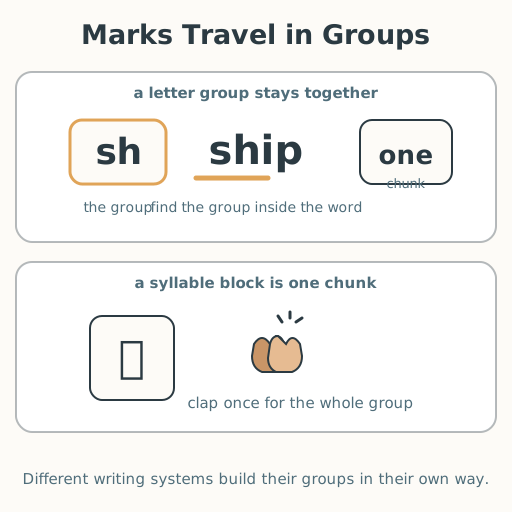
Learners recognize that marks travel in groups — letter groups or syllable blocks — that stay together as one part of a word, and they practice spotting and saying those groups in simple words.
Objectives
Objectives
- D04.S2.01.01 Decode simple words by sounding out letters and letter groups in their home writing system.
Essential question
How do marks work together in groups to make bigger parts of a word?
Key vocabulary
Materials
Standard materials
- A chart of one or two common letter groups (or syllable blocks) · 1 Groups chosen from the learners' home writing system
- Word cards built from those groups · 1 set Simple words that contain the group being practiced
Low-tech / no-cost
- Groups written large and a pointer Write each group big; no printed cards needed
- Clapping Clap once for the whole group, showing it stays together as one part
Enriched / lab & device
- Group-and-word puzzle cards · 1 set per pair Cards that snap a letter group onto a word to build it
- A digital word-builder app or audio clips · 1 Optional reinforcement of group sounds for independent practice
Works in different contexts
- large-group Show the group large, say it together, then find it inside a word on the board by underlining it
- self-directed A learner reads the group card, says it, then hunts for that group inside word cards, underlining it with a finger
- outdoor-only Write a group in the dirt, then build a word by adding marks around it; clap when the whole group stays together
- multi-age Older readers underline letter groups in a shared word list while younger learners read the group aloud
Lesson 6 — Letter Groups
Summary
Learners discover that marks often travel together as groups — letter groups in alphabetic systems, or syllable and word parts in character systems — and that these groups stay together as one chunk of a word. They practice spotting and saying groups inside simple words.
Objectives
- Decode simple words by sounding out letters and letter groups in their home writing system. (D04.S2.01.01)
Connection
Some friends always walk to school together, side by side. Marks in writing do this too — certain marks appear together so often that we read them as one part. Reading groups as one chunk makes reading faster, the way a cook who knows a recipe stirs several steps at once.
Materials
- A chart of one or two common letter groups (or syllable blocks)
- Word cards built from those groups
Preparation
- Choose 1–2 letter groups (or syllable blocks) from the learners’ home writing system.
- Prepare word cards that contain each group.
- Plan to model finding the group inside a word.
Facilitator note
This lesson is written to the learner (“you”) so it works in a classroom and for a self-directed learner. Choose groups that are real in the learners’ home writing system — in an alphabetic system, a letter group such as a common vowel pair; in a syllabic or character system, a syllable block or a two-mark combination. Remain script-agnostic; do not import English-specific groups into a different system. Explicitly model, then guide practice (philosophy §13). For a learner who is blind or has low vision, make the group tactile (raised string, sand-glue, or clay) so it can be felt and found by touch; a learner who does not use a speaking voice spots and says the group by pointing, tapping, or using a device.
Procedure
- Gather (5 min). Look at the group on the chart. Say it together. It is a team of marks that almost always stays together.
- Meet the group (10 min). Listen as the group is said slowly, then fast. Notice it is one part, one chunk — clap once for the whole group, not once for each mark.
- Find it in words (15 min). Look at a word card. Slide your finger until you spot the group hiding inside. Underline it. Say the whole word, keeping the group together as one part.
- Build with groups (10 min). Take the group and add marks before or after it to make a real word. Read your new word aloud. Does it sound right?
- Close (5 min). Reading in groups makes words come faster. The marks of your language work as a team, and now you can read them as one.
Differentiation
- Support: Practice only one group, finding it in two words and saying it many times.
- Support (blind/low-vision): Use tactile group shapes and find them by touch.
- Support (non-speaking): Point to or tap the group and blend with a gesture or a device instead of a spoken voice.
- Extension: Find the same group in a short sentence and read the sentence aloud.
Assessment
- Formative (observation): Can the learner spot a letter group inside a word and say the word with the group kept together as one part?
Home connection
Show someone at home the letter group you practiced, and find it together inside one written word.