Lesson 08 — Beginning, Middle, End
Learners read a simple text and retell its beginning, middle, and end, using a three-part frame to hold the story's order.
Objectives
Objectives
- D04.S2.01.02 Read a simple text aloud and retell its beginning, middle, and end.
Essential question
How do I retell a story's beginning, middle, and end?
Key vocabulary
Materials
Standard materials
- A simple text with a clear beginning, middle, and end · 1 A short tale of three clear parts
- Three-part story frame · 1 Three boxes labeled beginning, middle, end for drawing or writing
Low-tech / no-cost
- A story told aloud from memory No book needed; a remembered tale with three clear parts
- Three stones or sticks Move one object as you retell each part — first, next, last
Enriched / lab & device
- Three-part story cards · 1 set per pair Cards with a picture for beginning, middle, and end to order
- A recording of the story · 1 Learners re-listen to check their retelling
Works in different contexts
- large-group Retell the story together, the whole group supplying the middle while the facilitator holds up the beginning and end pictures
- self-directed A learner reads or hears the story, then draws three pictures — beginning, middle, end — and retells aloud using them
- outdoor-only Retell the story while walking to three spots — first spot is the beginning, second the middle, third the end
- multi-age Older learners help younger ones put three picture cards in order and retell the story with a beginning, middle, and end
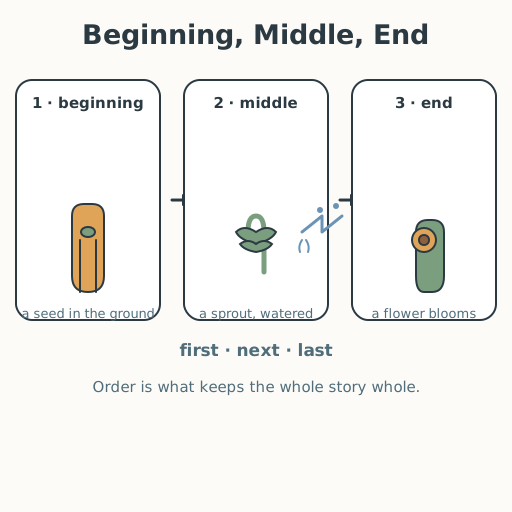
Lesson 8 — Beginning, Middle, End
Summary
Learners read a simple text and learn to retell it in order — beginning, middle, and end. They use a three-part frame to hold the story’s shape, so a retelling keeps its sense.
Objectives
- Read a simple text aloud and retell its beginning, middle, and end. (D04.S2.01.02)
Connection
A story is like a path with three parts: where it starts, what happens along the way, and where it lands. If you skip the middle, the story makes no sense — like telling someone you baked a cake but forgetting the mixing and the oven. Retelling the beginning, middle, and end keeps the whole story whole.
Materials
- A simple text with a clear beginning, middle, and end
- A three-part story frame (beginning, middle, end)
Preparation
- Choose a story with three clear parts.
- Prepare the three-part frame (three boxes labeled beginning, middle, end).
- Plan to model retelling once.
Facilitator note
This lesson is written to the learner (“you”) so it works in a classroom and for a self-directed learner. Model a retelling in three clear moves, then guide practice. Retelling is about order and understanding, not exact words — honor a learner’s own wording. Oral traditions carry stories the same way; celebrate retelling as an ancient and universal skill. A retelling can be spoken, signed, pointed to in pictures, or acted out — holding the order is what matters.
Procedure
- Gather (5 min). Listen to or read the story once, all the way through.
- Meet the three parts (5 min). Every story has a beginning (where it starts), a middle (what happens), and an end (where it lands). Say the three words and hold up one, two, three fingers.
- Find the parts (10 min). Think about the story. What happened first? That is the beginning. What happened next, in the middle? What happened last, at the end?
- Fill the frame (15 min). In the three boxes, draw or write one picture for each part. Then point to each box and retell that part aloud in order: beginning, middle, end.
- Retell to a partner (5 min). Tell the whole story to a partner in three moves. Listen as your partner retells it back.
- Close (5 min). Order is what makes a story make sense. Beginning, middle, end — that is the shape of every tale, in every language.
Differentiation
- Support: Retell with just two parts at first (beginning, end), then add the middle; use pictures instead of words.
- Support (non-speaking): Retell by pointing to three pictures in order, signing, or acting out each part — the order is the retelling.
- Extension: Retell a second story and notice what the middle adds that the beginning and end alone cannot tell.
Assessment
- Formative (observation): Can the learner retell the story’s beginning, middle, and end in order, in their own words?
Home connection
Retell a favorite story to someone at home in three parts — beginning, middle, and end — and ask them to guess which part was the middle.