Lesson 09 — Writing Letters and Words
Learners practice forming the marks of their own writing system and write simple words, following explicit modeling and guided practice.
Objectives
Objectives
- D04.S3.01.01 Write letters and simple words to express an idea, and read back what they wrote.
Essential question
How do I form the marks of my writing system and write a simple word?
Key vocabulary
Materials
Standard materials
- Writing surface and tool · 1 per learner Paper and pencil, or a sand tray and stick, or a slate and chalk
- Model cards of a few marks and simple words · 1 set Marks and words in the learners' home writing system
Low-tech / no-cost
- Finger tracing in sand, dust, or air No paper or pencil needed; a fingertip and any surface work
- A stick and a patch of earth Write marks large outdoors
Enriched / lab & device
- Lined paper and pencils of varied grips · 1 per learner Tools that fit small hands comfortably
- A slate or whiteboard with marker · 1 per pair For wipe-clean practice before committing to paper
Works in different contexts
- large-group Model each mark large while the whole group traces it in the air together, then writes it on their own surface
- self-directed A learner traces a model mark, then writes it from memory several times, then writes a simple word
- outdoor-only Write marks and words in the sand or dirt with a stick, saying the sound as each is written
- level-grouped Learners who form marks easily write whole words while others keep tracing single marks with support
Lesson 9 — Writing Letters and Words
Summary
Learners practice forming the marks of their own writing system — letters or characters — and write simple words, following explicit modeling and guided practice. Writing turns a spoken idea into marks that last.
Objectives
- Write letters and simple words to express an idea, and read back what they wrote. (D04.S3.01.01)
Connection
A spoken word vanishes as soon as it is said. A written word stays — on paper, on a slate, in the sand — so someone far away or years later can read it. When you learn to form the marks of your writing system, you learn to keep your words. That is how letters, recipes, and stories have traveled across the world.
Materials
- A writing surface and tool (paper and pencil, or sand tray and stick)
- Model cards of a few marks and simple words
Preparation
- Choose 2–4 marks and 1–2 simple words in the learners’ home writing system.
- Prepare model cards or write the marks large to copy.
- Set out writing surfaces for each learner.
Facilitator note
This lesson is written to the learner (“you”) so it works in a classroom and for a self-directed learner. Use explicit instruction and guided practice (philosophy §13): model each mark’s strokes, then guide. Remain script-agnostic — a learner’s system may be Latin, Arabic, Devanagari, Chinese characters, Cyrillic, Ethiopic, Hangul, or another; teach the strokes of the learner’s actual system and never rank scripts. Encourage slow, careful forming over speed. Writing is about keeping the idea, not perfect marks: a learner may also dictate to a scribe, choose marks on a letter board, type on any device, or trace with the whole arm, a foot, or a mouth stick — handwriting is never judged as “correct.”
Procedure
- Gather (5 min). Say a word you know. It was sound a moment ago, and now it is gone. Today you will learn to write marks so your word stays.
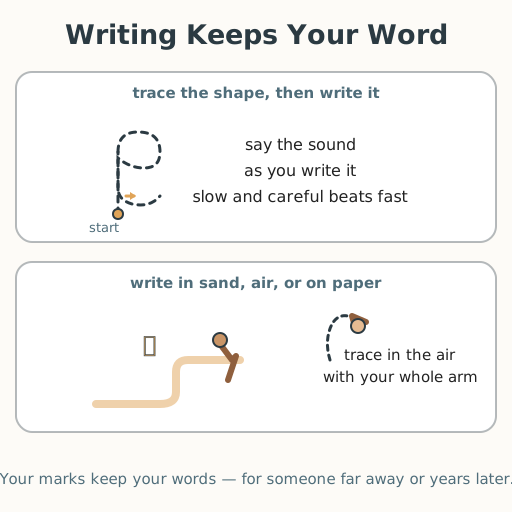
- Watch and trace (10 min). Watch a mark being written slowly. Notice where it starts, which way it moves, and where it stops. Now trace it in the air with your finger, then on your writing surface.
- Write the mark (10 min). Write the mark yourself, several times. Say its sound as you write it. Slow and careful beats fast and messy.
- Write a word (15 min). Put your marks together to write a simple word. Look at the model, then write it. Say the word when you finish — does the writing match what you said?
- Close (5 min). You just kept a word. Every time you write, you are doing what people have done for thousands of years — leaving a mark that lasts.
Differentiation
- Support: Trace over a dotted model; write just one mark today.
- Support (motor-limited): Dictate to a scribe, choose marks on a letter board, type, or trace with a whole-arm, foot, or mouth-stick movement — the mark is the idea, not the hand shape.
- Extension: Write a second word using the same marks, and write your name.
Assessment
- Formative (observation): Can the learner form the marks of their writing system and write a simple word that matches what they say?
- Artifact (portfolio): A sample of the learner’s written marks and word.
Home connection
Write one word at home and show it to someone — tell them what it says, then keep it somewhere safe.