Lesson 13 — My Home Language
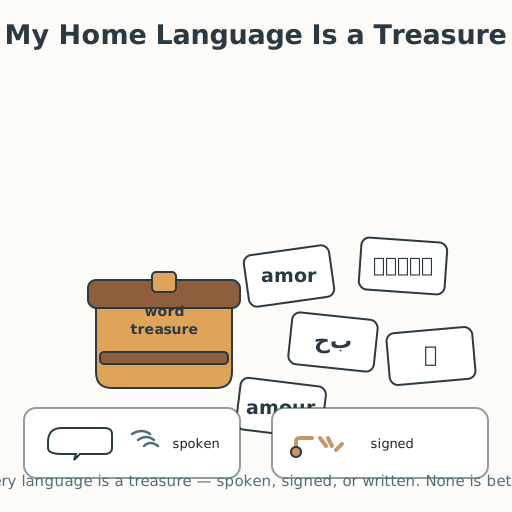
Learners name their home language or languages and share a few words in each with pride, building a class "word treasure" that honors every language as wealth.
Objectives
Objectives
- D04.S4.01.01 Name their home language or languages and share a few words in each with pride.
Essential question
What is my home language, and which of its words can I share with pride?
Key vocabulary
Materials
Standard materials
- A "language treasure" chart or wall · 1 A place to collect words from learners' home languages
- Word cards for home-language words · 1 set Cards learners can write or draw a word on
Low-tech / no-cost
- Voice and memory Just saying home-language words aloud; no cards or chart needed
- A shared spoken circle Pass a word around the circle by voice alone
Enriched / lab & device
- A class "word treasure" book · 1 A growing book of home-language words with pictures and meanings
- A recording device · 1 Record each learner saying their words so the sounds are kept too
Works in different contexts
- large-group Invite each learner to share one home-language word in turn while the facilitator writes or draws it on the treasure chart
- self-directed A learner lists or draws three home-language words and says each aloud with pride, then teaches one to a family member or a mirror
- outdoor-only Sit in a circle outside and share home-language words for things you can see — tree, sky, bird — in each language
- multi-age Older learners help younger ones write or draw their home-language word, and share a word of their own
Lesson 13 — My Home Language
Summary
Learners name their home language or languages and share a few words in each with pride. Together they build a class “word treasure” that treats every language as wealth and no language as better than another.
Objectives
- Name their home language or languages and share a few words in each with pride. (D04.S4.01.01)
Connection
The first words you ever heard were probably in your home language — the language of your family’s lullabies, greetings, and stories. Your home language is a treasure you carry with you, wherever you go. Sharing its words with others is sharing a piece of your home, and every language is a treasure to its people.
Materials
- A “language treasure” chart or wall
- Word cards for home-language words
Preparation
- Prepare the language treasure chart or wall.
- Prepare word cards (or plan for drawing).
- Think of how you will welcome every language, including signed languages and languages that are mostly spoken, not written.
Facilitator note
This lesson is written to the learner (“you”) so it works in a classroom and for a self-directed learner. This is a values-critical lesson: honor each learner’s home language first, and treat multilingualism as wealth, never a deficit. Do not rank languages or scripts, and remember that oral and signed traditions are full languages too — a learner’s language may not have a written form, and that is fine. Celebrate every word with genuine warmth, and let the home language lead. Sharing is by invitation, never requirement: a learner may pass, draw a word instead, or share only with a trusted partner — no one is ever made to perform their language. A learner may also share by signing, pointing to a picture, or using a device; their home language may be a signed or spoken (not written) one, and that is a full language to celebrate.
Procedure
- Gather (5 min). Think: what language or languages does your family speak at home? You might speak one, or more than one. Hold the name of yours in your mind.
- Name your language (10 min). Say the name of your home language aloud to the group. If you speak more than one, name them all. Each name is a treasure.
- Share your words (15 min). Choose two or three words from your home language to share — words for love, food, family, or something you love. Say each word, then tell what it means. Everyone listens and repeats it with care.
- Build the word treasure (10 min). Write or draw your words on a card and add them to the class treasure chart. Look at all the different words gathered there — many languages, all valuable.
- Close (5 min). Your home language is part of who you are. Sharing it makes everyone richer, and no language is better than another — every one is a treasure.
Differentiation
- Support: Share just one word; the facilitator or a peer helps say it slowly and write it.
- Extension: Teach the group a short phrase or a counting rhyme from your home language.
Assessment
- Formative (observation): Can the learner name their home language and share a few of its words with pride?
- Artifact (portfolio): The learner’s word card in the class word treasure.
Home connection
Ask someone at home for one more special word from your home language and bring it to share tomorrow.