Lesson 14 — Greetings in Another Language
Learners learn a greeting and a courtesy word, such as please or thank you, in another language, and practice using them with care and respect.
Objectives
Objectives
- D04.S4.01.02 Learn and use a greeting and a courtesy word, such as please or thank you, in another language.
Essential question
How do I learn and use a greeting and a courtesy word in another language?
Key vocabulary
Materials
Standard materials
- A chart of a greeting and a courtesy word in one or more languages · 1 With the meaning written alongside in the learners' home language
- Greeting cards for practice · 1 set Cards pairing each greeting with a picture of a friendly moment
Low-tech / no-cost
- A spoken greeting from a person who knows the language Learn it by voice and practice; no chart needed
- Gesture to match Pair the greeting with a bow, wave, or smile so the meaning carries
Enriched / lab & device
- Audio clips of the greeting and courtesy word · 1 To hear the sounds from a fluent speaker and practice matching them
- Greeting cards in several languages · 1 set per pair So pairs can practice greeting each other in more than one language
Works in different contexts
- large-group Learn the greeting together in one voice, then move around the room greeting different classmates, saying please or thank you as you go
- self-directed A learner practices the greeting and courtesy word aloud, saying them to a mirror or recording, and checks the meaning
- outdoor-only Practice greeting a partner with a wave or bow outside, saying the greeting and courtesy word as you meet
- multi-age Pair learners so an older learner who knows the language models the sounds, and both practice greeting each other
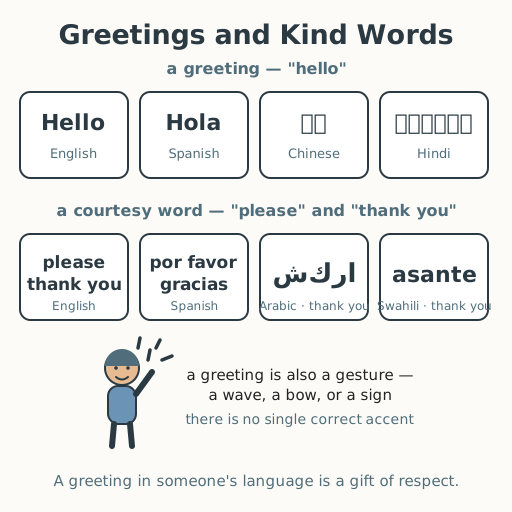
Lesson 14 — Greetings in Another Language
Summary
Learners learn a greeting and a courtesy word — such as please or thank you — in another language, and practice using them with a partner. They discover that a greeting in someone’s language is a gift of respect.
Objectives
- Learn and use a greeting and a courtesy word, such as please or thank you, in another language. (D04.S4.01.02)
Connection
When you greet someone in their own language, you are saying, “I see you, and I want to meet you where you are.” Even one word — hello, please, thank you — opens a door between two people. Learning a greeting in another language is a small act with big kindness, and it is how strangers become neighbors.
Materials
- A chart of a greeting and a courtesy word in one or more languages
- Greeting cards for practice
Preparation
- Choose one or more languages to teach, ideally one spoken by a learner or community member.
- Prepare the chart with the greeting, the courtesy word, and their meanings.
- Plan to have learners practice greeting each other.
Facilitator note
This lesson is written to the learner (“you”) so it works in a classroom and for a self-directed learner. Where possible, learn from a fluent speaker so the sounds are right; if no speaker is available, use a careful recording. There is no “correct” accent — the goal is a respectful attempt, not perfection. Honor the language and its speakers; never reduce a language to a gimmick. Let learners who already know the language be the experts and teachers. Signed languages carry greetings and courtesy words too — a learner may greet in a sign language, or with a gesture, wave, or device; these are greetings, not lesser ones.
Procedure
- Gather (5 min). Think of how you greet a friend. Now imagine greeting someone whose home language is different from yours. Wouldn’t it be kind to say hello in their words?
- Learn the greeting (10 min). Listen to the greeting. Say it slowly together, then at a normal speed. Notice how it feels in your mouth. Repeat it until it feels comfortable.
- Learn the courtesy word (10 min). Now learn a courtesy word — “please” or “thank you.” Say it slowly, then naturally. Learn what it means and when to use it.
- Practice together (15 min). Walk around the room. Greet each classmate with the new greeting, and use the courtesy word — thank someone, or say please when you ask. Trade greetings with as many people as you can.
- Close (5 min). One greeting, one kind word — and you have reached across the space between languages. Every attempt at another’s language is a gift of respect.
Differentiation
- Support: Learn only the greeting today, and use it with a smile and a wave.
- Support (deaf/non-speaking): Greet in a sign language or with a gesture, wave, or device — the respectful reaching-out is the greeting.
- Extension: Learn one more courtesy word, or teach the greeting to someone at home and report back.
Assessment
- Formative (performance): Can the learner say the greeting and the courtesy word in another language and use them with a partner?
Home connection
Greet someone at home with the new greeting tonight, and teach them the courtesy word.