Lesson 12 — Writing My Own Sentence
Learners compose one or more complete sentences about a topic or picture, using a capital letter and an end mark, and share their writing.
Objectives
Objectives
- D04.S3.01.02 Compose one or more complete sentences about a topic or picture, using a capital letter and an end mark.
Essential question
How do I compose my own complete sentence about a topic or picture?
Key vocabulary
Materials
Standard materials
- A picture or topic to write about · 1 A picture card or a class-chosen topic
- Writing surface and tool · 1 per learner Paper and pencil, slate, or sand tray
Low-tech / no-cost
- A real scene to describe Write about something actually in view — no picture card needed
- Any writing surface Paper, slate, or a patch of earth all work
Enriched / lab & device
- A word wall of helpful words · 1 Words learners may want, posted for reference as they compose
- A personal writing journal · 1 per learner A lasting place to keep their composed sentences
Works in different contexts
- large-group Compose a sentence together about a shared picture first, then let each learner write their own about the same picture
- self-directed A learner chooses a picture, says a sentence aloud, writes it, then checks for the capital and end mark
- outdoor-only Choose something outdoors to describe, say a sentence aloud, and write it in the dirt or on a slate
- level-grouped Learners ready for more write two sentences about the same topic, each with a capital and an end mark
Lesson 12 — Writing My Own Sentence
Summary
Learners compose their own complete sentence about a topic or picture, using a capital letter and an end mark, and share what they wrote. This is where all the unit’s writing skills come together.
Objectives
- Compose one or more complete sentences about a topic or picture, using a capital letter and an end mark. (D04.S3.01.02)
Connection
You have ideas every day — what you see on the way to school, what you love to eat, who you play with. Writing lets you catch one idea and pin it to the page as a complete sentence, with a capital to open it and an end mark to close it. Today you will be the author of your own sentence.
Materials
- A picture or topic to write about
- A writing surface and tool
Preparation
- Choose a picture or topic (or a real scene) learners can describe.
- Set out writing surfaces.
- Plan to model composing one sentence aloud, then in writing.
Facilitator note
This lesson is written to the learner (“you”) so it works in a classroom and for a self-directed learner. Model “say it, write it, check it” explicitly, then guide practice (philosophy §13). The convention of a capital letter and end mark belongs to the learner’s writing system; honor other systems’ ways of marking sentences and never rank them. Celebrate every attempt — composing is the goal; inventing spelling is a normal and healthy part of early writing and should not be discouraged here. A learner may compose by dictating to a scribe, typing on any device, or arranging word cards — the sentence, not the handwriting, is the goal.
Procedure
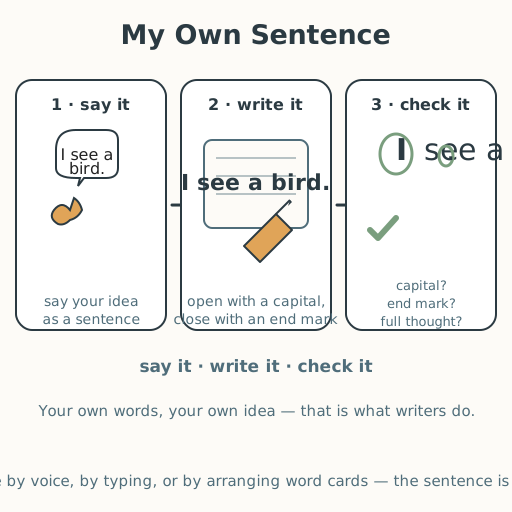
- Gather (5 min). Look at the picture (or topic). Think of one thing it makes you want to say.
- Say it first (5 min). Say your idea aloud as a complete sentence, with a who and a what happened. Say it a second time so it is firm in your mind.
- Write it (15 min). Write your sentence. Open with a capital letter, and finish with an end mark — a period, question mark, or exclamation mark. Write slowly and carefully.
- Check it (10 min). Read your sentence back. Does it have a capital at the start? An end mark at the finish? A full thought in the middle? Fix anything missing.
- Share it (5 min). Read your sentence to a partner or the group. Listen to theirs. Each one is an idea caught on the page.
- Close (5 min). You composed a sentence — your own words, your own idea. That is what writers do.
Differentiation
- Support: Use a sentence frame (“I see ___.”) and write it together, with the capital and end mark pointed out.
- Support (motor-limited): Compose by dictating to a scribe, typing, or arranging word cards, then check the capital and end mark by pointing.
- Extension: Write two sentences about the same topic, each with a capital and an end mark.
Assessment
- Formative (portfolio): Can the learner compose a complete sentence about the topic or picture with a capital letter and an end mark? Keep the sentence as a portfolio artifact.
Home connection
Write one sentence about something at home and read it to your family at a meal.