Lesson 15 — Letters, Sounds & Words Festival
A capstone "language festival" in which learners bring together all eight skills — listening and asking, speaking in sentences, decoding, reading aloud and retelling, writing a sentence, and sharing their home language and a greeting in another.
Objectives
Objectives
- D04.S1.01.01 Listen to a speaker or story and ask or answer a simple question about it.
- D04.S1.01.02 Speak in complete sentences to share an idea or experience so others can understand.
- D04.S2.01.01 Decode simple words by sounding out letters and letter groups in their home writing system.
- D04.S2.01.02 Read a simple text aloud and retell its beginning, middle, and end.
- D04.S3.01.01 Write letters and simple words to express an idea, and read back what they wrote.
- D04.S3.01.02 Compose one or more complete sentences about a topic or picture, using a capital letter and an end mark.
- D04.S4.01.01 Name their home language or languages and share a few words in each with pride.
- D04.S4.01.02 Learn and use a greeting and a courtesy word, such as please or thank you, in another language.
Essential question
How do listening, speaking, reading, writing, and sharing languages all come together?
Key vocabulary
Materials
Standard materials
- A short story or text in the home writing system · 1 To listen to, read aloud, and retell
- Writing surfaces and tools · 1 per learner For composing a sentence
- A "language festival" display space · 1 A place to gather learners' writing and home-language words
Low-tech / no-cost
- A story told aloud and words written in the dirt or on a shared chart No printed materials needed
- Voice and memory The whole festival can happen with voices and remembered stories
Enriched / lab & device
- A recording device · 1 To capture the read-alouds, retellings, and greetings as a class keepsake
- A "language passport" booklet per learner · 1 A small book to collect each learner's sentence and home-language words
Works in different contexts
- large-group Run the festival as stations — listen and ask, read and retell, write a sentence, share languages — with the group rotating through
- self-directed A learner works through the four stations independently, checking off each one in turn — ask, read, write, share a greeting and home-language word
- outdoor-only Hold the festival outside; use the ground for writing, a circle for reading aloud, and the open air for greetings and language sharing
- multi-age Older learners run each station as guides, and younger learners travel between them collecting stamps in their language passport
Lesson 15 — Letters, Sounds & Words Festival
Summary
The unit’s capstone: a “language festival” where learners bring together everything they have practiced — listening and asking questions, speaking in complete sentences, sounding out and reading aloud with a beginning, middle, and end, writing a complete sentence, and sharing their home language and a greeting in another. It is a celebration of every language as wealth.
Objectives
- Listen to a speaker or story and ask or answer a simple question about it. (D04.S1.01.01)
- Speak in complete sentences to share an idea or experience. (D04.S1.01.02)
- Decode simple words by sounding out letters and letter groups in their home writing system. (D04.S2.01.01)
- Read a simple text aloud and retell its beginning, middle, and end. (D04.S2.01.02)
- Write letters and simple words and read back what they wrote. (D04.S3.01.01)
- Compose a complete sentence with a capital letter and an end mark. (D04.S3.01.02)
- Name their home language and share a few of its words with pride. (D04.S4.01.01)
- Learn and use a greeting and a courtesy word in another language. (D04.S4.01.02)
Connection
Over these weeks you have learned to listen, speak, read, write, and greet in more than one language — the same powers people everywhere use to share their inner worlds and build shared ones. Today you put them all together, the way a cook gathers every ingredient into one feast. Language is how we reach each other, and you are now a traveler with many ways to do it.
Materials
- A short story or text in the home writing system
- Writing surfaces and tools
- A “language festival” display space
Preparation
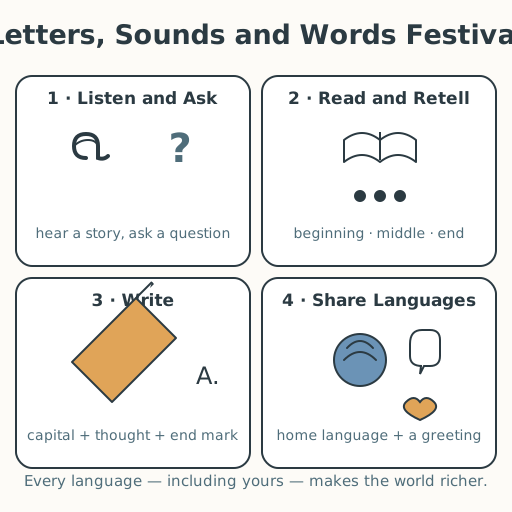
- Set up four festival stations: Listen & Ask, Read & Retell, Write, Share Languages.
- Prepare the story or text, writing surfaces, and display space.
- Plan how learners rotate through stations, and who guides each one.
Facilitator note
This lesson is written to the learner (“you”) so it works in a classroom and for a self-directed learner. This is a summative celebration, not a ranking — assess what each learner can do and celebrate it. Keep every commitment alive: honor home language first, treat multilingualism as wealth, remain script-agnostic, and never rank languages, scripts, or accents. Where possible, invite families or community members to share in the festival. Oral and signed traditions are welcomed as full equals. Every station honors every way of communicating: a learner may read by signing or by pointing while a partner or device voices, ask and answer by signing or pointing, write by dictating or typing, and greet by signing or gesturing — each is a full success at the festival.
Procedure
- Gather (5 min). Welcome to the language festival! You have four things to do today, one at each station.
- Listen & Ask (10 min). Hear a short story. Listen with your whole body, then ask one question about it — or answer a friend’s question in a complete sentence.
- Read & Retell (10 min). Read a simple text aloud, sounding out tricky words as you go. Then retell its beginning, middle, and end in your own words.
- Write (10 min). Write one complete sentence about the festival or the story — capital letter, full thought, end mark. Then read it back and add it to the display.
- Share Languages (10 min). Say the name of your home language and share a word or two with pride. Greet a classmate in another language and use a courtesy word — please or thank you.
- Close (5 min). Look at all you can do now. You listen, speak, read, write, and reach across languages. Every one of them is a treasure, and every language — including yours — makes the world richer.
Differentiation
- Support: Travel with a partner or guide who reads the prompts aloud; complete one task per station at your own pace.
- Extension: Add a second sentence at the writing station, or teach the group a phrase in your home language.
Assessment
- Summative (performance/portfolio): Across the four stations, can the learner ask or answer a question, read and retell a text, compose a complete sentence, and share a home-language word and a greeting in another language? Collect each learner’s written sentence and word card as portfolio artifacts.
Home connection
Invite your family to hear you read, see your sentence, and teach them the greeting you learned — then celebrate together.