Lesson 02 — Reading and Writing Numbers to 120
Learners discover that the ten digits 0-9 can be combined to write every number up to 120, and that a written number can be read by looking at its tens and its ones. They honor these numerals as one counting system among many that humans have used.
Objectives
Objectives
- D05.S1.01.01 Count, read, and write whole numbers up to 120 and use them to say how many objects are in a group.
Essential question
How do the marks we write stand for numbers, and how do I read and write them up to 120?
Key vocabulary
Materials
Standard materials
- Sand tray, paper, or slate with a writing tool · 1 per learner Any surface to trace and write numerals with a finger or tool
- Cards showing numerals 0-9 · 1 set One card per digit, large enough to see and trace
- Bundles of ten and loose ones · per learner or pair From the previous lesson, to connect tens and ones to written numbers
Low-tech / no-cost
- The ground and a stick Write numerals large in sand, dirt, or dust; trace with the whole arm
- Fingers and voice Show a number with ten-fingers-plus-ones and say it aloud
Enriched / lab & device
- A number chart to 120 · 1 per learner or pair A grid to find and read numbers aloud, by rows of ten
- Durable numeral cards and a tray · 1 set per pair Sturdy digit cards (0-9) to build any number up to 120 and read it back
Works in different contexts
- large-group Write one number at a time large for all to see, say it together, and have the whole group trace it in the air
- self-directed A learner builds a number with digit cards or by writing, then reads it aloud and checks it against a 120 chart
- outdoor-only Write numerals in the earth with a stick or a wet finger, saying each number as it is written
- multi-age Older learners read and write two- and three-digit numbers fluently and coach younger ones in forming each digit
Lesson 2 — Reading and Writing Numbers to 120
Summary
Learners meet the ten digit marks 0–9 and learn that these marks combine to write every number up to 120. They connect a written number to its meaning — tens and ones — and practice forming and reading numerals in sand, air, and on paper. They learn that these numerals are one system among many humans have used.
Objectives
- Count, read, and write whole numbers up to 120 and use them to say how many objects are in a group. (D05.S1.01.01)
Connection
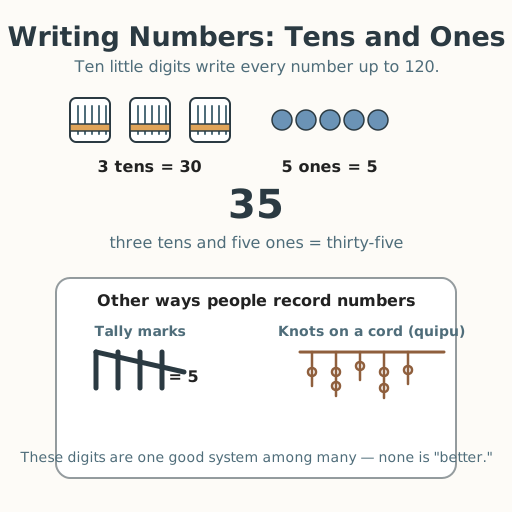
Everywhere people keep count, they need a way to record it: a tally scratched on wood, knots tied in a cord, marks drawn in the dust. The digits you will write today — 0, 1, 2, 3, 4, 5, 6, 7, 8, 9 — traveled from mathematicians in India, through the Arabic-speaking world, to the rest of the world, which is why they are called Hindu-Arabic numerals. They are one good way among many; what matters is that everyone who sees the marks can agree on what they mean.
Materials
- A sand tray, paper, or slate with a writing tool
- Cards showing the digits 0–9
- Bundles of ten and loose ones from the last lesson
Preparation
- Prepare digit cards 0–9 and a writing surface for each learner.
- Have bundles of ten and loose ones ready to connect written numbers to real quantities.
- Plan where to write numbers large for everyone to see.
Facilitator note
This lesson is written to the learner (“you”). The key commitment is script awareness without ranking: these Hindu-Arabic digits are taught because this curriculum uses them, but they are honored as one system among many — tally marks, knot records like the Inka quipu, and other numeral traditions all worked for the people who used them, and none is “better.” Teach the one new skill — combining digits into a written number and reading tens-and-ones — as a worked example first. Connect every written number to a real quantity, never a bare symbol. For a learner who is blind or low-vision, form numerals with raised materials (string, clay, sand-glue) so the shape can be felt; for a learner who is Deaf or hard of hearing, read numbers in sign or by matching digits to bundles. A learner who does not use a speaking voice reads by pointing, tracing, or holding up digit cards. Never compare handwriting quality to smartness; messy numerals carry the same meaning as neat ones.
Procedure
- Gather — recall counting (5 min). Yesterday you counted to one hundred twenty. Count by tens together: ten, twenty … one hundred twenty. Today we learn the marks that write those numbers down.
- Meet the ten digits (8 min). Look at the digit cards 0 through 9. Say each one. Trace each shape in the air with your whole arm — where it curves, where it stands straight. These ten marks are the building blocks of every number.
- Worked example — write tens and ones (10 min). Watch and help: here are three bundles of ten and five loose ones. Three tens is thirty, and five ones is five — so we write 35. The “3” says “three tens,” the “5” says “five ones.” Say it: thirty-five.
- Guided practice — build and read (12 min). With your bundles and loose ones, build a number, then write it. Start small: two tens and three ones is 23. Then four tens and zero ones is 40. Keep going as high as you like, up to one hundred twenty.
- Check with a partner (7 min). Show your written number to a friend. Can they read it? Can they build your number from bundles to check? Trade and try again. Reading a number someone else wrote is how you know your marks are clear.
- Close (3 min). Ten little marks can write every number up to one hundred twenty — and far beyond. You now hold a way of recording numbers that people share across the world.
Differentiation
- Support: Focus on reading and writing numbers to 20 today; build to higher numbers a few at a time, always with real bundles beside the numeral.
- Support (blind/low-vision): Use raised or textured digits; “write” by shaping the number in clay or string and reading it with the hands.
- Support (motor): “Write” without fine grip — point to digit cards, arrange large raised digits, or direct a partner to write while the learner reads the number back; tracing with the whole arm in air or sand needs no finger control.
- Extension: Write a number for a friend to read without seeing your bundles, then check by building it; or write the number just before and just after a given number.
Assessment
- Formative (observation): Can the learner write a two-digit (and some three-digit) number up to 120 and read it back, connecting the digits to tens and ones?
- Formative (matching): Can the learner match a written number to the correct group of tens and ones?
Home connection
At home, write the ages of everyone in your family, or count something and write the number you got — then read it to a grown-up.
Resources
- Ifrah, G. (2000). The Universal History of Numbers: From Prehistory to the Invention of the Computer. Wiley. (The origin and spread of Hindu-Arabic numerals and other numeral systems.)
- Zaslavsky, C. (1999). Africa Counts: Number and Pattern in African Cultures (3rd ed.). Lawrence Hill Books. (Tally marks, knot records, and counting systems across cultures.)