Lesson 03 — Saying How Many
Learners discover the cardinal rule of counting — the last number said is how many there are — and practice saying a total and comparing two groups with "more," "fewer," and "the same," estimating before they count.
Objectives
Objectives
- D05.S1.01.01 Count, read, and write whole numbers up to 120 and use them to say how many objects are in a group.
Essential question
When I count a group of things, how do I know — and say — how many there are?
Key vocabulary
Materials
Standard materials
- Several collections of small objects · 2-3 piles per learner or pair Pebbles, seeds, shells, or beans, in different sizes (some under 20, some up to 120)
- Two cups or trays · 2 per learner or pair To hold a counted group while comparing it with another
Low-tech / no-cost
- Found objects and the ground Gather two handfuls of natural objects and count each onto a patch of cleared ground
- Voice and body Count aloud and hold up the number with fingers or by moving for each count
Enriched / lab & device
- Number cards to 120 · 1 set To place beside a counted group and label its total
- A counting mat with a marked line · 1 per learner A mat where objects are placed one by one, ending at the total
Works in different contexts
- large-group Count two big class collections together as one voice, then compare them; let different learners lead each count
- self-directed A learner counts each pile, labels it with a number card, and compares the two totals, checking by recounting
- outdoor-only Count two natural collections — stones versus leaves — and decide which has more by counting each
- level-grouped Learners still building to 20 compare small piles; those fluent compare piles near 120 and estimate first
Lesson 3 — Saying How Many
Summary
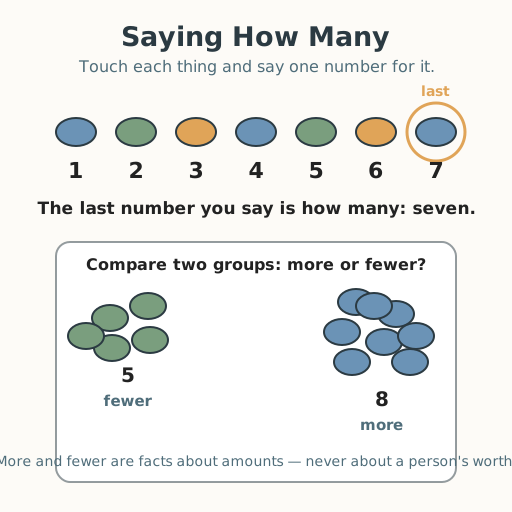
Learners discover that when you count a group, the last number you say is the answer to “how many.” They practice counting collections of different sizes, saying the total, and comparing two groups with “more,” “fewer,” and “the same,” making a guess (an estimate) before they count.
Objectives
- Count, read, and write whole numbers up to 120 and use them to say how many objects are in a group. (D05.S1.01.01)
Connection
“How many?” is one of the oldest questions people ask. A cook wants to know if she has enough eggs; a child wants to know if she has more shells than her friend; a farmer wants to know how many seeds he planted. The answer to “how many” is not a feeling — it is a number you can find by counting, and the last number you say is the total. Counting turns “a lot” or “a little” into something everyone can agree on.
Materials
- Two or three collections of small objects in different sizes
- Two cups or trays for comparing counted groups
Preparation
- Prepare collections of different sizes: some under 20, some larger, up to 120.
- Give each learner or pair two cups or trays for side-by-side comparison.
- Plan to model estimating (“I think about 40”) before counting.
Facilitator note
This lesson is written to the learner (“you”). The one idea that makes counting meaningful is cardinality — the last number said names the whole group — and it is best taught with a worked example, then practiced with real objects. Always pair “how many” with a real answer, and treat estimating as a respected thinking move, not a wrong answer: “I think about 40 — let’s count and see.” Comparing groups teaches that more and fewer are facts about quantities, never about a person’s worth. For learners who are Deaf or hard of hearing, count in sign or by touching each object; for learners who are blind or low-vision, move objects one by one into a cup so the count grows by feel and sound. A learner who does not speak can show the total by holding up a number card, tapping that many times, or pointing. No ranking by speed or by how high a learner can count; a correct total is correct however it was reached.
Procedure
- Gather — recall tens and ones (5 min). You can count to one hundred twenty and write the numbers. Now we answer the big question: how many?
- Worked example — the last number is the total (8 min). Watch and help: count a pile together, touching each thing — one, two, three … seven. The last number you said, seven, is how many there are. Say it: “There are seven.”
- Estimate first (5 min). Before you count your next pile, make a guess — an estimate — about how many it is. Estimates are not right or wrong; they are your thoughtful first guess. Say or sign your estimate.
- Count and say how many (12 min). Count each of your collections, touching each thing once. Say the last number as your answer: “There are ___.” Label the pile with a number card if you have one.
- Compare two groups (10 min). Put two counted groups side by side. Which has more? Which has fewer? Are they the same? Count again to be sure — a careful recount is how you check yourself.
- Close (5 min). Share: what was your biggest total today? Remember, “how many” always has a real answer, and counting is how you find it — for everyone, at any speed.
Differentiation
- Support: Use piles under 10 first, then under 20; say the total together and touch each object while counting.
- Support (motor): A partner moves each object while the learner counts by voice or sign, or indicates each item with eye-gaze or a pointer.
- Extension: Compare three groups and order them from fewest to most, or write the number sentence “23 is more than 19.”
Assessment
- Formative (observation): Does the learner touch each object once, say the last number as the total, and compare two groups correctly with “more,” “fewer,” or “the same”?
- Self-assessment: Can the learner recount a group and notice whether the two counts match?
Home connection
At home, ask “how many?” about three different things — spoons, shoes, books — and count each one with a grown-up, then say which has more.
Resources
- Clements, D. H., & Sarama, J. (2014). Learning and Teaching Early Math (2nd ed.). Routledge. (Cardinality — the last number named is the size of the set — as a foundational counting principle.)