Lesson 04 — Joining Two Groups: Adding Within 20
Learners discover that adding means joining two groups into one, count the new total with objects and by counting on, and meet the written number sentence — with the plus and equals signs — always with real things in their hands first.
Objectives
Objectives
- D05.S1.01.02 Add and subtract within 20 using objects, drawings, or counting strategies, and explain what the operation means.
Essential question
What happens to a number when I join two groups together, and how do I write it?
Key vocabulary
Materials
Standard materials
- Two cups or trays of small objects · per learner or pair Pebbles, seeds, beans, or counters, up to 10 in each cup
- Paper or slate and a writing tool · per learner To write the number sentence after joining
Low-tech / no-cost
- Two piles of found objects and the ground Join two piles of seeds, stones, or sticks and count the total in the dirt
- Fingers and voice Show each group on two hands, then join them and count on
Enriched / lab & device
- Ten-frames · 2 per learner or pair To fill and see how joining two groups grows toward twenty
- Number sentence cards · 1 set Cards with "+" and "=" to build written sentences beside the objects
Works in different contexts
- large-group Join two class collections together in one basket while the whole group counts the total aloud
- self-directed A learner joins two piles, counts the total, writes the number sentence, and checks it by separating the piles again
- outdoor-only Gather two handfuls of natural objects, join them into one pile, and count the total on the ground
- multi-age Older learners write the number sentence while younger ones join the objects and count the total, then compare answers
Lesson 4 — Joining Two Groups: Adding Within 20
Summary
Learners discover that adding means joining two groups into one bigger group. They join real objects, count the total, practice the “count on” strategy, and meet the written number sentence with the plus and equals signs — always with real things in hand before the symbols.
Objectives
- Add and subtract within 20 using objects, drawings, or counting strategies, and explain what the operation means. (D05.S1.01.02)
Connection
A fisher pours two nets of fish into one basket; a beader joins the blue beads and the red beads she has threaded; a cook stirs two handfuls of beans into one pot. In every one of these, two groups become one, and the new group is bigger than either group alone. That joining is called adding, and people in every land do it every day — even without ever writing a sign for it.
Materials
- Two cups or trays of small objects (up to 10 in each)
- Paper or slate and a writing tool
Preparation
- Give each learner or pair two cups of objects and a writing surface.
- Plan to model one joining problem fully before learners try their own.
- Prepare a few joining story-starters (“Two fish … then three more …”).
Facilitator note
This lesson is written to the learner (“you”). Adding is a skill, so teach it with a worked example and guided practice before independent work (philosophy §13). The one new idea is that two groups joined become one group whose total you can count; the written signs (+, =) come after the objects, never before. Keep sums within 20. Use the “count on” strategy as one tool, not the only one — some learners count all, and that is fine; both are correct. The number sentence is a record of what the hands did, not a rule to memorize. For learners who are Deaf or hard of hearing, act out joining in sign or by moving objects; for learners who are blind or low-vision, join two bowls of objects and count the total by touch and sound. A learner who does not speak can show the total by pointing to a number card or holding up that many fingers. Never rank learners by how fast they add; a correct total, reached any way, is correct.
Procedure
- Gather — recall counting (5 min). You can count and say “how many.” Today we learn what happens when two groups come together into one. That is called adding.
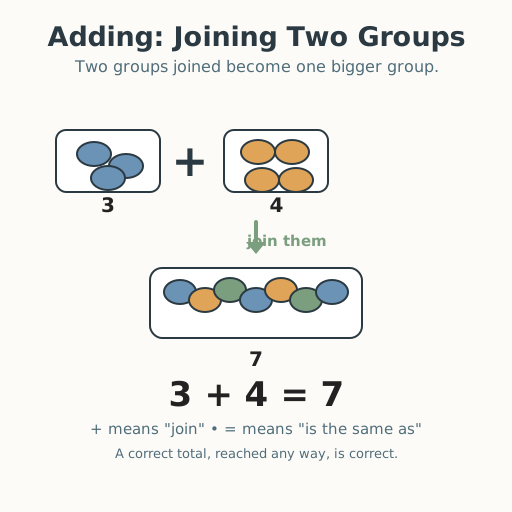
- Worked example — join two groups (10 min). Watch and help: here is a cup with 3 pebbles and a cup with 4 pebbles. Pour them together into one pile. Count them: 1, 2, 3, 4, 5, 6, 7. Seven! Joining 3 and 4 makes 7.
- Meet the signs (5 min). We can write what we just did: 3 + 4 = 7. The plus sign + means “join.” The equals sign = means “is the same as.” Read it together: “three plus four equals seven.”
- Count on (10 min). Try a fast way: start with the bigger group and count on. With 5 beans and 3 beans, say “five,” then count on — six, seven, eight. So 5 + 3 = 8. Try “counting on” with your own two groups.
- Your turn — join and record (12 min). Join your two cups, count the total, and write your number sentence. Check yourself: split the pile back into two groups and see if you get your starting numbers. Do they match?
- Close (3 min). Adding is joining. Two groups become one, and the total is always there to count. Tomorrow we learn the opposite — taking away.
Differentiation
- Support: Keep both groups small (under 5 each) and count all the objects together; write the sentence only after the total is counted.
- Support (motor): A partner joins the objects while the learner counts and directs; use large, easy-to-grip objects.
- Extension: Write three different number sentences that all make the same total (for example, 4 + 4, 5 + 3, 6 + 2 all make 8), and join objects to prove each one.
Assessment
- Formative (observation): Can the learner join two groups, find a total within 20, and record it as a number sentence?
- Formative (oral): Can the learner explain in their own words that adding means joining two groups into one?
Home connection
At home, join two groups of things — spoons and forks, or two piles of beans — and tell a grown-up the total, then write the number sentence together.
Resources
- Carpenter, T. P., Fennema, E., Franke, M. L., Levi, L., & Empson, S. B. (2015). Children’s Mathematics: Cognitively Guided Instruction (2nd ed.). Heinemann. (Joining problems as the foundation of addition, and children’s counting strategies.)