Lesson 06 — What Add and Subtract Mean
Learners tell joining and taking-away stories apart, act each one out with real objects, and explain in their own words what add and subtract mean, recording each story as a number sentence. The emphasis is on *meaning*, not just answers.
Objectives
Objectives
- D05.S1.01.02 Add and subtract within 20 using objects, drawings, or counting strategies, and explain what the operation means.
Essential question
How do I tell a joining story from a taking-away story, and how do I act out and explain each one?
Key vocabulary
Materials
Standard materials
- Small objects · up to 20 per learner or pair Pebbles, seeds, beans, or counters for acting out stories
- Paper or slate and a drawing tool · per learner To draw the story and write the number sentence
Low-tech / no-cost
- Found objects and the ground Act out joining and taking-away stories with seeds, stones, or sticks in the dirt
- Voice and body Act out the story with movements — hands coming together to join, hands moving apart to take away
Enriched / lab & device
- Story cards with simple join/take-away situations · 1 set Picture-and-word cards, each with one joining or taking-away story
- A small "story mat" with two circles · 1 per learner or pair Two marked circles to place objects in and out of while acting out the story
Works in different contexts
- large-group Act out one joining and one taking-away story as a whole group, with the class calling out the action and the total
- self-directed A learner reads or draws a story, acts it out with objects, decides "join or take away?", and writes the sentence
- outdoor-only Tell joining and taking-away stories about gathering and letting go of natural things, and act them out on the ground
- multi-age Older learners tell the story aloud while younger ones act it out with objects, then together decide join or take away
Lesson 6 — What Add and Subtract Mean
Summary
Learners practice telling a joining story from a taking-away story, act each one out with real objects, and explain in their own words what adding and subtracting mean. They record each story as a number sentence. The focus is on the meaning of the operation, not just finding answers.
Objectives
- Add and subtract within 20 using objects, drawings, or counting strategies, and explain what the operation means. (D05.S1.01.02)
Connection
Every day is full of joining and taking-away stories. In the morning you put on socks — you join each sock to your feet. At a meal you share food out — some takes away from the pot and lands on plates. A flock of birds lands in a tree (joining), then some fly off (taking away). When you can tell these two stories apart, you understand the very heart of numbers: things grow by joining and shrink by taking away.
Materials
- Small objects for acting out stories (up to 20)
- Paper or slate and a drawing tool
Preparation
- Prepare a few simple joining and taking-away stories about real life.
- Give each learner or pair objects and a drawing surface.
- Plan to model deciding “join or take away?” aloud before learners try.
Facilitator note
This lesson is written to the learner (“you”). It is a meaning lesson: the goal is that a learner can hear a story and say whether it is joining (add) or taking away (subtract), then act it out and explain it in their own words. Use worked examples and guided practice (philosophy §13). Model your own thinking aloud: “The birds came to the tree — that is joining, so I add.” Draw the story before writing the sentence, so the picture carries the meaning. Keep numbers within 20. The learner’s own words are the measure of understanding, and there is no single “correct” way to explain — every clear explanation is honored. For learners who are Deaf or hard of hearing, tell the story in sign or pictures and let the learner act it out with objects; for learners who are blind or low-vision, tell the story aloud and act it out with real objects by touch. A learner who does not speak explains by pointing, signing, drawing, or moving objects — all of these are explaining. Never rank explanations; each learner’s words are their own.
Procedure
- Gather — recall the two moves (5 min). You have met two math moves: joining (adding) and taking away (subtracting). Today we practice telling them apart and saying what each one means.
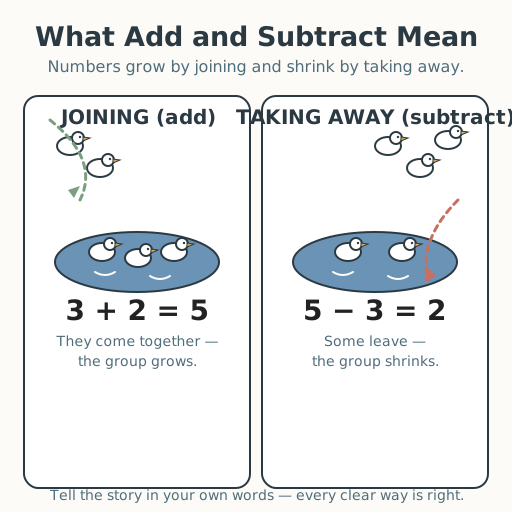
- Worked example — hear and decide (10 min). Listen to a story: “Three ducks swam in the pond. Two more ducks landed.” Is this joining or taking away? It is joining — the ducks came together. Act it out with objects: 3 and 2 make 5. Write 3 + 2 = 5. Now listen: “Five ducks swam in the pond. Three flew away.” This is taking away — some left. Act it out: 5 − 3 = 2.
- Listen and act (12 min). Hear more stories, one at a time. For each, first say “join” or “take away,” then act it out with your objects, then write the number sentence. Does the story match your sentence?
- Explain it in your own words (10 min). Tell a partner (or draw): what does adding mean? What does subtracting mean? Use your own words — “adding is putting together,” “subtracting is taking some away” — any clear way is right.
- Check together (5 min). Trade one story with a friend. Act out their story and write the sentence. Do you both agree on join or take away? If not, act it out again together and talk it through.
- Close (3 min). Numbers grow by joining and shrink by taking away. When you can explain that in your own words, you truly understand it — and that matters more than being fast.
Differentiation
- Support: Use only two very clear stories (one join, one take away) and act them out with the learner; accept a drawing as the explanation.
- Support (non-speaking): The learner explains by moving objects or drawing; acting out the story is the explanation.
- Extension: Write a joining story and a taking-away story that use the same numbers (for example, 6 and 3), and show how the stories are opposites.
Assessment
- Formative (observation): Can the learner hear a story, identify it as joining or taking away, act it out, and record a matching number sentence?
- Formative (oral/drawn): Can the learner explain in their own words what adding and subtracting mean?
Home connection
At home, tell a grown-up one “joining” story and one “taking-away” story from your day, and act each one out with small objects together.
Resources
- Carpenter, T. P., Fennema, E., Franke, M. L., Levi, L., & Empson, S. B. (2015). Children’s Mathematics: Cognitively Guided Instruction (2nd ed.). Heinemann. (Joining and separate problem types and the importance of children explaining their own strategies.)