Lesson 07 — Repeating Patterns: Identify and Extend
Learners find the repeating part — the core — of patterns made of objects, sounds, and colors, and practice extending them. They move from copying patterns (which they learned in Kindergarten) to identifying and continuing them on their own.
Objectives
Objectives
- D05.S2.01.01 Identify, extend, and create repeating patterns using objects, sounds, or colors, and tell the rule of the pattern.
Essential question
How do I spot the part of a pattern that repeats, and how do I keep the pattern going?
Key vocabulary
Materials
Standard materials
- Collections of objects in two or three kinds · 1 set per learner or pair Seeds, shells, buttons, or leaves in two or three colors or kinds, for building patterns
- Paper or slate and a drawing tool · per learner To draw and extend a pattern
Low-tech / no-cost
- Found objects and the ground Build repeating patterns with stones, leaves, and seeds in the dirt
- Voice and body Clap, tap, and step repeating patterns with the voice and body
Enriched / lab & device
- Pattern strips and cards · 1 set Cards showing pattern cores to continue, in color and in sound symbols
- Beads or loom thread (optional) · per learner or pair Real beading or weaving to build and extend a color pattern
Works in different contexts
- large-group Build one big pattern across the floor, and have the whole group say the core together, then continue it around the room
- self-directed A learner builds a pattern, finds its core, extends it, and draws what comes next
- outdoor-only Make repeating patterns from natural objects — stone, leaf, stone, leaf — and extend them along a path
- multi-age Older learners model finding the core and continuing a longer pattern; younger learners copy and extend a simple one
Lesson 7 — Repeating Patterns: Identify and Extend
Summary
Learners move beyond Kindergarten’s “copy the pattern” to finding the repeating part — the core — of patterns made of objects, sounds, and colors, and continuing the pattern on their own. They learn that every repeating pattern has a part that comes again and again.
Objectives
- Identify, extend, and create repeating patterns using objects, sounds, or colors, and tell the rule of the pattern. (D05.S2.01.01)
Connection
Patterns are everywhere people live and make things. A weaver passes the shuttle over and under, over and under; a beadworker threads red, blue, red, blue; a drummer taps boom-boom-clap, boom-boom-clap; a tiler lays a mosaic of light stone, dark stone, light stone, dark stone. From one end of the Earth to the other, people find the same secret: something repeats. When you can spot the repeating part, you can keep the pattern going as far as you like.
Materials
- Collections of objects in two or three kinds (seeds, shells, buttons, leaves)
- Paper or slate and a drawing tool
Preparation
- Prepare collections with two or three clearly different kinds or colors.
- Build one starter pattern to model finding the core.
- Clear space for body-and-voice pattern games.
Facilitator note
This lesson is written to the learner (“you”). It spirals up from Kindergarten’s “copy a pattern” to identifying the core and extending it — the new skill. Teach it with a worked example (philosophy §13): say the core aloud, mark where it ends, and show it repeating. Patterns can live in objects, sounds, colors, or movement — use all of them so every body can join. There is no “wrong” place to find a pattern; if a learner’s core is different from yours but truly repeats, honor it. For learners who are Deaf or hard of hearing, use visible patterns (objects, colors, movement) and sign or clap with a partner; for learners who are blind or low-vision, use sound and touch patterns — beats, and rows of textured objects. A learner who does not speak continues a pattern by pointing to or placing the next object. Pattern-making is a joy, not a race.
Procedure
- Gather — recall shapes of things (5 min). Last year you copied patterns — red, blue, red, blue. Today we learn the secret inside a pattern: the part that repeats, called the core.
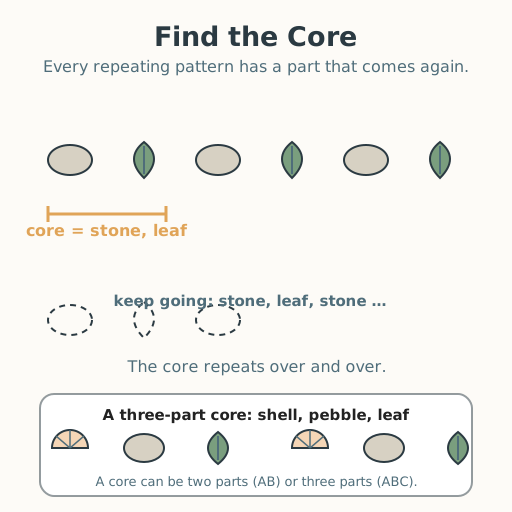
- Worked example — find the core (10 min). Watch and help: here is a pattern — stone, leaf, stone, leaf, stone, leaf. What comes again and again? It is “stone, leaf.” That is the core. Say it: “stone, leaf — stone, leaf.” The core repeats over and over.
- Extend the pattern (10 min). Keep the pattern going. After “stone, leaf, stone, leaf,” what comes next? A stone! Then a leaf. Say the core as you place each thing, and the pattern will carry you forward.
- Patterns in sound and body (10 min). Clap a pattern: clap-clap-pat, clap-clap-pat. What is the core? “clap-clap-pat.” Continue it together. Now make a pattern with your body — step-step-hop, step-step-hop — and keep it going.
- Your turn — build and extend (7 min). Build your own repeating pattern with your objects. Find its core, say it, and extend it until it is long. A friend can check by finding the core in your pattern.
- Close (3 min). Every repeating pattern has a core — a part that comes again. Finding the core is how you see the pattern, and continuing it is how you make the pattern your own.
Differentiation
- Support: Use a two-part core (AB) only; say the core together and place the next item hand-over-hand if needed.
- Support (blind/low-vision): Use sound and touch patterns — two claps and one pat, or a row of two round pebbles and one flat leaf — felt and heard.
- Support (motor / seated): Make patterns that need no large movement — tap a table or your lap, blink, or direct a partner to place objects or step for you; the pattern is still the learner’s own, and “step-step-hop” becomes a tap-tap-pause.
- Extension: Build a three-part core (ABC) or a pattern with two attributes (big red, small blue), and find the core of a friend’s long pattern.
Assessment
- Formative (observation): Can the learner find the repeating core of a pattern and extend it correctly with objects, sounds, or colors?
- Formative (oral): Can the learner say the core of a pattern aloud or in sign?
Home connection
At home, find a repeating pattern on cloth, a wall, or a song, and tell a grown-up what the repeating part is — then continue it together.
Resources
- Clements, D. H., & Sarama, J. (2014). Learning and Teaching Early Math (2nd ed.). Routledge. (Repeating-pattern knowledge as a precursor to algebraic reasoning, including identifying the unit of repeat.)
- Zaslavsky, C. (1999). Africa Counts: Number and Pattern in African Cultures (3rd ed.). Lawrence Hill Books. (Pattern in weaving, beading, and design across cultures.)