Lesson 04 — What Living Things Need
Learners discover that every living thing needs four things to stay alive and healthy — food, water, air, and shelter — and that caring for living things means making sure they have them.
Objectives
Objectives
- D06.S2.01.01 Observe and describe what living things need to stay alive (food, water, air, and shelter).
Essential question
What do living things need to stay alive and healthy?
Key vocabulary
Materials
Standard materials
- Picture cards of living things and their needs · 1 set A plant, a puppy/dog, a chick/hen, a fish, a bird, and a person — each with food, water, air, shelter
- Paper and crayons · per learner
Low-tech / no-cost
- Body and voice Act out a plant drinking water or an animal finding shelter; no cards needed
- A window or doorway to breathe and feel air Notice your own breath to feel the need for air
Enriched / lab & device
- A real plant to care for · 1 A classroom plant learners can water and watch over the weeks
- Pictures of living things in different homes · 1 set A fish in water, a bird in a nest, a camel in the desert — different needs, same four
Works in different contexts
- large-group Hold up each living thing and have the whole group call out its four needs together before sorting cards in pairs
- self-directed A learner matches each living thing to its four needs and draws one living thing with what it needs
- outdoor-only Find a living thing outside (plant, bird, insect) and wonder what it needs right now — point to food, water, air, shelter nearby
- level-grouped Learners who can compare talk about how two living things' shelters differ; learners still learning match just one living thing to its needs
Lesson 4 — What Living Things Need
Summary
Learners discover the four things every living thing needs to stay alive and healthy: food, water, air, and shelter. They match each need to a plant, an animal, and a person, and learn that caring for living things means making sure they have what they need.
Objectives
- Observe and describe what living things need to stay alive (food, water, air, and shelter). (D06.S2.01.01)
Connection
You get thirsty and you drink water. You get hungry and you eat. You breathe air all day without thinking about it, and you sleep somewhere warm and safe. Every living thing — a plant on a windowsill, a fish in a river, a camel in the desert, a person anywhere on Earth — needs the same four things to stay alive: food, water, air, and shelter.
Materials
- Picture cards of living things and their needs (a plant, a puppy/dog, a chick/hen, a fish, and a person — each with food, water, air, and shelter)
- Paper and crayons
Preparation
- Prepare cards: a few living things, and cards showing food, water, air, and shelter for each.
- Plan a simple way to act out each need (drinking, breathing, finding shelter).
Facilitator note
This lesson is written to the learner (“you”). Keep it gentle and concrete. Use the word “alive and healthy,” and let learners lead with their own lives. Be sensitive: a learner may live somewhere food, water, or a safe home is not always certain. Hold this without shame — say that everyone needs these four things, and that people everywhere work hard so that all living things can have them; that is why caring for each other and the Earth matters. Different living things meet the four needs differently (a fish “breathes” water’s air; a cactus finds water in dry places) — let that be wonder, not a quiz. Honor every body: act, point, or draw rather than speak if that is easier.
Procedure
- Gather (5 min). Think of a plant or an animal you know — a pet, a bird you have seen, a fish, a farm animal, or a wild creature near your home. What does it need every day so it can stay alive and healthy?
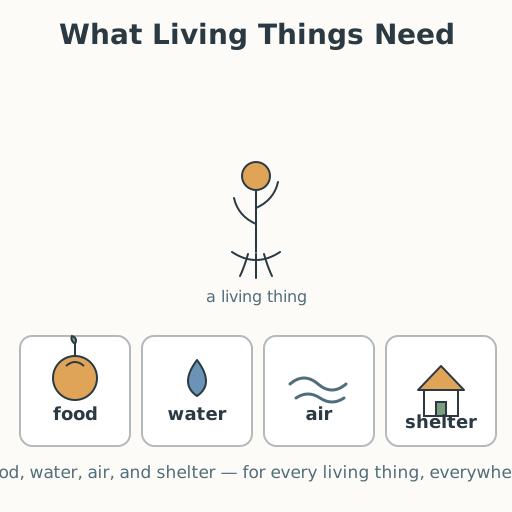
- The four needs (10 min). There are four things every living thing needs: food to grow, water to drink, air to breathe, and shelter — a safe place to rest and be protected. Take a big breath in. Feel the air. That is a need, right now.
- Match needs to living things (15 min). For each living thing — the plant, the puppy, the chick, the fish, the bird, and you — point to its food, its water, its air, and its shelter. A plant’s food comes from light and soil; a fish’s shelter is the water itself; a bird’s shelter is a nest. Act out one need for one living thing.
- Draw one living thing and its needs (10 min). Draw one living thing and the four things it needs around it.
- Close (5 min). Food, water, air, and shelter — every living thing, everywhere. When we care for living things, we make sure they have them.
Differentiation
- Support: Focus on one living thing (the plant or the puppy) and match its four needs one at a time.
- Support (non-speaking): Point to the need cards and to the living thing to show the match.
- Support (blind/low-vision): Use real objects and touch or spoken description instead of picture cards — feel a leaf (a plant), water, air on the skin, and a soft “shelter” cloth, and match each need by touch and voice.
- Extension: Compare two living things and name how their shelter (or food) is different.
Assessment
- Formative (observation): Can the learner name (or point to) the four needs and match at least two of them to a living thing?
- Artifact (portfolio): The “living thing and its needs” drawing.
Home connection
At home, help care for one living thing — a plant, a pet, or even a seed — by giving it one thing it needs (water, food, or a safe spot). Tell a grown-up which need you gave it.
Resources
- BBC Bitesize (KS1 Science), “What do animals need to survive?” — animals need air, water, shelter, and food to survive. https://www.bbc.co.uk/bitesize/topics/z6882hv/articles/zx38wmn
- BBC Bitesize (KS1 Science), “What does a plant need to grow?” — plants need water, light, the right temperature, air, and time; they use light to make food in their leaves and take up water and nutrients through their roots. https://www.bbc.co.uk/bitesize/topics/zpxnyrd/articles/zkp2jsg