Lesson 05 — Living and Nonliving
Learners sort things into living and nonliving and learn three things living things do — grow, move, and reproduce — always with gentle care for the creatures they meet.
Objectives
Objectives
- D06.S2.01.02 Sort things into living and nonliving, and tell what living things do (grow, move, and reproduce).
Essential question
How can I tell what is living and what is not?
Key vocabulary
Materials
Standard materials
- A mixed collection to sort · 1 set A seed or plant, a picture of an animal, a rock, a pencil, a toy, water, a leaf
- Two sorting mats or hoops · 2 One labeled "living," one "nonliving"
- Paper and crayons · per learner
Low-tech / no-cost
- Body and voice Act out "grow" (curl small, stretch tall) for living, and "stays the same" for nonliving; no mats needed
- Found things from outside A leaf, a stone, a stick, a feather — sort with your hands
Enriched / lab & device
- A live plant or classroom pet to observe · 1 Watch it grow or move over days to see "living" in action
- A magnifying lens · a few to share Look closely at a leaf and a rock to compare
Works in different contexts
- large-group Sort the whole collection together on two big mats, then let pairs sort their own small pile
- self-directed A learner sorts a pile into living and nonliving and tells (or draws) the rule they used
- outdoor-only Gather a leaf, a stone, a stick, and a feather outside; sort them and explain each choice
- level-grouped Learners still learning sort by one clue (it grows); learners who can explain sort by all three clues (grow, move, reproduce)
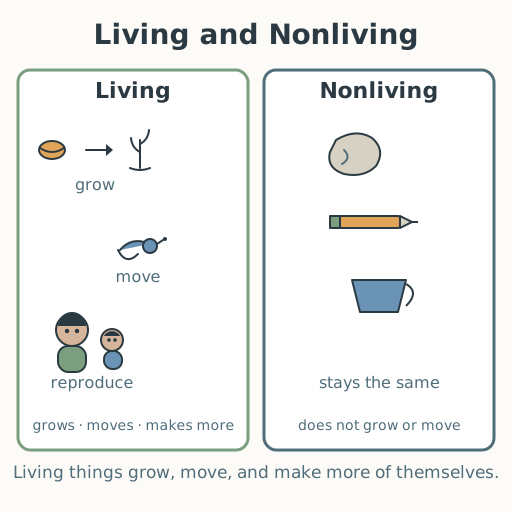
Lesson 5 — Living and Nonliving
Summary
Learners sort real things into living and nonliving and discover three clues that something is alive: living things grow, move, and reproduce (make more of themselves). They practice gentle care for the living things they meet.
Objectives
- Sort things into living and nonliving, and tell what living things do (grow, move, and reproduce). (D06.S2.01.02)
Connection
A rock and a seed sit side by side. They might look alike when they are small and still. But the seed can grow into a plant, and the rock mostly stays the same. The seed is living; the rock is nonliving. Knowing the difference helps us care for the living world around us.
Materials
- A mixed collection to sort (a seed or plant, a picture of an animal, a rock, a pencil, a toy, water, a leaf)
- Two sorting mats or hoops (one “living,” one “nonliving”)
- Paper and crayons
Preparation
- Gather a mixed pile of living and nonliving things learners can touch safely.
- Label two mats or hoops “living” and “nonliving.”
Facilitator note
This lesson is written to the learner (“you”). The three clues — grow, move, reproduce — are a first map, not a strict rule; a seed does not look like it moves, and a cloud “moves” but is not living. Hold the clues loosely and welcome wonder: “living things do these three things — what about this one?” Do not frighten: there is no death or harm content here. Model gentle care: if a learner finds a live creature (an insect, a worm), watch without touching, and return it gently where it came from; never hurt a living thing. “Reproduce” is best said to this age as “make more of themselves” or “have babies” — with the seed–plant and chick–hen pairs kept gentle. Honor every body: sort by pointing, touching, or acting; speaking is one way, not the only way. Many cultures name and care for living things differently — honor local names and ways.
Procedure
- Gather (5 min). Look at a rock and a seed. Which one will grow? Which will stay the same? One is living, one is not.
- Three clues (10 min). Living things do three things. They grow (a puppy becomes a dog). They move (a bird flies, a plant turns toward the light). They reproduce — they make more of themselves (a seed makes more seeds; a hen lays an egg that can become a chick). Act out growing: curl small, then stretch tall.
- Sort the pile (15 min). Sort each thing into “living” or “nonliving.” For each one ask: does it grow? does it move on its own? does it make more of itself? A leaf is living (it grew on a plant); a pencil is not. Water is a trick question — it is not alive, but living things need it. There are no silly answers; explain your thinking.
- Draw the sort (10 min). Draw one living thing and one nonliving thing and the clue that told you apart (a seed growing vs a rock staying the same).
- Close (5 min). Living things grow, move, and make more of themselves. The rest of the world is nonliving — and living things need it. Both matter.
Differentiation
- Support: Sort with just one clue (“does it grow?”) and a small pile.
- Support (non-speaking): Place each object on the mat by pointing or moving it.
- Support (blind/low-vision): Sort by touch and spoken description — feel a leaf beside a rock and tell (or act out) which clue told them apart.
- Extension: Find three living and three nonliving things in the room or outside, and tell the rule for each.
Assessment
- Formative (observation): Can the learner sort several things into living and nonliving and give at least one living clue (grow, move, or reproduce)?
- Artifact (portfolio): The living/nonliving drawing.
Home connection
At home, walk through one room or the yard and point to two living things and two nonliving things. Tell a grown-up how you knew which was which.
Resources
- BBC Bitesize (KS1 Science), “How can I sort objects into dead, living and non-living?” — living things feed, grow, move, reproduce, need air, and get rid of waste; non-living things have never been alive (for example, water, rocks, and metal). https://www.bbc.co.uk/bitesize/topics/zx882hv/articles/zfhfn9q