Lesson 06 — Properties of Materials
Learners discover that things are made of materials, and that materials have properties — hard, soft, shiny, heavy, light — they can observe and describe with their senses.
Objectives
Objectives
- D06.S3.01.01 Observe and describe the properties of materials (such as hard, soft, shiny, heavy, and light).
Essential question
What is a thing made of, and how does it feel and behave?
Key vocabulary
Materials
Standard materials
- A collection of objects made of different materials · 1 set A stone, a cloth, a metal spoon, a wooden stick, a leaf, a plastic cup, a paper
- Paper and crayons · per learner
Low-tech / no-cost
- Body and voice Describe objects already around you — hard, soft, heavy, light; no special objects needed
- Found objects from outside A stone, a stick, a leaf, a feather to feel and compare
Enriched / lab & device
- A "feely bag" · 1 A bag of objects to describe by touch alone, then check by looking
- A simple balance (two cups on a stick) · 1 To compare which object is heavier and which is lighter
Works in different contexts
- large-group Describe one shared object together, collecting property words on a chart, before pairs sort their own objects by one property
- self-directed A learner picks two objects, lists their properties, and sorts a small pile by heavy/light or hard/soft
- outdoor-only Gather a stone, a stick, a leaf, and a feather; describe each and line them up from lightest to heaviest
- level-grouped Learners new to properties name one (hard or soft); learners who can compare sort by two properties at once and explain
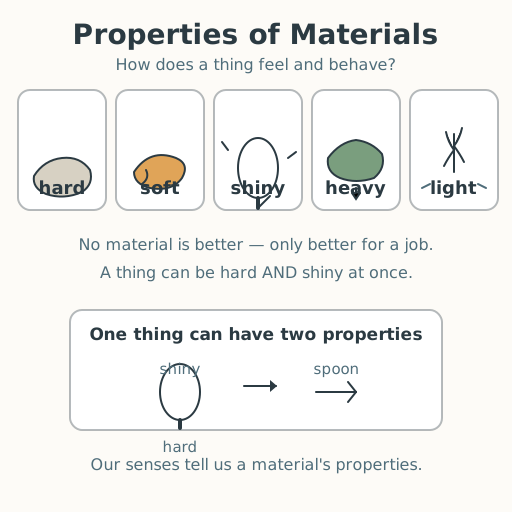
Lesson 6 — Properties of Materials
Summary
Learners discover that every thing is made of a material, and that materials have properties — hard or soft, shiny or dull, heavy or light — they can observe with their senses. They sort and describe real objects by their properties.
Objectives
- Observe and describe the properties of materials (such as hard, soft, shiny, heavy, and light). (D06.S3.01.01)
Connection
A spoon, a cup, a leaf, and a stone are all things you can hold. But they are not the same: the spoon is hard and shiny, the cup might be light, the leaf is soft, the stone is heavy. What a thing is made of — its material — gives it its properties, and properties are why we choose one material for one job and another for another.
Materials
- A collection of objects made of different materials (a stone, a cloth, a metal spoon, a wooden stick, a leaf, a plastic cup, a paper)
- Paper and crayons
Preparation
- Gather objects of clearly different materials and properties, safe to handle.
- Plan a simple way to compare heavy and light (hand-feel, or a simple balance).
Facilitator note
This lesson is written to the learner (“you”). Keep it sensory and concrete — this is not about memorizing material names (wood, metal, plastic) but about observing properties: hard, soft, shiny, heavy, light, rough, smooth. All such words are welcome, including in learners’ home languages. Honor every body: a learner who is blind or has low vision feels weight and texture; a learner who does not speak points or sorts; a learner with a motor difference may need objects brought close or a partner to lift and compare. The technology lens is quiet here: talk about how people everywhere choose materials for a job — a clay pot for water, a metal pan for cooking, a wooden bowl for food — and that no material is “better,” only better for something. There is no correct answer for how a thing feels; notice differences without ranking.
Procedure
- Gather (5 min). Pick up two things near you. Are they the same? How are they different? What they are made of gives them their properties.
- Meet the property words (10 min). Feel and look at the objects. A stone is hard; a cloth is soft. A metal spoon is shiny; a leaf is not. A stone is heavy; a feather or a paper is light. Say each word and find an object that shows it.
- Sort by a property (15 min). Choose one property and sort the objects into two groups: hard / soft, shiny / dull, heavy / light. Then try another property. Does the same object land in a different group? (Yes — an object can be hard and shiny.)
- Draw two materials (10 min). Draw two objects and write or say one property for each: “The stone is hard.” “The cloth is soft.”
- Close (5 min). Things are made of materials, and materials have properties. Our senses tell us what those properties are — and why each material is good for its job.
Differentiation
- Support: Use two properties only (hard/soft) and sort a small pile.
- Support (blind/low-vision): Describe by weight and texture (heavy/light, rough/smooth) by hand.
- Support (non-speaking): Point to the object that is hard, soft, heavy, or light, and sort by moving the objects.
- Extension: Sort the same objects by two properties at once (hard and shiny, soft and light) and explain.
Assessment
- Formative (observation): Can the learner name (or show) at least two properties of a material and sort objects by one property?
- Artifact (portfolio): The “two materials” drawing with a property for each.
Home connection
At home, find one thing that is hard and one that is soft, one that is heavy and one that is light. Tell a grown-up what each thing is made of and what it is good for.
Resources
- BBC Bitesize (KS1 Science), “Describing materials” — materials have properties (soft, hard, shiny) that describe how they look, feel, and behave, and we choose the right material for each job. https://www.bbc.co.uk/bitesize/topics/zrssgk7/articles/zvpysk7