Lesson 07 — How Objects Move
Learners explore how objects move — push, pull, roll, and slide — and discover that a push or a pull makes something start, and something (like a hand or the ground) makes it stop.
Objectives
Objectives
- D06.S3.01.02 Describe how objects move (push, pull, roll, and slide) and what makes them start or stop.
Essential question
How do objects move, and what makes them start or stop?
Key vocabulary
Materials
Standard materials
- Objects that move in different ways · 1 set A ball, a toy car or wheeled object, a block, a smooth ramp or book
- Paper and crayons · per learner
Low-tech / no-cost
- Body and voice Push a partner's hand gently, pull a sleeve, roll and slide your own body; no objects needed
- Found objects A round stone or seed to roll, a flat leaf or bark to slide, a stick to push
Enriched / lab & device
- A ramp (a slanted board or book) · 1 To test rolling and sliding and to change the slope
- A toy with wheels to take apart and roll · a few To notice how wheels help things roll
Works in different contexts
- large-group Demonstrate push and pull for the whole group with one big object, then let pairs test rolling and sliding at stations
- self-directed A learner tests how a ball and a block move, records push/pull/roll/slide, and tries to make each start and stop
- outdoor-only Use a round stone, a stick, and a flat leaf on the ground; push, pull, roll, and slide each, and notice what makes them stop
- level-grouped Learners new to the words act out push and pull; learners who can explain say what force they used and what stopped the object
Lesson 7 — How Objects Move
Summary
Learners explore the ways objects move — push, pull, roll, and slide — and discover that a push or a pull makes something start, and a hand, a wall, or the ground makes it stop. They learn by moving real things and their own bodies.
Objectives
- Describe how objects move (push, pull, roll, and slide) and what makes them start or stop. (D06.S3.01.02)
Connection
You roll a ball and it moves away. You push a swing and it starts to go. You pull a wagon and it follows you. A toy car rolls on its wheels; a box slides across the floor. Whenever something starts to move, a push or a pull started it — and when it stops, something (your hand, the ground, a wall) stopped it.
Materials
- Objects that move in different ways (a ball, a toy car or wheeled object, a block, a smooth ramp or book)
- Paper and crayons
Preparation
- Gather objects that roll (ball, car) and slide (block, book), and a ramp if available.
- Clear a floor space so things can move without bumping anyone.
Facilitator note
This lesson is written to the learner (“you”). It is a body-first lesson: the strongest learning here is learners pushing and pulling real things and feeling the push/pull in their own muscles. Keep it safe and gentle — no throwing, no rough play; a soft push is enough to learn the idea. Honor every body: a learner who uses a wheelchair or has limited movement can push or pull with a hand, a foot, a stick, or a partner’s help — the point is the idea, not the strength. A learner who cannot see feels the object start and stop; a learner who does not speak shows the movement with hands or body. Introduce the word “force” only lightly if learners ask: “a push or a pull is a force.” The stop matters as much as the start — friction (the ground rubbing against the object) is the quiet reason most things stop; save the word for later grades, but let the observation land.
Procedure
- Gather (5 min). How did you get here today? You moved! Now think about a ball: how does it move, and how do you make it start?
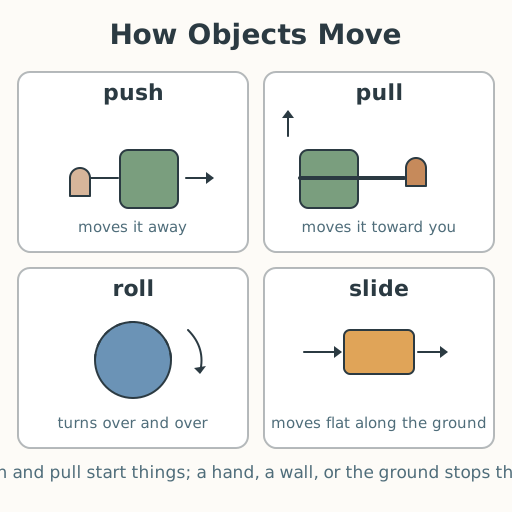
- Push and pull (10 min). Hold a block. Give it a gentle push — it moves away from you. Now pull it back toward you. A push moves something away; a pull moves it toward you. Feel the push and pull in your hand.
- Roll and slide (15 min). Try the ball and the block on the floor and down the ramp. The ball rolls (it turns over and over); the block slides (it moves flat along the ground). Which one rolls? Which one slides? What did you do to make each start? What made it stop — your hand, the wall, or the ground?
- Your body moves (7 min). Be the object: roll like a ball (curl up and turn), slide like a block (move flat), then push and pull a partner’s hands gently.
- Close (3 min). Push and pull make things start; hands, walls, and the ground make things stop. Rolling and sliding are two ways things travel.
Differentiation
- Support: Use two words only (push, pull) with one object, and act them out.
- Support (motor difference): Use a stick or a partner to push/pull; observe and describe rather than do if needed.
- Support (blind/low-vision): Feel the difference — a ball turns over in the hand (rolls) while a block stays flat (slides); feel the object start and stop under your hand.
- Extension: Change the ramp to make it steeper or flatter and tell what happens — does the object roll farther or stop sooner?
Assessment
- Formative (observation): Can the learner show or name a push and a pull, and say what made an object start or stop?
- Artifact (portfolio): A drawing of one object moving, labeled push, pull, roll, or slide.
Home connection
At home, find one thing you can push and one thing you can pull. Roll a round thing and slide a flat thing. Tell a grown-up what made each one start and stop.
Resources
- BBC Bitesize (KS2 Science), “Friction” — friction is a force that acts when an object moves across a surface, and it helps explain why a moving object slows and stops. https://www.bbc.co.uk/bitesize/topics/znmmn39/articles/zcmwkty
- BBC Bitesize (KS2 Science), “Moving on different surfaces” — objects move differently depending on the surface they are on. https://www.bbc.co.uk/bitesize/topics/znmmn39/articles/zqxnhcw