Lesson 08 — Sun, Moon, and Stars
Learners observe the patterns of the Sun, Moon, and stars and discover that day turns into night because the Earth slowly turns — the Sun only *seems* to move across the sky — while honoring many peoples' sky stories side by side.
Objectives
Objectives
- D06.S4.01.01 Observe and describe patterns of the Sun, Moon, and stars, and how day turns into night.
Essential question
What patterns do the Sun, Moon, and stars make, and how does day turn into night?
Key vocabulary
Materials
Standard materials
- A ball or globe and a lamp or flashlight · 1 set To show how one side of the ball is in light and the other in dark
- Paper and crayons · per learner
Low-tech / no-cost
- Body and voice One learner is the Sun (lamp/arms bright), another spins slowly as the Earth; no ball needed
- The real sky Watch the sky at different times of day and at night, and name what you see
Enriched / lab & device
- A globe and a bright lamp · 1 set Spin the globe slowly to show day turning into night on different parts of the Earth
- A picture book of sky stories from many cultures · 1 To honor different peoples' stories about the Sun, Moon, and stars side by side
Works in different contexts
- large-group Act out the Earth spinning with the whole group — one child is the Sun, the others are the Earth turning slowly into light and dark
- self-directed A learner watches the sky (or a lamp and ball) and draws what they see in the day sky and the night sky
- outdoor-only Find the Sun and your shadow outside; notice where the light comes from, and imagine the same spot at night
- multi-age Older learners hold the lamp steady and turn the ball while younger ones say "day!" and "night!" as each side comes into the light
Lesson 8 — Sun, Moon, and Stars
Summary
Learners observe the patterns of the Sun, Moon, and stars and discover that day turns into night because the Earth slowly turns — so the Sun only seems to move across the sky. They honor many peoples’ sky stories as stories, side by side, and hold the big questions as wonder.
Objectives
- Observe and describe patterns of the Sun, Moon, and stars, and how day turns into night. (D06.S4.01.01)
Connection
Every morning the Sun seems to climb up into the sky, and every evening it seems to sink down and the sky grows dark. The Moon sometimes looks round and full, and sometimes like a thin smile. Stars sparkle in the night sky in the same quiet patterns. People everywhere, for thousands of years, have looked up and wondered about these lights — and told stories about them.
Materials
- A ball or globe and a lamp or flashlight
- Paper and crayons
Preparation
- Set up the lamp or flashlight (the “Sun”) and a ball (the “Earth”).
- Prepare to tell one or two sky stories from different cultures, as stories.
Facilitator note
This lesson is written to the learner (“you”). Two commitments are non-negotiable here. First, no geocentrism: day and night happen because the Earth slowly turns, so one side faces the Sun (day) while the other faces away (night); the Sun only seems to move across the sky. Use appearance language — “the Sun seems to rise and set” — never “the Sun goes around the Earth.” (This is the factual model taught by NASA and space agencies worldwide; see the NASA Space Place resource below.) Second, inquiry over creed: the origins of the Sun, Moon, and stars are held as wonder, not dogma. Honor many peoples’ sky stories side by side — an Indigenous story of the Sun, a story about the Moon from Africa, Asia, or the Pacific, a Greek or Norse tale — as stories people tell, without ranking any as more true. Never mock a family’s beliefs. Honor every body: describe the sky in words for a learner who cannot see it, and let movement tell the story (the slow turning). Some questions — why the stars are there — we cannot answer yet, and that is wonderful.
Procedure
- Gather (5 min). What did the sky look like last night? What does it look like now? Look out the window or remember.
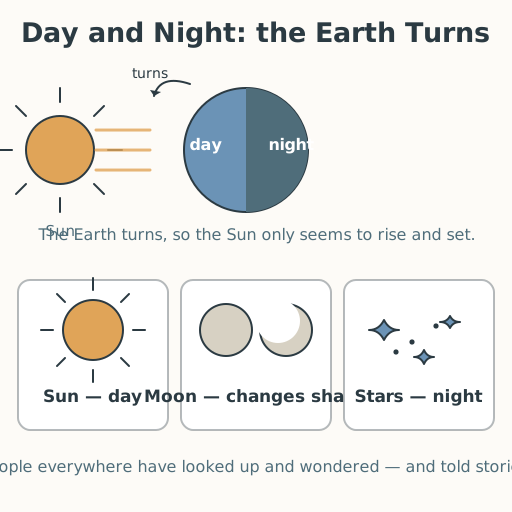
- The lights in the sky (10 min). The Sun gives us light in the day. The Moon and stars we usually see at night. The Moon changes shape a little each night, over and over — a pattern. The stars stay in the same patterns night after night.
- Day turns into night (15 min). Watch the lamp and ball. One side of the ball is in light — that is day. The other side is in dark — that is night. The Earth turns slowly, all the time. As it turns, your part of the Earth comes into the light (morning) and then leaves it (evening). The Sun does not really go around us; we turn, so the Sun only seems to rise and set. Act it out: one friend is the Sun, the rest turn slowly like the Earth, saying “day!” when you face the light and “night!” when you face away.
- Sky stories (10 min). Listen to a story people have told about the Sun, Moon, or stars — from here and from far away. Every people has wondered at the sky and told a story about it. No story is the only story; we hold them side by side and keep wondering.
- Close (5 min). Day and night follow a pattern because the Earth turns. The Sun, Moon, and stars have kept their patterns for a very long time — and people have always looked up and wondered.
Differentiation
- Support: Focus on the one idea “the Earth turns, so we get day and night” with the lamp-and-ball model.
- Support (blind/low-vision): Feel the warm side and cool side of a lamp-lit ball, or turn a partner gently to feel “facing the Sun” and “facing away.”
- Support (motor/limited-movement): Turn a ball or a partner’s shoulders gently, or point with an arm, instead of spinning the whole body.
- Extension: Draw the day sky and the night sky and label one pattern in each (the Sun by day; the Moon or stars by night).
Assessment
- Formative (observation): Can the learner describe (in words or by acting) that the Earth turns, so day turns into night, and name one pattern of the Sun, Moon, or stars?
- Artifact (portfolio): The day-sky/night-sky drawing.
Resources
- BBC Bitesize (KS1 Science), “What is day and night?” — explains that the Sun is the star at the centre of our solar system, that Earth rotates, and that the Sun shines on only half of Earth at once, so as Earth turns some places face the Sun (daytime) and others face away (night-time). https://www.bbc.co.uk/bitesize/topics/zkvv4wx/articles/zyfhxbk
- NASA Space Place, “What Causes the Seasons?” — states that Earth “spins around this pole, making one complete turn each day. That is why we have day and night,” and explains that Earth’s tilted axis makes the seasons. https://spaceplace.nasa.gov/seasons/en/
Home connection
At home, watch the sky in the morning and again at night. Tell a grown-up what changed and what stayed the same — and ask them if they know a story about the Sun, Moon, or stars.