Lesson 02 — Food Groups: Fruits, Vegetables, Grains, and Proteins
Learners sort foods into four groups — fruits, vegetables, grains, and proteins — discovering that grouping is a tool for noticing the many foods that help bodies, not a rule that ranks any food or family.
Objectives
Objectives
- D03.S3.01.01 Name a variety of foods from different groups, such as fruits, vegetables, grains, and proteins.
Essential question
How do I sort foods into groups?
Key vocabulary
Materials
Standard materials
- Four sorting baskets or mats · 4 Labeled "fruits," "vegetables," "grains," and "proteins"
- Food picture cards · 1 set Fruits, vegetables, grains, and proteins from many places — mango, greens, rice, flatbread, maize, beans, lentils, eggs, fish, root vegetables
Low-tech / no-cost
- Four drawn circles Draw four circles on the ground or floor and label them; sort by naming foods aloud and placing real or drawn foods into a circle
- Voice and remembered foods Sort foods by saying their names and pointing to the right circle; no cards needed
Enriched / lab & device
- Durable food-group cards · 1 set per pair Sturdy cards for repeated sorting games
- A class food-group chart · 1 A large chart to record where each food was sorted
Works in different contexts
- large-group Hold up each card and have the group point or call out which basket it goes in, then place it and say why
- self-directed A learner sorts a small set of cards alone, then checks by saying why each food went where
- outdoor-only Draw four circles in the dirt with a stick and sort foods by naming them and standing in the matching circle
- multi-age Older learners act as recorders, writing each food under its group while younger learners sort the cards
- level-grouped Group learners who are ready to explain their sorting in full sentences; others sort by pointing and simple words
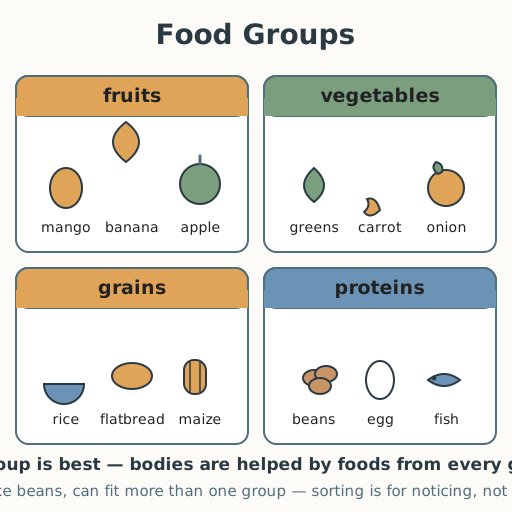
Lesson 2 — Food Groups: Fruits, Vegetables, Grains, and Proteins
Summary
Learners sort foods into four groups — fruits, vegetables, grains, and proteins — and discover that grouping is a tool for noticing the many different foods that help a body. The four groups are one way to sort, never a rule that ranks any food or family.
Objectives
- Name a variety of foods from different groups, such as fruits, vegetables, grains, and proteins. (D03.S3.01.01)
Connection
When a cook or a market seller gathers food, they often sort it into kinds — a basket of greens, a bag of rice, a tray of eggs, a pile of fruit. Sorting helps us notice the many different foods that help our bodies. Today you will sort foods into four groups: fruits, vegetables, grains, and proteins.
Materials
- Four sorting baskets or mats labeled “fruits,” “vegetables,” “grains,” and “proteins”
- Food picture cards (fruits, vegetables, grains, and proteins from many places)
Preparation
- Prepare four labeled baskets or mats.
- Gather food picture cards covering all four groups, from many cultures.
- Remind learners there are no “bad” foods and no wrong answers that shame — sorting is about noticing.
Facilitator note
This lesson is written to the learner (“you”). Hold the line on no food shaming. The four groups are one way to sort, not the only right one — different schools and cultures sort foods differently, and some families add a milk-foods group or group foods by where they come from. Honor all of it. Let learners sort by their own family’s real foods, and celebrate differences. Do not rank any group or any food, and never tie food to a child’s size or appetite. A food may feel at home in more than one group (beans are proteins, and some also think of them as a grain-like food) — that is fine; sorting is a tool, not a test. A learner who is blind or has low vision sorts by touch (real foods or textured cards); a learner who does not use a speaking voice sorts by pointing. A learner who is deaf or hard of hearing sorts by pointing to the labeled baskets and watching the demonstration from the front, since sorting here is shown with cards and baskets, not only told. This lesson extends Kindergarten’s everyday/sometimes sorting (U.00.002, U.00.008) into naming food groups.
Procedure
- Gather (5 min). Remember all the foods we named last time. Today we will sort them into groups, like a cook sorting at the market.
- Meet the four groups (10 min). Look at the four baskets. Fruits grow from a plant’s flower and often hold seeds — mango, banana, apple, papaya. Vegetables are plant parts we eat — leaves like greens, roots like carrots or cassava, stems and more. Grains are seeds we eat — rice, maize, wheat (flatbread is made from wheat), millet. Proteins are foods that help your body grow, build, and mend — beans, lentils, eggs, fish, and meat. Every group has foods that help bodies.
- Sort together (15 min). Pick up a food card. Which group does it belong to? Place it in a basket and say why: “A mango is a fruit because it grows on a tree and holds a seed.” Talk with a partner about each food. If you are not sure, wonder together — sorting is about noticing, not being right.
- Some foods fit more than one place (5 min). Beans are proteins — and some people also group them with grains. That is okay. Sorting is a tool to help us notice, not a rule that must be perfect.
- Close (5 min). Look at the four full baskets. No group is “best” — bodies are helped by foods from every group. Which food from each group does your family enjoy?
Differentiation
- Support: Sort just four familiar foods first; use real foods from the learner’s own kitchen. Learners may point, gesture, or name foods aloud instead of picking up cards.
- Support (blind/low-vision): Use real or textured foods and sort by touch, naming each food as it is felt.
- Extension: Name one food from each of the four groups that their family eats, and wonder aloud about a food that could fit two groups.
Assessment
- Formative (observation): Can the learner place a food into one of the four groups and give a simple reason, in their own way?
- Self: The learner names one food from two different groups.
Home connection
At your next meal or at the market, point to one fruit, one vegetable, one grain, and one protein. Say each food’s name and its group.