Lesson 03 — Food Gives Me Energy to Grow, Play, and Learn
Learners discover that food is the body's fuel, giving energy to grow, play, and learn. They match foods to the jobs of a busy body and build a "foods that give me energy" chart — always without ranking any food or commenting on any body.
Objectives
Objectives
- D03.S3.01.02 Explain that food gives the body energy to grow, play, and learn.
Essential question
How does food give my body energy to grow, play, and learn?
Key vocabulary
Materials
Standard materials
- Food picture cards · 1 set A variety of everyday foods from many places — rice, beans, flatbread, maize, fruit, vegetables, fish, eggs
- A "foods that give me energy" chart · 1 A large chart to collect foods and what they help the body do
- A small plant or sprouting seed · 1 To show that living things need food and water to grow, just like bodies
Low-tech / no-cost
- A real seed or bean A bean soaked in water to watch it swell and sprout; shows growth needs food and water
- Voice and body Act out the three jobs of energy — grow, play, learn — with movements; no cards needed
Enriched / lab & device
- A class sprouting jar · 1 Grow a bean or lentil in a clear jar to watch roots and shoots appear over days
- A picture book about food and energy · 1 A story showing where food comes from and how it fuels a busy body
Works in different contexts
- large-group Build one big "foods that give me energy" chart — every learner adds a food and says what it helps their body do
- self-directed A learner matches each food card to a job (grow, play, or learn) and draws one energy food, then checks with a grown-up or older peer
- outdoor-only Visit or imagine a garden; look at a real plant and talk about how food and water help it — and us — grow and move
- multi-age Older learners explain the seed-to-plant idea to younger ones and help write the class energy chart
- level-grouped Learners ready to explain in sentences say how a food helps; others act out grow-play-learn and point to foods
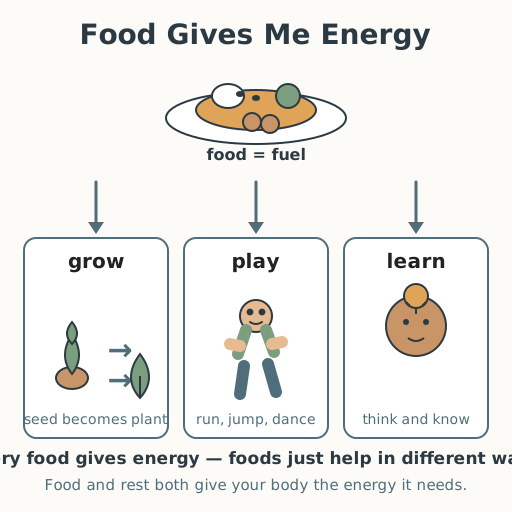
Lesson 3 — Food Gives Me Energy to Grow, Play, and Learn
Summary
Learners discover that food is the body’s fuel, giving energy to grow, play, and learn. They match foods to the jobs of a busy body and build a “foods that give me energy” chart — always without ranking any food or commenting on any body.
Objectives
- Explain that food gives the body energy to grow, play, and learn. (D03.S3.01.02)
Connection
A cooking fire needs wood to burn; a lamp needs oil or a battery; a bicycle needs your legs to pedal. Everything that moves or grows needs some kind of fuel. Your body needs fuel too — and that fuel is food. Food gives your body the energy to grow, to play, and to learn.
Materials
- Food picture cards (everyday foods from many places)
- A “foods that give me energy” chart
- A small plant or a sprouting seed
Preparation
- Have a small plant or a bean sprouting in a jar to show growth.
- Prepare the “foods that give me energy” chart.
- Clear space for acting out grow, play, and learn.
Facilitator note
This lesson is written to the learner (“you”). Hold the line on no food shaming. Keep the focus on what foods do — give energy — never on amounts, weight, or appetite, and never comment on what or how much a learner eats. Speak of food as fuel that all living things need, and honor the many ways people get it — farming, fishing, gathering, buying, growing in pots. Some children have little food at home; keep the tone warm and matter-of-fact. It is basic biology that the body breaks food down and turns it into energy for moving, thinking, and growing — a fact, not a value. The value we add is that every body and every family’s food is honored. The “foods that give me energy” chart is a unit portfolio artifact; keep learners’ additions. Every body and every way of moving is honored. A learner who does not use a speaking voice points, signs, or draws their foods and energy jobs; a learner who is deaf or hard of hearing follows the demonstration from the front, where the picture cards and acted-out grow-play-learn motions carry the meaning visually. A learner who is blind or has low vision feels the seed or plant, names the three energy jobs aloud, and can model their energy-food in clay or choose a real food to hold instead of drawing. This lesson extends Kindergarten’s “Foods That Help Me Grow” (U.00.002) and “Food for My Growing Body” (U.00.008).
Procedure
- Gather (5 min). Put a hand on your tummy. Remember the food groups from last time. Food doesn’t just fill you up — it is your body’s fuel.
- Fuel and energy (10 min). Look at the little plant. What does a plant need to grow? Water and food from the soil. A lamp needs fuel to shine; a fire needs wood to burn. Your body needs food to run, jump, think, and grow. Every food gives energy — no food is “bad” or “empty”; foods just help in different ways and different amounts.
- Grow, play, learn (10 min). Your body’s energy has three jobs. Grow — stretch tall like a seed becoming a plant. Play — run in place, jump, dance. Learn — touch your head and think hard about something you want to know. Food gives your body the energy for all three.
- Match foods to jobs (10 min). Pick a food card. Say how it helps: “Rice gives me energy to play,” “Beans help me grow,” “Fruit gives me energy to learn.” Add each food to the “foods that give me energy” chart.
- Draw your energy food (5 min). Draw one food that gives you energy, and say (or write) what it helps you do — grow, play, or learn.
- Close (5 min). Food and rest both give your body energy. Which food are you glad to have today?
Differentiation
- Support: Use three familiar foods and act out “grow,” “play,” and “learn” energy; let learners point or draw instead of speaking in sentences.
- Support (blind/low-vision): Feel the seed or plant to understand growth; name the grow-play-learn jobs aloud and describe one energy food by touch or scent.
- Support (motor-difference): Show grow-play-learn with whatever movement is comfortable — a nod, a blink, a partner moving alongside, or pointing to a picture — so every body can join.
- Extension: Invite learners to think of one food for each of the three jobs — grow, play, learn — and to explain their choice.
Assessment
- Formative (observation): Can the learner say, in simple words or actions, that food gives the body energy to grow, play, and learn?
- Portfolio: The learner’s “foods that give me energy” drawing or chart addition becomes a unit portfolio artifact.
Home connection
At your next meal, ask a grown-up what you will do with the energy from that food — play, learn, or grow. Tell them which food gives you energy to run and play.
Resources
- World Health Organization, “Healthy diet” (what food does for a body, worldwide): https://www.who.int/news-room/fact-sheets/detail/healthy-diet