Lesson 02 — Then and Now — A Tool or Toy
Learners compare one thing from long ago with one thing today — a tool or a toy — and name what changed and what stayed the same, without calling either better.
Objectives
Objectives
- D08.S1.01.02 Compare one thing from long ago with one thing today, such as a tool or a toy, and tell what changed and what stayed the same.
Essential question
What changed and what stayed the same in one tool or toy from long ago?
Key vocabulary
Materials
Standard materials
- Then-and-now object or picture pairs · 1 set Pairs such as a candle and a lamp, a clay pot and a jug, a hand-carved top and a store toy — one "long ago" and one "today," each still used by many people
- Paper and crayons · per learner For drawing the pair and marking what is the same and what is different
Low-tech / no-cost
- Real found objects to hold A candle or oil lamp and a bulb lamp; a gourd or clay pot and a cup — anything learners can hold to feel "same" and "different"
- Two labeled spots A "long ago" spot and a "today" spot, with a third "both" spot where the two overlap
Enriched / lab & device
- A short photo set of one tool over time · 1 per group Photos of light, or water-carrying, or a toy across generations, shown side by side without ranking
- A visiting object from an elder · 1 Optional — a real older object shared by a community elder, handled with care
Works in different contexts
- large-group Hold each pair up large; the whole group calls out what is "the same" and what is "different" before one learner places it on the two spots
- self-directed The learner sorts and compares one pair alone, then tells a grown-up or peer one thing that changed and one thing that stayed the same
- outdoor-only Find a living pair outside — a hand-tool and a newer tool, or a seed and a fruit — and feel what is the same and what is different
- level-grouped Learners who grasp the comparison quickly coach others by asking "what is the same? what is different?" rather than telling
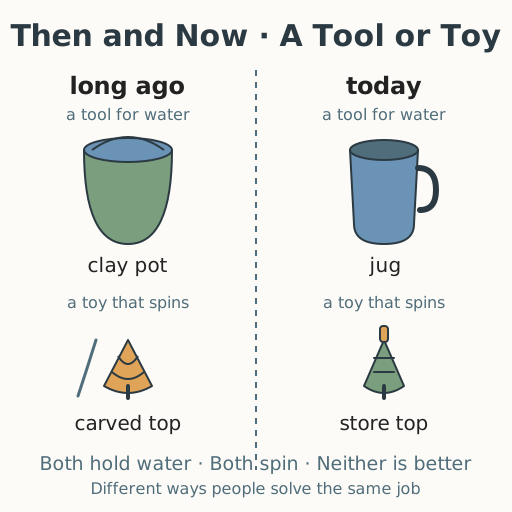
Lesson 2 — Then and Now: A Tool or Toy
Summary
Learners compare one thing from long ago with one thing today — a tool or a toy — and say what changed and what stayed the same. Neither is called better; both are real ways people live, and many are still used today.
Objectives
- Compare one thing from long ago with one thing today, such as a tool or a toy, and tell what changed and what stayed the same. (D08.S1.01.02)
Connection
Long ago, people lit the dark with a candle or an oil lamp. Today many homes light the dark with an electric bulb — and many homes still use a candle or a lamp too. Both give light; the flame and the bulb just do it differently. A tool or toy from long ago is not “worse” and today’s is not “better” — they are different ways humans have solved the same problem.
Materials
- Then-and-now object or picture pairs (candle/lamp, clay pot/jug, hand-carved top/store toy)
- Paper and crayons
Preparation
- Gather or draw at least one then-and-now pair for the worked example.
- Set up two labeled spots — “long ago” and “today” — plus a “both” spot where they overlap.
Facilitator note
This lesson is written to the learner (“you”) so it works in a classroom and for a self-directed learner. Comparing is a foundational skill, so model it once before independent work (Kirschner, Sweller & Clark, 2006): hold up a candle and a lamp, and think aloud — “Both give light. That is the same. The candle burns with a flame; the lamp uses a bulb. That changed.” Then guide the same two moves for a second pair. Never rank: do not say old things were harder, slower, or worse. A candle-lantern and a pot carried on the head are equally valid living ways — still today, in many homes, these are the everyday tools. The point is noticing change and sameness, never progress. Honor every body: a learner who is blind or has low vision feels the objects; a learner who does not use a speaking voice points to “same” and “different” spots.
Procedure
- Gather (5 min). Think of one thing you use every day — a light, a cup, a toy. Did people long ago use something for the very same job?
- Meet “long ago” and “today” (10 min). Look at the pair: a candle and a lamp. Both help you see in the dark. The candle uses a flame; the lamp uses a bulb. Say it together: “The same: both give light. Different: flame and bulb.”
- Guided practice (10 min). Take a second pair — a clay pot and a jug, or a carved top and a store toy. Together, put the older one on the “long ago” spot, the newer one on the “today” spot, and the thing they both do on the “both” spot.
- Compare your own pair (15 min). Choose one pair and hold or look at both. Find one thing that stayed the same (they both hold water; they both roll; they both give light). Find one thing that changed (what it is made of, or how it works). Draw both and mark your two findings.
- Share (5 min). Tell a partner: “It is the same because… It is different because…” Point, sign, or draw if you like.
- Close (5 min). Many people today still use the older tool, and many use the newer one. Both are real, both work, and both are part of how humans have lived.
Differentiation
- Support: Use just one pair; ask only two questions — “what is the same?” and “what is different?” — with clear gestures toward the “both” spot.
- Support (blind/low-vision): Compare by touch — a smooth bowl and a ribbed bottle — and describe what feels the same and different aloud.
- Support (non-speaking): Point to the “same” spot, the “different” spot, and the “both” spot to show each finding, or draw the pair and mark the two findings.
- Support (Deaf/HH): The objects and picture pairs are already visual — compare by looking and pointing, and sign “same” and “different” as you place each item on its spot.
- Support (motor-difference): Choose objects that are easy to hold or use larger cards; a partner moves each object to its spot while the learner directs with a point, a word, or eye-gaze.
- Extension: Choose a second pair and find two things that changed and two that stayed the same.
Assessment
- Formative (observation): Does the learner name at least one thing that changed and one thing that stayed the same for a pair?
- Formative (oral/performance): Does the learner say or show “same” and “different” without ranking one as better?
Home connection
Ask someone at home about a tool or toy they used when they were little. What was it for? What is the same about what you use today, and what is different?