Lesson 03 — A Family or Community Tradition
Learners meet one or two family or community traditions, held respectfully, and describe what the tradition means to the people who practice it.
Objectives
Objectives
- D08.S2.01.01 Describe a family or community tradition and what it means to the people who practice it.
Essential question
What is a tradition, and what does it mean to the people who keep it?
Key vocabulary
Materials
Standard materials
- Story or picture cards of a few gentle traditions · 1 set Examples chosen from many regions — a harvest meal, a naming day, a season song, a coming-together — each told respectfully, with its meaning
- Paper and crayons · per learner For drawing a tradition and its meaning
Low-tech / no-cost
- A told or remembered tradition The facilitator tells one tradition they know well and can share respectfully; no printed cards needed
- A "meaning" holding object A bowl or cloth passed around; the learner holding it names what a tradition means
Enriched / lab & device
- A recording or visit from a community member · 1 Optional — a community elder or family member shares their own tradition in their own words
- Photos of the tradition · 1 set Images from the tradition's own community, shown with respect, never as a costume
Works in different contexts
- large-group Share one tradition to the whole circle, then let learners draw or point to what they think it means before the meaning is named
- self-directed The learner reads or listens to a described tradition, then draws it and writes or tells what it means
- outdoor-only Share a tradition tied to the seasons or the land — a harvest, a rain, a first-fruit — and notice how place is part of its meaning
- multi-age Older learners help younger ones put the meaning into words; younger learners can draw it
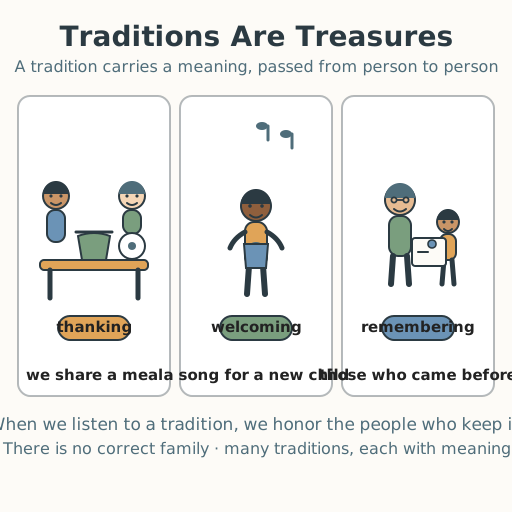
Lesson 3 — A Family or Community Tradition
Summary
Learners meet one or two family or community traditions, told respectfully, and describe what each tradition means to the people who keep it. The focus is meaning, never costume or caricature.
Objectives
- Describe a family or community tradition and what it means to the people who practice it. (D08.S2.01.01)
Connection
A tradition is something people do again and again, on purpose, because it means something to them — a special meal, a song sung at a certain time of year, a way of welcoming a new baby. Every family and community has traditions, in every corner of the world. The same tradition can mean different things to different people, and that is what makes each one worth listening to.
Materials
- Story or picture cards of one or two gentle traditions
- Paper and crayons
Preparation
- Choose one or two traditions to share, from many possible regions, and learn to tell each respectfully with its meaning. Avoid anything that could feel like a costume or a caricature.
- Prepare a “meaning” holding object if using one.
Facilitator note
This lesson is written to the learner (“you”) so it works in a classroom and for a self-directed learner. Choose traditions with care and tell them from inside their meaning. A tradition is described, never imitated as dress-up or “pretend.” Never tokenize — do not reduce a whole people to one food or one garment — and never rank traditions as better or worse. The heart of the standard is what it means: a harvest meal means gratitude for the land and the hands that grew the food; a naming day means welcoming a child into belonging; a season song means remembering those who came before. Honor adopted, fostered, and chosen families equally — “no correct family.” A learner may pass and never has to perform or disclose their own tradition; inviting is fine, requiring is not.
Procedure
- Gather (5 min). Think of something your family or community does again and again that feels special. (You do not have to share it — just think of it.)
- Meet a tradition (15 min). Listen to a tradition being described — for example, a harvest meal where a community gathers to share food and thank the land, or a naming day where a child is welcomed with a song. Notice the people, the objects, and the feelings.
- Find the meaning (10 min). Ask: what does this tradition mean to the people who keep it? Is it about gathering? remembering? welcoming? thanking? Say it, point to a picture, or draw it.
- Draw the meaning (10 min). Draw the tradition you heard, and mark or caption what it means. Your drawing may show the food, the people, the song, or the feeling.
- Close (5 min). A tradition is a way people hold on to what matters to them and pass it on. When we listen to a tradition, we honor the people who keep it.
Differentiation
- Support: Share one tradition only, and offer three meaning words to choose from (gathering, remembering, welcoming).
- Non-speaking: A learner may point to a picture, act a small part, or draw to show the meaning, instead of speaking.
- Blind/low-vision: Describe the tradition’s sounds, foods, and feelings richly; the learner draws by feel or tells the meaning aloud.
- Deaf/HH: Tell the tradition with a picture sequence or in sign so it is seen, not only heard; the learner shows the meaning by pointing to a picture or signing it.
- Motor difference: The learner tells the meaning while a partner scribes or places pictures; the “meaning” holding object can rest in their lap or on a tray.
- Extension: Compare two traditions and notice what their meanings share (both about gathering, both about thanking).
Assessment
- Formative (observation): Can the learner describe one tradition and name or show what it means to its people?
- Formative (oral/performance): Does the learner honor the meaning rather than only naming a food or object?
Home connection
With a grown-up, think of one small tradition in your home or community. What do people do, and what does it mean to them? (Only share it at school if you want to.)