Lesson 09 — Making Things Right
Learners practice suggesting a way to make things right after feelings or something was hurt — repair, not punishment — and learn what makes an apology real: meaning it and trying to fix the harm.
Objectives
Objectives
- D09.S4.01.02 Suggest one way to make things right after someone's feelings or something was hurt.
Essential question
How do I suggest a way to make things right after feelings or something was hurt?
Key vocabulary
Materials
Standard materials
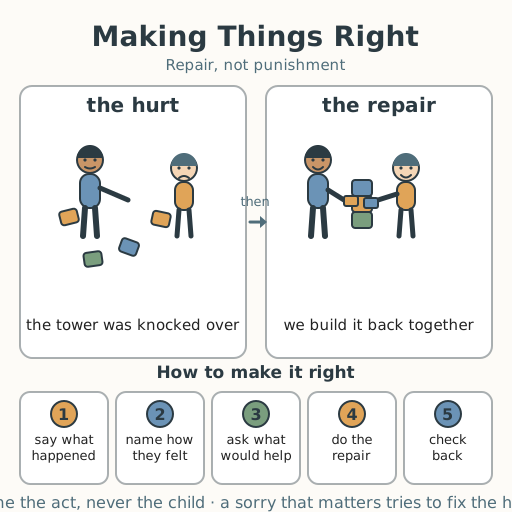
- A "make it right" picture strip · 1 Steps — say what happened, name how the other felt, ask what would help, do the repair, check back
- Two puppets or soft toys · 2 For acting out a small hurt and its repair
- Crayons and paper · per learner
Low-tech / no-cost
- Voice and body Act out the hurt and repair with hands and words; no strip or toys needed
- A drawn "make it right" strip Draw the steps together on paper or the ground
Enriched / lab & device
- Laminated "make it right" cards · 1 per learner A durable reminder card for the classroom peace corner
- A small repair kit · 1 set A soft cloth, tape, and a kind-word card for acting out fixes
Works in different contexts
- large-group Act out a small hurt with two puppets while the group suggests the repair, then rehearse in pairs
- self-directed The learner follows the strip alone and suggests a repair for a gentle, acted-out hurt
- outdoor-only Use a real small hurt (a knocked-over fort, a broken twig) and practice making it right right there
- multi-age Older learners model the repair, then younger learners suggest and try a repair of their own
Lesson 9 — Making Things Right
Summary
Learners practice suggesting a way to make things right after a small hurt — return what was taken, fix what was broken, ask what would help — and learn that repair, not punishment, heals the hurt so everyone can be well again.
Objectives
- Suggest one way to make things right after someone’s feelings or something was hurt. (D09.S4.01.02)
Connection
Think of a time something small was broken or someone’s feelings were hurt — a tower knocked over, a toy grabbed, a mean word said. The hurt can be fixed. Making it right means repairing the hurt: returning what was taken, fixing what was broken, saying sorry in a way that means it, and checking the person is okay. People everywhere repair what is broken — mending a torn net, replanting a broken branch, saying sorry to a friend. Today you will practice making things right.
Materials
- A “make it right” picture strip (say what happened, name how the other felt, ask what would help, do the repair, check back)
- Two puppets or soft toys
- Crayons and paper
Preparation
- Prepare the “make it right” picture strip.
- Set up a small space for acting out a gentle hurt and its repair.
Facilitator note
Written to the learner (“you”). This lesson teaches repair, not punishment. After a small hurt, the goal is making things right — returning what was taken, fixing what was broken, a sorry that means it, checking the friend is okay — never shaming, excluding, or “getting in trouble.” Name the act (“that word hurt”), never the child; there are no “bad children,” only hurts to repair. An apology is real when it means something: the person names what happened, notices how the other felt, and tries to fix it. A learner may suggest any honest repair — a kind word, a returned toy, help rebuilding — there is no single correct answer. Keep hurts small and gentle (a knocked-over block tower, a grabbed turn, a hurtful word), never heavy or frightening, and never ask a learner to confess a real private hurt. A learner who does not speak aloud suggests a repair by pointing to a step or a picture, signing, or having a peer voice it; a learner who is blind or low-vision names the repair aloud and touches the repaired object; a learner with a motor difference can direct a partner to do the repair while they choose it. A learner may always pass. The aim is that every learner can say, in their own way, “I can help make it right.”
Procedure
- Gather (5 min). Think of a small hurt you have seen fixed — something returned, something rebuilt, a sorry that felt real. How did it feel when things were made right?
- Meet the steps (10 min). Learn to make it right: say what happened, name how the other person felt, ask what would help, do the repair, and check back. A sorry that matters is one where you mean it and try to fix the harm.
- Act it out (15 min). With the puppets, show a small hurt — one puppet knocks over the other’s block tower. Practice making it right: “I knocked your tower over. You look sad. Can I help you build it again?” Then help rebuild. A learner who does not move the puppets can point to a step or direct a partner.
- Suggest a repair (10 min). Think of another small hurt. Suggest one way to make it right (say, sign, point, or draw it). Wonder together: does it fix the hurt and help everyone feel better?
- Close (5 min). Hurts can be repaired. Making things right heals the hurt so everyone can be well again.
Differentiation
- Support: Practice one step at a time — first “name how the other felt,” then “do one small fix.” A non-speaking learner points to the repair on the strip; a learner with limited movement directs a partner.
- Extension: Invite learners to compare two repairs for the same hurt and wonder which heals better and why.
Assessment
- Formative (observation): Can the learner suggest one way to make things right after feelings or something was hurt?
- Performance: The acted-out repair, shared with the group.
Home connection
At home, if a small hurt happens, try making it right together — return, fix, say a sorry that matters, and check everyone is okay.
Resources
- International Institute for Restorative Practices (repairing harm rather than only punishing): https://www.iirp.edu/