Lesson 02 — How a Tool Makes Work Easier or Faster
Learners try a task two ways — by hand and with a tool — and describe how the tool makes it easier or faster. They learn that tools help by holding more, reaching farther, or saving effort, and that an old basket is just as much a tool as anything new.
Objectives
Objectives
- D10.S1.01.02 Describe one way a tool makes a task easier or faster than doing it by hand.
Essential question
How does a tool make a task easier or faster than doing it by hand?
Key vocabulary
Materials
Standard materials
- Small, dry objects to carry · 1 bowlful per group Dry beans, pebbles, or seeds — never water, so nothing is wasted and everyone can use them
- A basket, bag, cup, or folded cloth · 1 per group A real carrier to compare with cupped hands
- Paper and crayons · per learner
Low-tech / no-cost
- Cupped hands and one found carrier A basket, a gourd, a folded cloth, or a cupped leaf — carry small dry things by hand, then in the carrier, and compare
- Voice and body Act out the difference — scooping and carrying with hands only versus with a tool — and say which is easier or faster and why
Enriched / lab & device
- A set of "by hand vs. with a tool" comparison cards · 1 set Carry with hands vs. basket, scoop with hand vs. spoon, sweep with hand vs. broom, cut with fingers vs. scissors — one job per card pair
- A real tool to try for each comparison · 1 per group A spoon, a broom, or scissors for a short, safe guided try
Works in different contexts
- large-group One pair of learners demonstrates "by hand" while another demonstrates "with a tool"; the whole group calls out which was easier or faster and why
- self-directed A learner carries a small pile of dry things by hand, then with a carrier, and writes or draws which was easier and why
- outdoor-only Carry a handful of small stones by hand, then in a basket or folded cloth, and compare; or sweep a patch of ground with a hand and then with a branch-broom
- level-grouped Pair learners who have mastered "easier/faster" with those still learning, so each pair takes turns being the one who tries and the one who watches and says why
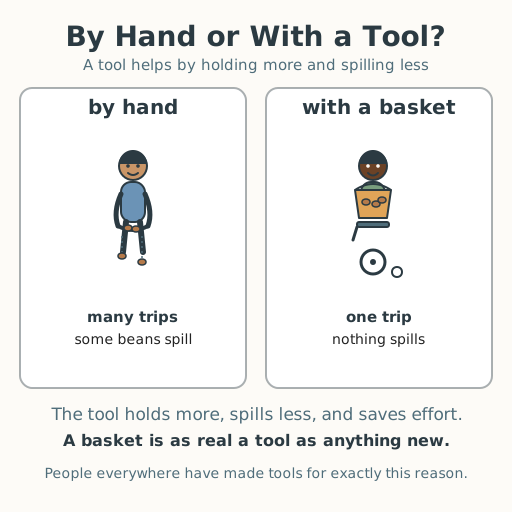
Lesson 2 — How a Tool Makes Work Easier or Faster
Summary
Learners do a small task two ways — carrying by hand, then carrying with a basket or cup — and describe how the tool changes the task. They learn to say why a tool helps: it holds more, spills less, or lets one trip do the work of many. The lesson keeps the message even-handed: a basket is just as much a tool as anything new, and no tool is “better” simply because it is new.
Objectives
- Describe one way a tool makes a task easier or faster than doing it by hand. (D10.S1.01.02)
Connection
Try this: scoop up a big pile of dry beans with just your two hands and carry them across the room. Some fall, your hands feel full, and you have to make many trips. Now carry the same beans in a basket or a cup. One trip, nothing spills. That is what a tool does — it makes a job easier or faster than your hands alone. People in every place and every time have made tools for exactly this reason.
Materials
- Small, dry objects to carry (dry beans, pebbles, or seeds)
- A basket, bag, cup, or folded cloth for each group
- Paper and crayons
Preparation
- Put a bowl of small, dry objects (beans, pebbles, or seeds) in each group’s space. Use dry things so nothing is wasted — save water for the living things that need it.
- Set out one carrier (basket, bag, cup, or folded cloth) per group.
- Mark a short “start” and “finish” line for the carrying task.
Facilitator note
This lesson is written to the learner (“you”). The heart of it is the comparison, so let every learner actually try both ways and say the difference in their own words. Keep it hands-on and concrete: carrying, scooping, and sweeping are real tasks a six-year-old knows. Do not use water for the demonstration — in places where water is scarce, wasting even a little sends the wrong message and can be a real hardship; dry beans, pebbles, or seeds work perfectly. Reinforce the unit’s commitment: a basket, a gourd, or a folded cloth is just as much a tool as anything new, and an older tool is not “less.” For a learner with motor differences, the choosing and the saying are the task — they may direct a partner’s hands and describe the difference; adapt the tool too (a wide, light cup, a handled basket). A learner who is blind or has low vision can feel how many dry things fit in cupped hands versus in the carrier, and describe the difference by weight and fullness. A non-speaking learner can point to the fuller carrier and to a picture for “easier” or “faster.”
Procedure
- Gather (5 min). Look at the bowl of dry beans and the basket. Today you will do one small job two ways, and notice the difference.
- Try it by hand (10 min). Scoop as many dry beans as you can into your two cupped hands and carry them from the start line to the finish line. How many made it? How many trips did it take? How did your hands feel?
- Try it with a tool (10 min). Now use the basket, bag, cup, or cloth. Carry the same beans the same distance. How many made it this time? How many trips?
- Compare and say why (10 min). Talk with a partner: which way was easier? Which was faster? Say the reason with a sentence: “The basket makes carrying easier because it holds more and does not spill.” Or: “The cup makes scooping faster because one scoop does the work of many.”
- Try another pair (5 min). Think of another job — scooping soup, sweeping a floor, cutting paper. Which tool helps, and how? Act it out or say it.
- Close (5 min). A tool helps by holding more, reaching farther, or saving effort. A basket is as real a tool as anything new, and it has helped people carry for a very long time. Which tool would you choose if you had a big carrying job?
Differentiation
- Support: Do the two ways side by side and compare one thing only — “which holds more?” — then say the sentence together.
- Motor differences: Choose the task and direct a partner’s hands while saying which way is easier or faster; adapt the tool (a wide, light cup, a handled basket) so the learner’s own body can join when possible.
- Blind/low vision: Feel how full the cupped hands are versus the carrier, and judge by weight and spill; a partner names the parts and says the sentence together.
- Deaf/hard of hearing: Compare “by hand” and “with a tool” with sign, pictures, and acting; the learner signs or points to “easier” or “faster” and shows why with a gesture or a drawn arrow.
- Extension: Name two different tools that do the same job (a basket and a bag both carry; a broom and a mop both clean) and tell which one you would pick and why.
Assessment
- Formative (observation): Can the learner describe one way a tool made a task easier or faster than doing it by hand?
- Artifact (portfolio): The learner’s “by hand vs. with a tool” drawing or sentence, kept in their portfolio.
Home connection
At home, try a job two ways with a grown-up — carry things by hand, then with a bag or basket. Tell the grown-up which was easier or faster and why. Ask them about a tool they use that saves them time or effort.