Lesson 03 — Real Photo or Pretend?
Learners compare a real photo with a drawing of the same thing and learn to tell them apart and give one reason: a photo is made by a camera of something really there, while a drawing is made by a person's hand and may be real or made-up. They meet a pretend story with delight, not suspicion.
Objectives
Objectives
- D10.S2.01.01 Tell the difference between a real photo and a drawing or a pretend story, and give one reason.
Essential question
How can I tell a real photo from a drawing or a pretend story, and give one reason?
Key vocabulary
Materials
Standard materials
- Pairs of a real photo and a drawing of the same thing · 2–3 pairs A photo of a cat and a drawing of a cat; a photo of a tree and a drawing of a tree; a photo of a person and a drawing of a person
- A short pretend story to read or tell · 1 A clearly made-up story with a talking animal or a flying house
- Paper and crayons · per learner
Low-tech / no-cost
- A real thing to hold and a drawing of the same thing Hold a real leaf or spoon, then look at a drawn leaf or spoon; point to which is the photo-like real thing and which is hand-made
- Voice and body Say one real sentence ("I saw a bird on the fence") and one pretend sentence ("The bird sang a song about the moon"); signal which is which and give a reason
Enriched / lab & device
- A device to show a photo and a drawing side by side · 1 per group Optional, used gently and never to shame other media; show one real photo and one drawn picture and compare
- A picture book with photo pages and drawn pages · 1 Page through together and stop to ask "real photo or drawing?" and "how do you know?"
Works in different contexts
- large-group Hold each pair up big; the whole group calls out "photo!" or "drawing!" and one learner gives a reason before the next pair
- self-directed A learner sorts a few photo-and-drawing pairs alone and writes or says one reason for each choice
- outdoor-only Point to a real thing outside (a leaf, a tree, a bird) and then to a drawn picture of it; tell which is which and give one reason
- multi-age Older learners read the pretend story aloud and coach younger ones in giving one reason for "photo" or "drawing"
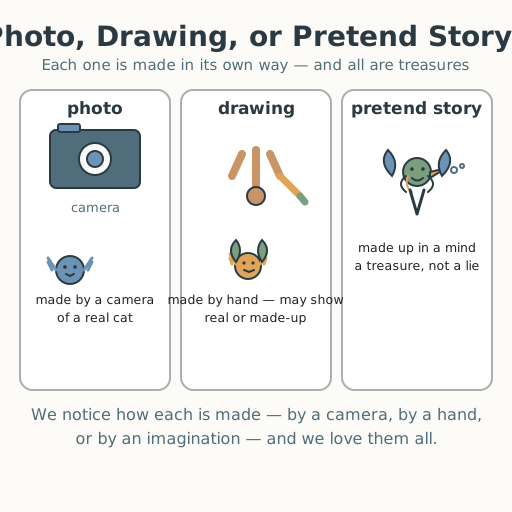
Lesson 3 — Real Photo or Pretend?
Summary
Learners look at pairs — a real photo and a drawing of the very same thing — and learn to tell them apart and give one reason. A photo is made by a camera of something that was really there; a drawing is made by a person’s hand, and it may show something real or something made-up. They also meet a pretend story, and learn that pretend is a treasure to love, not a trick to fear.
Objectives
- Tell the difference between a real photo and a drawing or a pretend story, and give one reason. (D10.S2.01.01)
Connection
Hold a real leaf in your hand — you can see it, feel it, and smell it. A camera can take a photo of that leaf, a picture made by a machine of something that was really there. A person can also make a drawing of the leaf with a hand and a crayon. Both are pictures, but they are made in different ways — and that is how we begin to tell them apart.
Materials
- Pairs of a real photo and a drawing of the same thing (a cat, a tree, a person)
- A short pretend story to read or tell
- Paper and crayons
Preparation
- Gather or make two or three photo-and-drawing pairs of the same subject.
- Choose or invent a clearly make-believe story (a talking animal, a flying house).
- Set out paper and crayons.
Facilitator note
This lesson is written to the learner (“you”). Keep it warm and wonder-full, never cynical. A photo is a picture a camera makes of something that was really there; a drawing is a picture a person makes by hand, and it may be of something real or something imagined. That is the whole distinction at this age — noticing, not judging. Make-believe is not “bad” or “a lie”; it is one of the great gifts of being human. If a learner insists a dragon could be real, honor the wonder: “What a wonderful story! Some people tell stories about dragons.” Then gently return to “a photo is made by a camera of something really there, and a drawing is made by a person’s hand.” Do not shame any media or screen; frame everything as noticing. If a learner names a story their family holds as true — a sacred story or a tale of their people — honor it and do not call it make-believe; steer the practice back to clearly fictional examples like talking animals and flying houses. For a learner who is blind or has low vision, use a real object and a raised-texture drawing of it, and let them tell which was made by a camera (a partner describes the photo) and which was made by hand (they feel the texture). A non-speaking learner can point or gesture to show the answer.
Procedure
- Gather (5 min). Look at a real photo and a drawing of the same thing side by side. They look a little different — can you see how?
- Meet a photo (5 min). A photo is a picture a camera makes. The camera sees something that is really there — a real cat, a real tree, a real person — and records it.
- Meet a drawing (5 min). A drawing is a picture a person makes by hand, with a crayon or pencil or brush. A drawing can show something real (a real cat) or something made-up (a cat with wings).
- Sort the pairs (10 min). For each pair, point to the photo and the drawing. Give one reason: “This is a photo because a camera made it of the real cat.” Or: “This is a drawing because a person drew it by hand.”
- Hear a pretend story (10 min). Listen to the pretend story about a talking animal or a flying house. Is it a photo, a drawing, or a story someone made up? How do you know? (It is a story — someone imagined it, and animals do not talk, houses do not fly.)
- Make one of each (5 min). Draw a real thing, and then imagine one small change that turns it into make-believe — a tree with a door in it. Which part is real and which part is pretend?
- Close (5 min). Photos, drawings, and pretend stories are all treasures. We notice how each is made — by a camera, by a hand, by an imagination — and we love them all.
Differentiation
- Support: Use just one photo-and-drawing pair and one reason, said together aloud, while holding a real object to compare.
- Blind/low vision: Compare a real object with a raised-texture drawing; a partner describes the photo while the learner feels which picture was made by hand.
- Deaf/hard of hearing / non-speaking: Tell the pretend story with sign, pictures, or acting; the learner signals “photo,” “drawing,” or “story” with a sign, a card, or a gesture.
- Motor differences: Point or gesture to choose the photo or the drawing, and direct a partner’s hands to draw one of each while the learner says or signals which part is real and which is pretend.
- Extension: Make up one pretend creature and tell one real thing about it (it has fur, it breathes) and one pretend thing (it breathes fire).
Assessment
- Formative (observation): Can the learner tell a real photo from a drawing or a pretend story and give one reason?
Home connection
At home, find one real photo and one drawing or painting. Tell a grown-up which is which and give one reason — then ask them to tell you a pretend story they loved as a child.