Lesson 06 — What Plants and Animals Both Need
Learners name what a plant needs and what an animal needs, then find the needs they share: both need water and air. They sort need cards into "plant," "animal," and "both," and learn that every living thing — plant, animal, and us — depends on the same few gifts from the Earth.
Objectives
Objectives
- D10.S3.01.02 Name two things a plant and an animal both need to live, such as water, food, light, or air.
Essential question
What two things do a plant and an animal both need to live?
Key vocabulary
Materials
Standard materials
- A real plant and a picture of an animal (or a real animal to observe) · 1 each Any living plant, and a clear picture of an animal learners know — a bird, a dog, a fish, or a farm animal
- Need cards · 1 set Water, air, light (sun), food, shelter — plus a few decoys (a toy, a hat, a song)
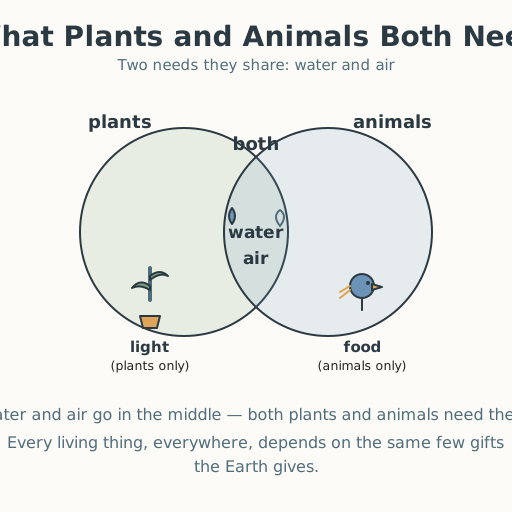
- Two large overlapping circles drawn as a "both" diagram · 1 One circle for plants, one for animals, with the overlap for what both need
Low-tech / no-cost
- A found plant and a told-about animal Observe a real plant outside and think of an animal you know; name each one's needs with voice and pointing — no cards or diagram needed
- Voice and body Act out a plant drinking water and reaching for sun, and an animal drinking water and breathing air, to feel the needs they share
Enriched / lab & device
- A small plant to keep and a pet or animal visitor to observe · 1 per group Observe both up close over days and watch their shared needs in action
- A magnifier · 1 per pair Look closely at leaves and, if possible, at an animal's fur, feather, or shell
Works in different contexts
- large-group Build the "both" diagram big on the floor; the whole group places each need card in the plant circle, the animal circle, or the middle where both need it
- self-directed A learner sorts the need cards into "plant," "animal," and "both," then draws a plant and an animal with the two needs they share
- outdoor-only Find a living plant and, if one is near, watch a bird or bug; name what each needs and point to the two needs they share — water and air
- level-grouped Learners who have mastered "both need water and air" coach peers who are still sorting, taking turns placing cards in the overlap
Lesson 6 — What Plants and Animals Both Need
Summary
Learners name what a plant needs and what an animal needs, then discover the needs they share: both need water and air. They sort need cards into “plant,” “animal,” and “both,” and learn that all living things — plant, animal, and us — depend on the same few gifts the Earth gives. Caring for those shared needs becomes the quiet thread.
Objectives
- Name two things a plant and an animal both need to live, such as water, food, light, or air. (D10.S3.01.02)
Connection
A plant and an animal look very different — one is green and still, the other moves and eats. But look closer: they both need the same few gifts to live. A plant needs water to drink and air to breathe, and it needs light from the sun to grow. An animal needs water to drink and air to breathe, and it needs food to eat. Two needs they share are water and air. Every living thing, everywhere, depends on these.
Materials
- A real plant and a picture of an animal (or a real animal to observe)
- “Need” cards (water, air, light, food, shelter; plus decoys like a toy, a hat, a song)
- Two large overlapping circles drawn as a “both” diagram
Preparation
- Bring a real plant and a clear picture of an animal learners know.
- Prepare need cards: water, air, light (sun), food, shelter, and a few decoys (a toy, a hat, a song).
- Draw two overlapping circles: one labeled “plants,” one labeled “animals,” and the overlap labeled “both.”
Facilitator note
This lesson is written to the learner (“you”). The clean, faithful answer at this age is that a plant and an animal both need water and air. Each also needs something else — a plant needs light (and it makes its own food from it, a fuller story saved for later grades); an animal needs food. Keep the distinction soft and true: water and air are the shared needs; light and food are the special ones. Do not overcomplicate with “plants make food from sunlight” as a system — at six it is enough to say a plant needs light to grow and an animal needs food to eat. Frame the Earth as a home that gives all living things what they need, not as a store to use up. For a learner who is blind or has low vision, feel the plant’s leaves and stem, and if an animal is present, feel its fur or shell gently; a partner names each need as it is discussed. A non-speaking learner can place cards in the “both” circle or point to show the shared needs.
Procedure
- Gather (5 min). Look at the plant and at the animal picture. How are they different? Here is a secret: they share some of the same needs.
- What does the plant need? (10 min). Name what the plant needs to live: water to drink, air to breathe, and light from the sun to grow. Touch its leaves gently and notice how they reach for the light.
- What does the animal need? (10 min). Name what the animal needs: water to drink, air to breathe, and food to eat. (Some animals also need a safe place to rest.)
- Find what both need (10 min). Look at the two overlapping circles. Place each need card: water and air go in the middle, where both plants and animals need them. Light goes with plants; food goes with animals. Say it: “A plant and an animal both need water and air.”
- Draw the shared needs (5 min). Draw a plant and an animal side by side, with water and air drawn for both of them.
- Close (5 min). Plant or animal, quiet or busy — every living thing needs water and air, and each needs something special too. The Earth gives all of us these gifts, and we help care for them.
Differentiation
- Support: Sort just two cards — water and air — into the “both” circle and say the shared-need sentence together.
- Blind/low vision: Feel the plant (and an animal, gently, if present) and hear a partner name the needs; place water and air in the overlap by touch.
- Deaf/hard of hearing: Share the needs with sign, pictures, and acting; the learner signs or points to the “both” overlap and to water and air to show the shared needs.
- Non-speaking: Place cards in the overlap or point to show the shared needs; a partner says the sentence aloud.
- Motor differences: Choose where each need card belongs and direct a partner’s hands to place it; draw the shared needs by directing a partner’s hands while naming water and air.
- Extension: Name one thing you need that is the same as what a plant or an animal needs (water, air) and one thing that is different (a story, a toy, a song).
Assessment
- Formative (observation): Can the learner name two things a plant and an animal both need (water and air), and place them in the shared circle?
- Artifact (portfolio): The drawing of a plant and an animal with their shared needs.
Resources
- BBC Bitesize (KS1 Science), “What does a plant need to grow?” — plants need water, light, air, the right temperature, and time. https://www.bbc.co.uk/bitesize/topics/zpxnyrd/articles/zkp2jsg
- BBC Bitesize (KS1 Science), “What do animals need to survive?” — animals need air, water, shelter, and food to survive. https://www.bbc.co.uk/bitesize/topics/z6882hv/articles/zx38wmn
Home connection
At home, look at a plant and think of an animal you know. Tell a grown-up the two things they both need (water and air), and, with their help, give one of them a little water — the plant, or a pet, or a dish of water left out for birds.