Lesson 05 — Living or Nonliving?
Learners sort things into living and nonliving and learn the simple clues: living things grow and change, need food or water, and breathe air; nonliving things do not. They give an example of each, and learn to treat every living thing with gentle care and respect.
Objectives
Objectives
- D10.S3.01.01 Tell the difference between a living thing and a nonliving thing, and give an example of each.
Essential question
How can I tell a living thing from a nonliving thing, and give an example of each?
Key vocabulary
Materials
Standard materials
- A real plant (or a clear picture of one) · 1 Any living plant learners can observe up close
- Living and nonliving sorting cards · 1 set Living (a plant, a dog, a bird, a fish) and nonliving (a rock, a spoon, a toy, water) — with a few that can surprise (a seed, a feather)
- Two sorting trays or hoops labeled "living" and "nonliving" · 2
Low-tech / no-cost
- Found objects and a living thing Hold a real plant or a creature nearby, and a rock or a spoon; sort real objects into "living" and "nonliving" by touch, sight, and sound — no cards needed
- Voice and body Act out growing (living) versus staying still (nonliving), and say why one is alive and the other is not
Enriched / lab & device
- A magnifier · 1 per pair Look closely at a leaf or stem to see signs of a living thing up close
- A seed and a small dish · 1 per group To wonder together about whether a seed is living — it can grow, and that is a clue
Works in different contexts
- large-group Hold each card up big; the whole group calls out "living!" or "nonliving!" and one learner gives the reason (grows, needs, or breathes) before sorting
- self-directed A learner sorts the cards into two piles alone and draws one living and one nonliving thing, saying one reason for each
- outdoor-only Find living things outside (a plant, a bug, a bird) and nonliving things (a stone, a stick, water in a puddle) and sort them as you walk
- multi-age Older learners coach younger ones in giving the reason — "it grows" or "it needs water" — for each sort
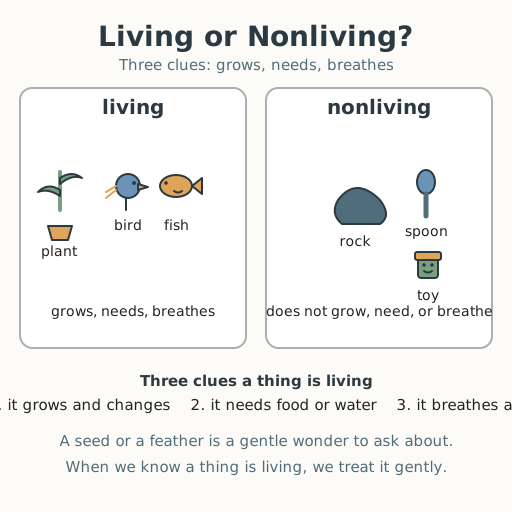
Lesson 5 — Living or Nonliving?
Summary
Learners learn the simple clues that tell a living thing from a nonliving thing: living things grow and change, need food or water, and breathe air; nonliving things do not. They sort real things and picture cards into the two groups, give an example of each, and learn that living things are to be cared for and respected — never harmed.
Objectives
- Tell the difference between a living thing and a nonliving thing, and give an example of each. (D10.S3.01.01)
Connection
You are a living thing. So is the plant on the windowsill, the bird outside, the fish in the water, and the bug under the stone. A rock, a spoon, a toy, and a puddle of water are not alive — they are nonliving. How can we tell? Living things grow and change, they need food or water, and they breathe air. Nonliving things do none of those. Today you will learn to notice the difference.
Materials
- A real plant (or a clear picture of one)
- “Living” and “nonliving” sorting cards
- Two sorting trays or hoops labeled “living” and “nonliving”
Preparation
- Bring a real plant (or a clear picture) for learners to observe.
- Prepare sorting cards: living (a plant, a dog, a bird, a fish) and nonliving (a rock, a spoon, a toy, water), plus a few that can surprise (a seed, a feather).
- Label two trays or hoops “living” and “nonliving.”
Facilitator note
This lesson is written to the learner (“you”). Keep it gentle and concrete: the three clues are grows and changes, needs food or water, and breathes air. A plant is living even though it does not walk or speak — it grows toward the sun, needs water, and takes in air. Water, sunlight, and air are nonliving, but living things need them. Do not raise the topic of death in this lesson; the focus is noticing what is alive and treating it with care. If a learner brings a living thing to observe (a bug, a leaf), it is a guest, not a toy — we watch without harming and we never hurt a living thing just to look at it. If a learner asks whether a seed or an egg is living, honor the wonder: it can grow and change, and that is a clue it is living — but we can wonder together and do not need to settle it today. For a learner who is blind or has low vision, sort by touch, sound, and smell — a leaf is soft and smells green, a rock is hard and still — and a partner names each thing as it is felt. A non-speaking learner can place each card in the correct tray or point to show the answer.
Procedure
- Gather (5 min). Look at the plant and then at a rock or a spoon. One is alive, one is not. How can you tell?
- Learn the clues (10 min). A living thing grows and changes. It needs food or water. It breathes air. A plant grows toward the sun and needs water; a bird eats food and breathes. A nonliving thing — a rock, a spoon, a toy — does not grow, does not need food or water, and does not breathe.
- Sort the cards (15 min). Look at each card. Ask the three questions: Does it grow and change? Does it need food or water? Does it breathe? Put each card in the “living” tray or the “nonliving” tray. If a seed or a feather surprises you, that is good — wonder about it out loud.
- Give an example (5 min). Point to one living thing and say, “___ is living because it grows and needs water.” Point to one nonliving thing and say, “___ is nonliving because it does not grow or breathe.”
- Draw one of each (5 min). Draw one living thing and one nonliving thing side by side.
- Close (5 min). Living things grow, need care, and breathe; nonliving things do not. When we know a thing is alive, we treat it gently and with respect. What living thing will you look at more kindly now?
Differentiation
- Support: Sort just two things — one living, one nonliving — while touching the real plant and the real rock; say the clue together.
- Blind/low vision: Sort by touch, sound, and smell with a partner naming each thing; feel a soft living leaf and a hard nonliving rock.
- Deaf/hard of hearing: Share the three clues (grows, needs, breathes) with sign, pictures, and acting; the learner signs or points to “living” or “nonliving” and gestures the clue.
- Non-speaking: Place each card in its tray or point to show the answer; a partner says the clue aloud.
- Motor differences: Choose where each thing goes and direct a partner’s hands to place it; draw one of each by directing a partner’s hands while naming the clue.
- Extension: Name one living thing that does not move the way an animal does (a plant) and explain how you still know it is living.
Assessment
- Formative (observation): Can the learner tell a living thing from a nonliving thing and give an example of each, with a simple reason?
- Artifact (portfolio): The “one living, one nonliving” drawing.
Resources
- BBC Bitesize (KS1 Science), “How can I sort objects into dead, living and non-living?” — living things react to their surroundings, need air, feed, grow, reproduce, and get rid of waste; non-living things have never been alive and do not need food, water, or air. https://www.bbc.co.uk/bitesize/topics/zx882hv/articles/zfhfn9q
Home connection
At home or outside, find one living thing and one nonliving thing. Tell a grown-up which is which and one clue that told you. Ask them to name one living thing they care for and what it needs.