Lesson 02 — Who I Am — Facts and One Thing I'm Proud Of
Learners describe themselves with several facts — age, likes, abilities, and family — and tell one thing they are proud of, practicing pride as a feeling about their own growth, never about being better than anyone else.
Objectives
Objectives
- D01.S2.01.01 Describe themselves with several facts such as age, likes, abilities, and family, and tell one thing they are proud of.
Essential question
Who am I this year — what facts make me me, and what is one thing I am proud of?
Key vocabulary
Materials
Standard materials
- A "Who I Am" page (folded into four boxes) · 1 per learner Boxes for age, likes, abilities, and family, with room to draw and one proud-moment box
- Crayons and pencils · per learner
Low-tech / no-cost
- A blank sheet folded into boxes Fold any paper into sections and draw one fact in each; no template needed
- Voice and a partner Tell your facts and your proud thing aloud instead of writing them
Enriched / lab & device
- Printed "Who I Am" booklet · 1 per learner A multi-page booklet to keep in the portfolio, one page per fact
- Tablet or camera · 1 per group Capture a photo for the self-portrait box
Works in different contexts
- large-group Brainstorm one fact box at a time together, then learners fill their own pages in small groups
- self-directed A learner fills the boxes alone and shares the page with a trusted person
- outdoor-only Find a small natural object that says something about you (a smooth stone for calm, a fast leaf for running) and add it to one box
- multi-age Older learners scribe the facts a younger learner dictates, then switch roles
- level-grouped Learners ready to extend add a second proud moment or one thing they are still learning
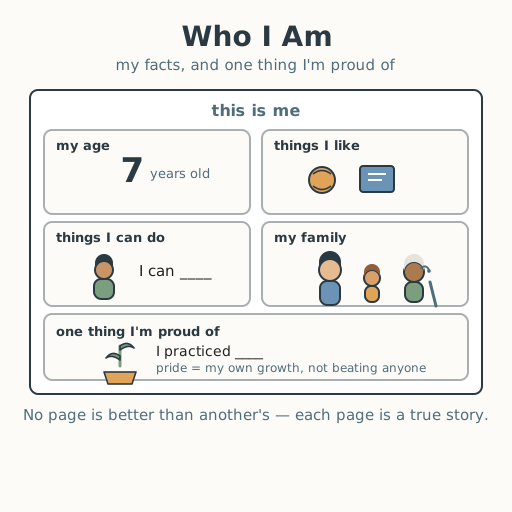
Lesson 2 — Who I Am: Facts and One Thing I’m Proud Of
Summary
Learners gather the facts of who they are — age, likes, abilities, and family — and choose one thing they are proud of, connecting it to the effort or practice behind it. They revisit the year’s opening “All About Me” work and see how much of their own story they can now tell, with pride held as personal growth, not comparison.
Objectives
- Describe themselves with several facts such as age, likes, abilities, and family, and tell one thing they are proud of. (D01.S2.01.01)
Connection
You are a whole person made of many facts — how old you are, what you like, what you can do, and who is in your family. And you also carry a feeling called pride: the warm, tall feeling of seeing how far you have come. Pride is not about beating anyone. It is about your own growth — something you practiced, tried, or worked at. Today you gather both: the facts of you, and one thing you are proud of.
Materials
- A “Who I Am” page folded into four boxes (age, likes, abilities, family) plus a proud-moment box
- Crayons and pencils
Preparation
- Fold or prepare the “Who I Am” page with its boxes.
- Set out crayons and pencils.
- Arrange partners for sharing.
Facilitator note
This lesson is written to the learner (“you”). It spirals back to the opening unit’s “All About Me” and “Something I’m Proud Of” lessons and deepens them: facts are joined to pride, and pride is firmly tied to growth, not competition. Watch for any learner drifting toward “I am proud I won” — gently re-anchor to effort: “What did you practice or work at?” Remember that “family” means many things — a parent, a grandparent, a guardian, a foster parent, siblings, chosen kin; there is no correct family to draw. No two pages should look alike, and that is the point. For a learner who does not use a speaking voice, accept pointing, drawing, acting, or a partner voicing the words.
Procedure
- Gather (5 min). At the start of the year you collected four kinds of facts about yourself: your age, your likes, your abilities, and your family. Do you still remember them? Today you will tell them again — and add one thing you are proud of.
- My facts today (10 min). Say or draw one fact for each box. Age: a number (and your birthday, if you know it). Likes: a favorite game, food, or place. Abilities: one thing you can do now that you could not do at the start of the year. Family: the people you live with or love.
- One thing I’m proud of (15 min). Pride is a feeling about your own growth. Pick one thing you are proud of — something you practiced, tried, or worked at. Finish this sentence: “I am proud of ___ because ___.” Draw it in the proud-moment box.
- Share with a partner (10 min). Tell your partner your facts and your proud thing. Listen to theirs. Notice what is the same about you and what is different — both are good.
- Close (5 min). Your facts and your pride are yours alone, and no one’s page is better than another’s. Each page is a true story, and yours is one of a kind.
Differentiation
- Support: Offer a sentence starter — “I am proud of ___ because ___” — and picture choices for facts.
- Support (non-speaking): Point to pictures for each fact; show the proud thing by acting it or pointing; a partner voices the words.
- Support (blind/low-vision): Tell facts aloud and have a partner scribe; use raised or textured marks to build the page tactually.
- Extension: Name a second thing you are proud of, or one thing you are still learning and want to grow at next year.
Assessment
- Formative (observation): Can the learner state several facts about themselves (age, a like, an ability, family) and name one thing they are proud of with a reason behind it?
Home connection
Tell someone at home one fact about you and one thing you are proud of — then ask them one fact about themselves and one thing they are proud of.