Lesson 03 — A Family Story or Tradition
Learners name a story or tradition from their own family, share it by invitation, and say what it means to them — honoring that every family has a different shape and story, and all are worth telling.
Objectives
Objectives
- D01.S2.01.02 Name a family story or tradition and tell what it means to them.
Essential question
What story or tradition does my family carry, and what does it mean to me?
Key vocabulary
Materials
Standard materials
- A story or tradition share-a-bag · 1 per learner A small bag to bring in one object that stands for a family story or tradition
- Drawing paper and crayons · per learner
- Chart paper · 1 To list the traditions the group shares aloud
Low-tech / no-cost
- A memory shared by voice No object or bag needed — tell the story or describe the tradition aloud
- Body and gesture Act out a tradition (a dance, a meal, a greeting) for others to guess
Enriched / lab & device
- A classroom story corner A quiet, decorated space where family stories are told and recorded across the year
- Recording device · 1 per group Record family stories told aloud, with permission, to keep in a class archive
Works in different contexts
- large-group Learners take turns sharing one at a time; the group listens and asks one gentle question each
- self-directed A learner draws their family tradition and writes or dictates one sentence about what it means
- outdoor-only Sit in a circle outdoors and share; invite learners to connect the tradition to a season or place if it has one
- multi-age Older learners model telling their own tradition first, then help younger learners retell theirs
- level-grouped Learners ready to extend tell a second tradition or share where one tradition may have come from
Lesson 3 — A Family Story or Tradition
Summary
Learners revisit the opening unit’s family story or tradition and now tell it with a year of growth behind them — naming what it means to them. Sharing is by invitation, never a requirement: a learner may tell it, show it, act it, draw it, point to it, or pass, and every family’s shape and story is honored.
Objectives
- Name a family story or tradition and tell what it means to them. (D01.S2.01.02)
Connection
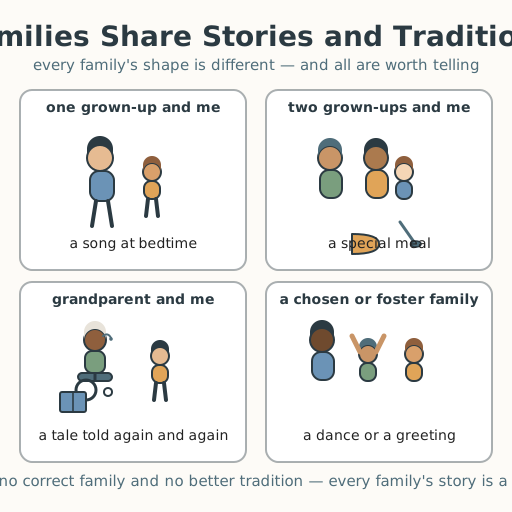
Every family carries stories and traditions — a special meal, a song, a holiday, a way of saying hello, a tale told again and again. A tradition is something a family passes down, like a treasure. These things belong to your family, whatever shape your family takes — one grown-up, two, grandparents, a foster family, chosen family, or many generations under one roof. People everywhere keep traditions, and each one is different and worth telling.
Materials
- A share-a-bag for each learner (or any small container)
- Drawing paper and crayons
- Chart paper for listing traditions
Preparation
- Send home (or explain) the share-a-bag: each learner brings one small object that stands for a family story or tradition.
- Set out drawing supplies and chart paper.
- Arrange a sharing circle.
Facilitator note
This lesson is written to the learner (“you”). It spirals back to the opening unit’s family-story lesson and deepens it: learners now say what the tradition means to them. Honor every family shape — one caregiver, two, grandparents, guardians, foster family, siblings, chosen family, several generations under one roof; there is no correct family. Sharing is by invitation, never a requirement: a learner may pass, or draw, point, or act instead of speaking — each of these counts as sharing. Keep the circle warm and non-competitive; there is no ranking of families or traditions. If a learner cannot name one — or has no family story to share, or prefers not to — offer gentle examples (a bedtime routine, a birthday way, a favorite food) or a class, school, or community tradition; a pass is always a full share.
Procedure
- Gather (5 min). At the start of the year you shared a family story or tradition. Think again, now with a year of knowing yourself: what does your family do that is special to you?
- Choose one (10 min). Pick one story or tradition. It can be big, like a holiday, or small, like a bedtime song. Draw it, or hold up the object you brought that stands for it.
- Share by invitation (15 min). Share only if you want to — sharing is an invitation, never a must. Tell it, show the object, act it out, or point to your drawing. Listeners ask one gentle question each (“Who taught it to you?” “When do you do it?”). A learner may pass, draw, or point instead of speaking; that counts as sharing.
- What it means (10 min). Say or draw one thing this tradition means to you: “This means ___ to me because ___.”
- Close (5 min). There is no correct family and no better tradition. Every family’s story is a treasure, and yours is worth telling — and so is everyone else’s.
Differentiation
- Support: Use a picture prompt; scribe the learner’s “what it means” sentence.
- Support (non-speaking): Point to a drawing or act the tradition; a partner voices the words.
- Support (blind/low-vision): Tell the tradition aloud or bring a touchable object; a partner describes a drawing.
- Extension: Ask a family member where the tradition began and share one new detail.
Assessment
- Formative (observation): Can the learner name one family story or tradition and say something it means to them?
- Performance: The learner shares their tradition with the group (by telling, showing, acting, pointing, or passing).
Home connection
Ask someone at home to tell you where one family tradition came from, and share what you learned next time.