Lesson 03 — Sad or Disappointed?
Learners go deep on the second look-alike pair — sad and disappointed — sorting everyday moments with a clue question, and learning that both heavy feelings are welcome, nameable, and different from each other.
Objectives
Objectives
- D01.S1.02.01 Use feeling words to tell the difference between similar emotions, such as mad and frustrated or sad and disappointed.
Essential question
How do I tell when I am sad and when I am disappointed?
Key vocabulary
Materials
Standard materials
- Sad vs. disappointed comparison card · 1 The two faces side by side with the clue question written between them
- Scenario strips · 1 set Short moments to sort as sad or disappointed, including some tender, heavy ones
- Two sorting baskets or hoops · 2 Labeled "sad" and "disappointed"
Low-tech / no-cost
- Voice and body Say each moment aloud and act it out; sort by pointing to two drawn circles
- Two circles drawn in the sand or dirt Step into the sad circle or the disappointed circle for each moment
Enriched / lab & device
- Printed scenario cards with pictures · 1 set per pair Picture + one-sentence scenarios for independent sorting
- A short storybook about loss and hope · 1 per group Optional read-aloud with moments of sadness and disappointment to notice
Works in different contexts
- large-group Sort each scenario as a whole group with a thumbs-down for sad or an open palms shrug for disappointed, then say why
- self-directed A learner sorts the strips alone, then checks with the clue question written at the top of the page
- outdoor-only Draw two circles on the ground and step into the one that matches each moment you hear
- multi-age Older learners read the tender moments gently and help younger learners find the words without pressing them to share
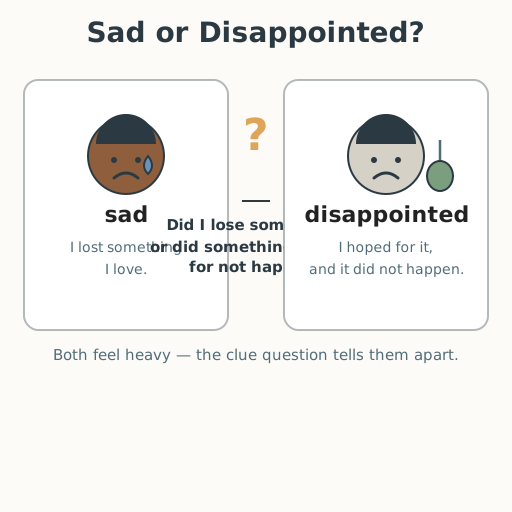
Lesson 3 — Sad or Disappointed?
Summary
Learners go deep on the second look-alike pair: sad and disappointed. Using the clue question “Did I lose something, or did something I hoped for not happen?” they sort everyday moments — including some tender ones — and learn that both heavy feelings are welcome, nameable, and different from each other. Naming them exactly is a gift you give yourself.
Objectives
- Use feeling words to tell the difference between similar emotions, such as sad and disappointed. (D01.S1.02.01)
Connection
When a favorite hen dies, or a friend moves far away, your chest feels heavy and you cry — that is sad: you lost something you love. But when the harvest festival is canceled because the rains came late, or the bus is full and you miss the trip you waited all week for, your shoulders droop — that is disappointed: you hoped for something, and it did not happen. Both feel heavy. The difference is loss or hope.
Materials
- Sad vs. disappointed comparison card
- Scenario strips
- Two sorting baskets or hoops
Preparation
- Print or draw the comparison card and the scenario strips.
- Set out the two labeled baskets or hoops: “sad” and “disappointed.”
- Write the clue question large: “Did I lose something, or did something I hoped for not happen?”
Facilitator note
This lesson is written to the learner (“you”). Some scenarios touch real loss (a pet, a person moving away). Hold them gently and calmly — name the feeling, do not push for disclosure, and never require a learner to share a personal loss. A learner may pass or just listen. Reassure the group that sad feelings are not a problem to fix; they are a signal of what matters to us. Read scenarios aloud for learners still building reading fluency, and keep the tone warm, not heavy.
Procedure
- Gather (5 min). Yesterday you mastered mad and frustrated. Quick check: what clue tells them apart? (Blocked vs. trying.) Today a new pair: sad and disappointed.
- Model the clue (10 min). Look at the comparison card. Sad is about loss — you lost something you love, or someone is gone. Disappointed is about hope — you hoped for something, and it did not happen. Watch: “Your cat has been missing for two days.” That is sad — a loss. Now: “You hoped to fly your new kite, and there is no wind today.” That is disappointed — a hope that did not happen.
- Sort together (10 min). Hear a moment, then point to the sad basket or the disappointed basket. “You saved seeds to plant, and the birds ate them all.” (Disappointed.) “Your grandmother who lived far away has passed.” (Sad — and it is okay to feel this deeply.) “The sweets at the stall were all gone when you got there.” (Disappointed.) Say your clue question out loud each time.
- Tender moments (10 min). Some heavy moments can be both. “You move to a new home and miss your old friends — and you had hoped the move would not happen.” Talk softly with a partner: sad, disappointed, or both? You do not have to share anything about your own life — you may just listen. Noticing both is brave and wise.
- Close (5 min). Sad says “I lost something I love.” Disappointed says “something I hoped for did not happen.” Knowing which one it is helps you know what you need — comfort and remembering, or a new hope and another try.
Differentiation
- Support: Offer only picture scenarios and two choices at a time; keep tender moments brief and optional.
- Extension: Write your own moment (a hope that did not happen) and have a partner sort it, then share one thing you can hope for next.
Assessment
- Formative (observation): Can the learner sort a new moment as sad or disappointed and give the clue (“loss” vs. “hope did not happen”)?
Home connection
Ask someone at home to tell you about a time they were disappointed, and listen for the hope inside it — then share one new hope with them.
Resources
- CASEL SEL Framework (self-awareness competency): https://casel.org/fundamentals-of-sel/