Lesson 04 — Where Feelings Live in My Body
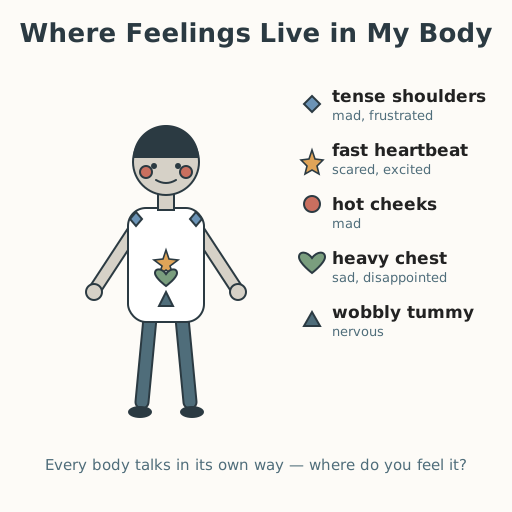
Learners build a body map: they notice where feelings show up — tense shoulders, a fast heartbeat, hot cheeks, a heavy chest, a wobbly tummy — and practice a short body scan, learning that the body is always talking to us.
Objectives
Objectives
- D01.S1.02.02 Notice where a feeling shows up in the body, such as tense shoulders or a fast heartbeat, and name the feeling.
Essential question
Where does a feeling show up in my body, and what is it telling me?
Key vocabulary
Materials
Standard materials
- Body map poster (blank body outline) · 1 A large child body outline to mark feeling spots on together
- Shape stickers or colored dots · 1 set Heart, diamond, circle, triangle, square, and star shapes, to mark the spots
- Small mirrors · several Optional, to notice what the face does with a feeling
Low-tech / no-cost
- Your own body Point to the spot where you feel a feeling; no poster or stickers needed
- A body outline drawn in sand or on the ground Step onto the outline and stand on the spot where a feeling lives
Enriched / lab & device
- Printed blank body maps · 1 per learner Each learner marks and colors their own body map to keep
- A quiet sound or heartbeat audio · 1 per group Optional, to notice a fast or slow heartbeat during a body scan
Works in different contexts
- large-group Mark the body map together as a group, naming each feeling spot aloud as you add a shape
- self-directed A learner points to the spot on their own body and says the feeling, using the body map as a guide
- outdoor-only Stand on a body outline drawn in the dirt and step to the spot where each feeling lives
- multi-age Older learners help younger ones find the right spot by naming the feeling and pointing to their own shoulder, chest, or tummy first
Lesson 4 — Where Feelings Live in My Body
Summary
Learners build a body map and learn that every feeling shows up somewhere in the body — tense shoulders, a fast heartbeat, hot cheeks, a heavy chest, a wobbly tummy. They practice a short body scan and mark their own feeling spots. The body is always talking; learning to listen is the beginning of understanding ourselves.
Objectives
- Notice where a feeling shows up in the body, such as tense shoulders or a fast heartbeat, and name the feeling. (D01.S1.02.02)
Connection
Put your hand on your chest right after you run fast — your heart is pounding. That is your body talking. Your body talks all the time, not just when you run. When you are mad, your shoulders might pull up tight. When you are scared or excited, your heart beats fast. When you are sad, your chest can feel heavy. Your body is a messenger, and learning to listen to it helps you know what you are feeling before you even have the words.
Materials
- Body map poster (blank body outline)
- Shape stickers or colored dots (heart, diamond, circle, triangle, square, star)
- Small mirrors (optional)
Preparation
- Draw or print the blank body map poster.
- Prepare the shape stickers or dots and a legend (shape → feeling spot).
- Set aside a quiet space for the body scan.
Facilitator note
This lesson is written to the learner (“you”). Some learners will feel a feeling everywhere or nowhere, and some bodies signal differently — honor both. There is no “wrong” spot; the goal is noticing, not matching a chart. Frame every description as a possibility (“many people feel mad as tense shoulders — where do you feel it?”). Model the body scan with your own body. For learners with limited sensation or mobility, the spot can be named and pointed to on the poster or on a partner’s body with consent.
Procedure
- Gather (5 min). You have named look-alike feelings — mad, frustrated, sad, disappointed. Today you find out where those feelings live in your body.
- Meet the body spots (15 min). Look at the body map. For each spot, hear where a feeling often lives — then check your own body: tense shoulders (mad, frustrated — your shoulders pull up toward your ears), fast heartbeat (scared, excited — put a hand on your chest and feel it), hot cheeks (mad — your face flushes warm), heavy chest (sad, disappointed — your chest feels full and slow), wobbly tummy (nervous — a fluttery, shaky feeling low in your belly).
- Body scan (10 min). Sit or lie quietly. Close your eyes or soften them. Travel from your head down to your toes: shoulders, chest, cheeks, tummy, hands. Notice one thing your body is doing right now. Is anything tight, fast, heavy, or warm? Name it, even if it is small.
- Mark your own map (10 min). On the big body map — or your own outline — put a shape on the spot where you feel mad, where you feel sad, where you feel excited. Your map may not match a friend’s map, and that is exactly right: every body talks in its own way.
- Close (5 min). Your body is always talking to you. Learning to listen is how you understand your feelings. Next time you notice tight shoulders or a fast heart, you can ask: “What am I feeling?”
Differentiation
- Support: Introduce one or two body spots at a time; point to the spot on the poster and on your own body.
- Extension: Keep a one-day “body signal journal” — draw or write one body signal you noticed and the feeling it named.
Assessment
- Formative (observation): Can the learner point to a body spot and name the feeling that often lives there?
- Artifact (portfolio): The learner’s marked body map.
Home connection
Teach someone at home one body signal — for example, “mad shows up as tense shoulders” — and ask them where they feel mad or sad.
Resources
- CASEL SEL Framework (self-awareness competency): https://casel.org/fundamentals-of-sel/